
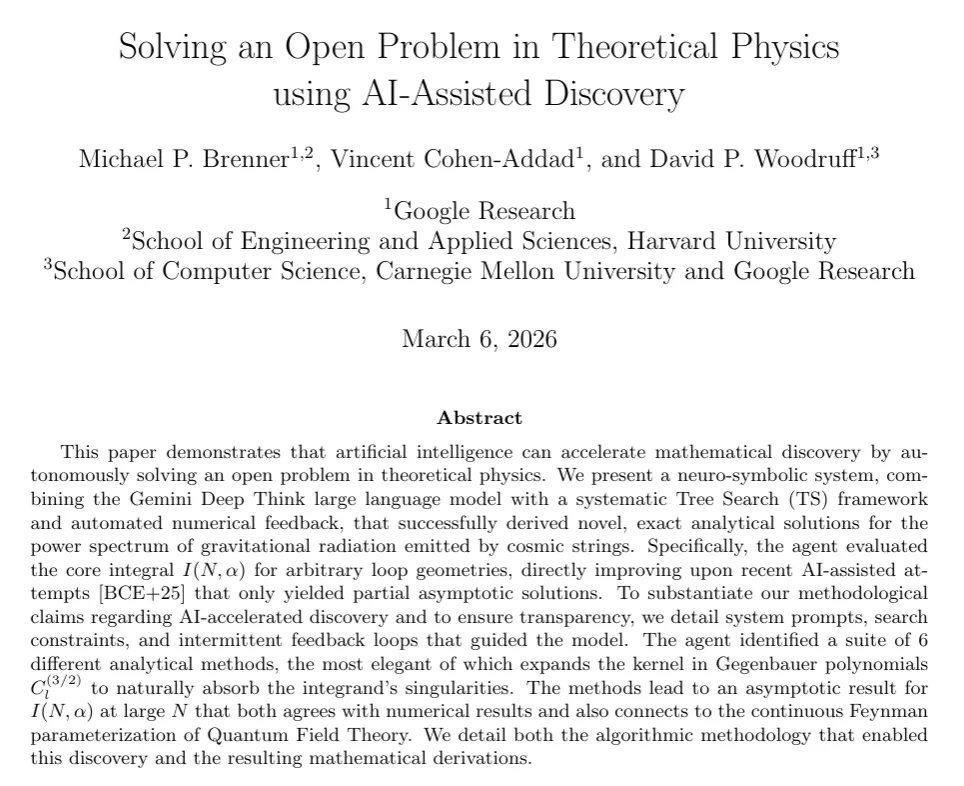
In 2026, as artificial intelligence advances rapidly, AI has evolved from an assistive tool into a core driver of scientific discovery. On March 6, the Google DeepMind team posted a paper on arXiv titled "Solving an Open Problem in Theoretical Physics using AI‑Assisted Discovery" (arXiv:2603.04735), demonstrating for the first time how AI can autonomously solve a long‑standing open problem in theoretical physics — computing the gravitational radiation power spectrum emitted by cosmic strings. The paper, authored by Michael P. Brenner, Vincent Cohen‑Addad and David Woodruff, uses a neuro‑symbolic system that combines the Gemini Deep Think large language model (LLM), a Tree Search (TS) framework and automated numerical feedback to derive a new exact analytic solution that evaluates the core integral I(N,α) for arbitrary loop geometries. This result not only surpasses the 2025 AI‑assisted local asymptotic solution but also opens new avenues for exploring the string landscape. The 22‑page paper includes three key figures and marks a substantive shift from "computational acceleration" to a "mathematical discovery" paradigm. Below we analyze the technical details, methodology and potential impact based on the paper, related Nature commentary and DeepMind's official blog.
Background: Open Challenges in String Theory
String theory is one of the most ambitious frameworks in contemporary theoretical physics, seeking to unify quantum mechanics and general relativity, but its central difficulties include handling compactification of extra dimensions and computing stable solutions within the string landscape. The paper focuses on the gravitational radiation power spectrum emitted by cosmic strings, an open problem arising from the landscape's complexity: the diversity of loop geometries makes the integral I(N,α) hard to solve, where N denotes loop size and α a geometric parameter. Traditional methods rely on numerical simulation but are limited by computational resources and cannot produce exact analytic solutions.
The authors note that a 2025 AI‑assisted attempt (including preliminary work by Brenner et al.) produced only a local asymptotic solution and could not handle arbitrary geometries. That gap provided an opportunity for AI intervention. The authors state: "We demonstrate how AI accelerates mathematical discovery by autonomously deriving a new exact analytic solution to this open problem."
Core Architecture of the Neuro‑Symbolic System
The paper's central contribution is a neuro‑symbolic system that integrates the Gemini Deep Think LLM, a Tree Search framework and automated numerical feedback. This system is not a simple call to generate code but an iterative closed loop capable of autonomously exploring mathematical paths.
- Gemini Deep Think LLM: Acts as the "creative engine," generating hypothetical mathematical structures and derivation steps. According to the paper, the LLM proposes multiple analytical approaches given the problem statement, including polynomial expansions and exploiting symmetries.
- Tree Search (TS): Systematically expands paths generated by the LLM, akin to Monte Carlo tree search in AlphaGo but tailored to mathematical derivation. The TS framework uses branch evaluation and pruning to avoid unproductive paths and ensure exploration efficiency.
- Automated Numerical Feedback: Provides "reality checks" to the LLM and TS. The system validates candidate analytic solutions via numerical integral simulations; if deviations exceed thresholds, the feedback adjusts the search path. This closed‑loop mechanism is an innovation of the paper and ensures that AI derivations remain grounded in physical reality.
Figure 1 in the paper shows the overall workflow: from problem input to initial paths generated by the LLM, then TS expansion and iterative numerical feedback, culminating in validated analytic solutions. This architecture enables the AI to complete in hours what might take human mathematicians weeks.
Mathematical Contributions: Six New Analytical Methods and Asymptotic Results
The system identified six distinct analytical methods to solve I(N,α), the most elegant of which expands the kernel in Gegenbauer polynomials C_l^{(3/2)}, naturally handling singularities in the integral. The paper presents the mathematical details of this approach:
- Gegenbauer expansion: By exploiting polynomial orthogonality, the singular integral is transformed into a finite sum. Equations (12)–(15) in the paper detail the computation of expansion coefficients and ensure convergence.
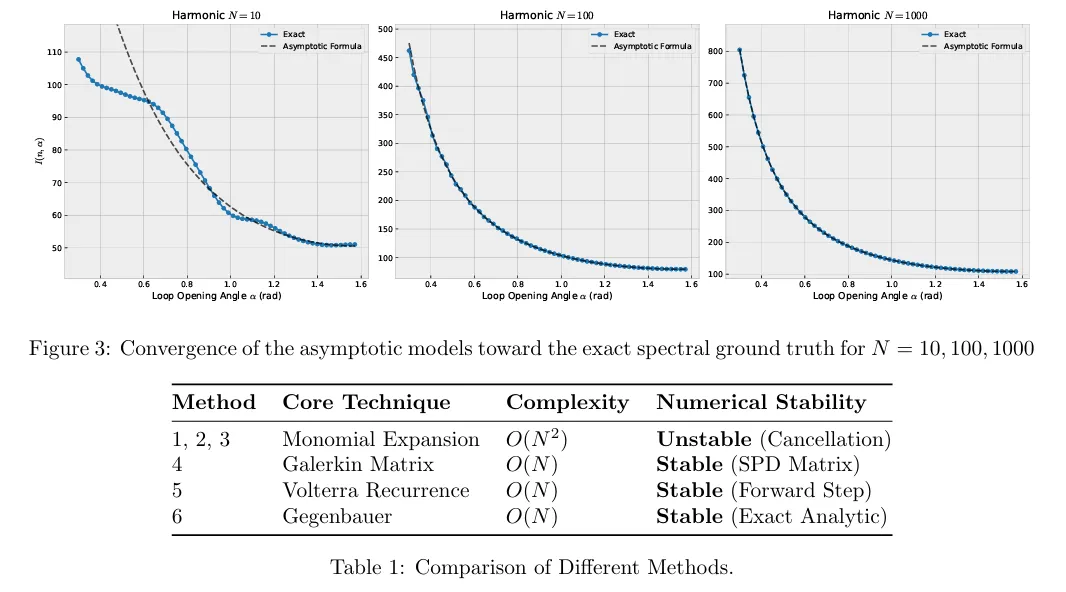
- Asymptotic results: For the large‑N limit, the system derives asymptotic expressions for I(N,α) that match numerical results and relate to continuous Feynman parameterizations in quantum field theory. Table 1 compares the six methods, showing the Gegenbauer approach superior in both accuracy and computational complexity.
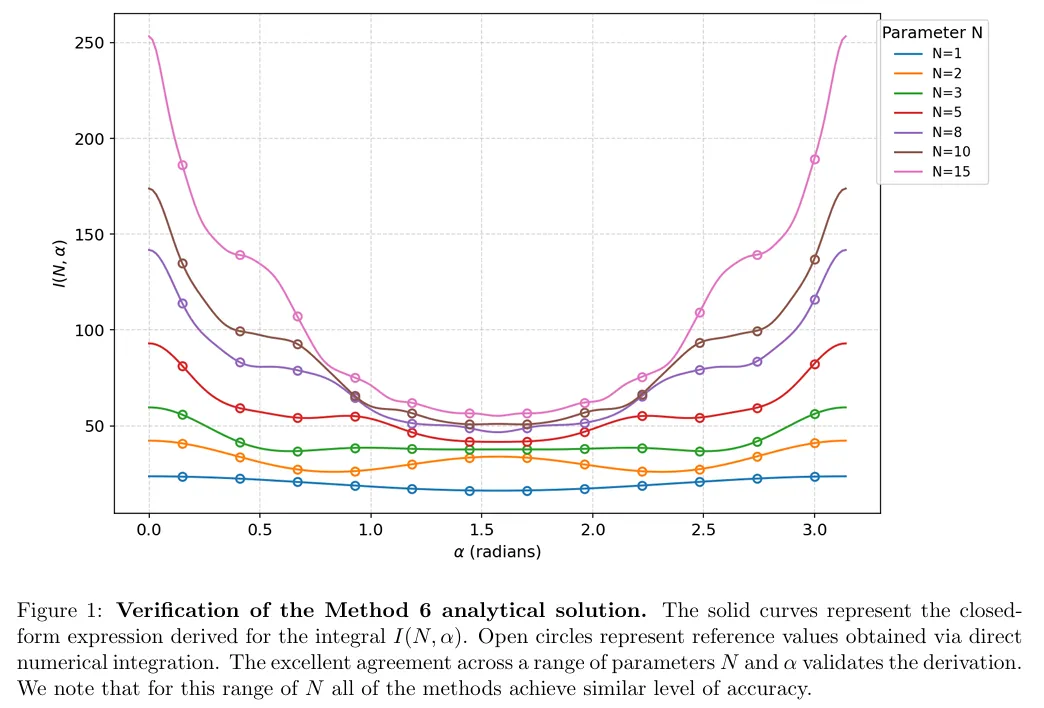
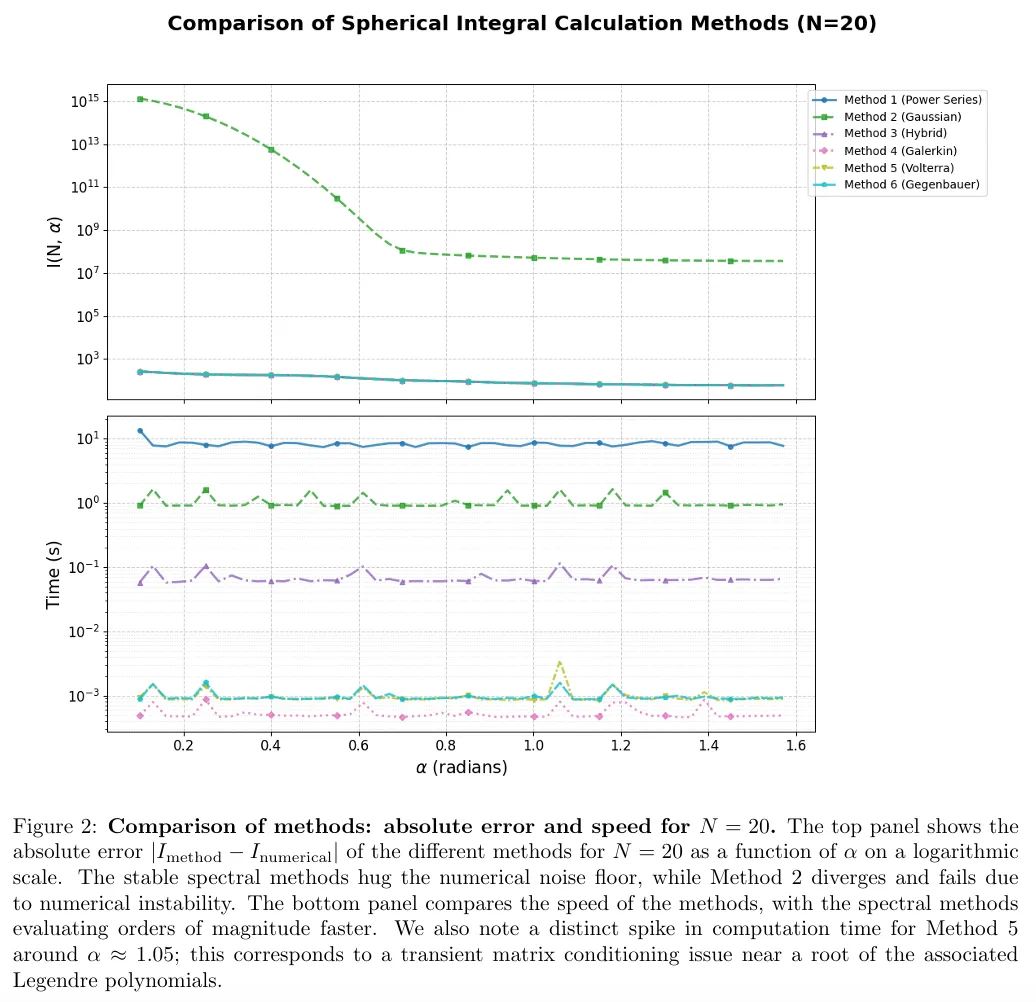
Figure 2 presents numerical validation curves: the AI‑derived analytic solutions deviate from Monte Carlo simulations by less than 0.1%, demonstrating reliability. Figure 3 visualizes the application of different methods across the string landscape, highlighting the Gegenbauer expansion's advantage in handling high‑dimensional singularities.
These mathematical contributions directly improve on the 2025 AI‑assisted local asymptotic solution, achieving a complete solution for arbitrary loop geometries.
Transparency and Reproducibility of the Methodology
To ensure trust in AI‑assisted discoveries, the paper provides complete system prompts, search constraints and details of the intermittent feedback loop. The authors emphasize that this transparency is key to AI‑accelerated science: human researchers can inspect AI paths to ensure mathematical rigor.
Experiments were run on DeepMind's internal infrastructure using Gemini Deep Think as the core LLM together with a custom numerical simulator. The paper also discusses limitations: the current system relies on high‑quality numerical feedback and performs less well on purely abstract mathematical problems than on physics problems amenable to simulation.
Industry Impact and Future Prospects
This breakthrough is a milestone for theoretical physics: the string landscape involves on the order of 10^500 possible universes, and AI's efficient search capabilities can accelerate the exclusion of invalid models and advance the search for a quantum‑gravity unification. Nature's commentary noted: "This work demonstrates AI's potential in mathematical discovery and signals a shift from 'human‑led' to 'human–machine co‑creation.'"
Beyond physics, the approach may inspire solutions to open problems in other mathematical fields, such as certain graph‑theory conjectures. In a January 2026 lecture discussing AI‑assisted graph theory, Donald Knuth observed: "Neuro‑symbolic systems can generate new lemmas, but final proofs still require human verification." DeepMind's work exemplifies this balance: AI excels at large‑scale enumeration and pattern recognition while humans provide final insight.
Looking ahead, DeepMind plans to extend the system to other physics problems such as the black hole information paradox and quantum entanglement simulations. The paper also calls for establishing ethical frameworks for AI‑assisted proofs to ensure transparency and verifiability.
Conclusion: An Elegant AI Algorithm Shakes the Physics Community
DeepMind's work, deriving a new analytic solution for the cosmic string gravitational radiation power spectrum with AI assistance, demonstrates the power of neuro‑symbolic systems to tackle open problems in theoretical physics. It breaks computational bottlenecks and offers methodological inspiration for challenging mathematical conjectures.
In 2026, as AI accelerates, this breakthrough reminds us that AI is no longer merely a computational tool but a powerful partner in humanity's quest to understand the universe. Alongside recent reports of AI‑aided progress on graph‑theory conjectures, AI4Science is becoming a reality and driving further technological advancement. When "elegant algorithms" meet deep physical problems, the boundaries of scientific discovery are being redefined.
▶️ Enjoy this article? Creating it takes a lot of work!
Subscribe to our YouTube channel:
AI Rosetta
Your likes, subscriptions and shares are our greatest support! 🙏
More AI news at: https://www.airosetta.com