
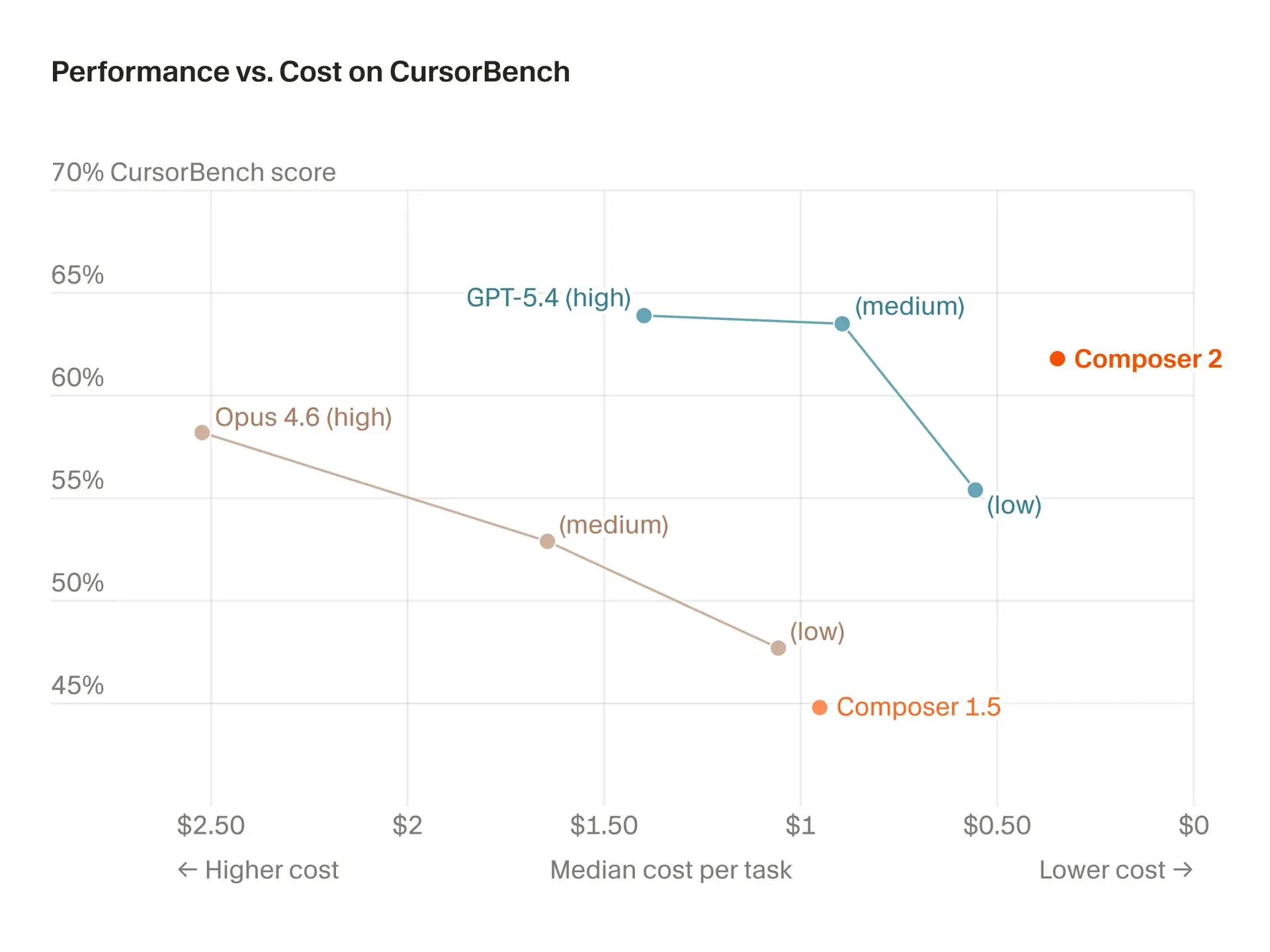
On March 19, 2026, AI code editor maker Cursor officially launched Composer 2 — its third‑generation, self‑developed programming large model. The company positions the model as "frontier‑level coding intelligence," and it achieved significant gains on multiple real software‑engineering benchmarks, notably scoring 61.7% on Terminal‑Bench 2.0 — outperforming Anthropic's Claude Opus 4.6 (58.0%) while still trailing OpenAI's GPT‑5.4 (75.1%). Despite that, its overall cost‑performance delivers a "disruptive advantage." The standard tier is priced at input $0.50/1M tokens and output $2.50/1M tokens (the fast tier default is $1.50/$7.50), far lower than GPT‑5.4 ($2.5/$15) and Claude Opus 4.6 ($5/$25), and has been dubbed the "value king of coding" by developer communities.
Composer 2 is not a simple iteration but marks Cursor's milestone shift from "using external models" to "self‑developed agentic coding models." It is optimized for long‑horizon agent tasks within the Cursor IDE such as multi‑file editing, terminal operations, and browser control. Composer 2 is already available in Cursor's main app and the early "Glass" interface, supporting semantic search, file read/write, shell command execution, image generation and a full suite of tool calls.
Core Breakthrough: From "Assistive" to "Autonomous Agent"
The Cursor team says Composer 2 was built via continuous pretraining plus reinforcement learning (RL), focusing on long‑horizon, multi‑step coding challenges. It can handle complex tasks requiring hundreds of operations and introduces a "self‑summarization" mechanism that reduces long‑context compression error rates by 50%. This delivers strong performance in real development scenarios:
- Multi‑file and agent capabilities: Native support for tool invocation, automated edits, and browser control, enabling end‑to‑end completion of the full "requirements‑to‑production" workflow.
- Terminal and engineering tasks: Scored 61.7% on Terminal‑Bench 2.0 (a real terminal software‑engineering benchmark), outperforming Opus 4.6.
- Internal benchmark gains: CursorBench rose from 44.2 for the previous 1.5 to 61.3; SWE‑bench Multilingual improved from 65.9 to 73.7.
Outlets such as The New Stack note that Composer 2 has "matched or locally surpassed" top closed‑source models in coding intelligence while balancing speed and cost. The fast tier is enabled by default, and single responses typically complete within 30 seconds, suited to high‑frequency iterative development.
Pricing Game‑changer: Cost Just 1/5–1/6 of GPT‑5.4
Pricing is Composer 2's biggest trump card:
- Standard: input $0.50/1M tokens, output $2.50/1M tokens (cache reads $0.20)
- Fast (default): input $1.50/1M tokens, output $7.50/1M tokens (cache reads $0.35)
For comparison:
- GPT‑5.4: $2.5/$15 (about 5–6×)
- Claude Opus 4.6: $5/$25 (about 10×)
- Previous Composer 1.5: $3.50/$17.50 (an 86% price reduction this release)
Individual users also receive a generous personal usage pool, while team and enterprise plans are billed directly via API. Cursor emphasizes that although the fast tier is pricier than the standard tier, it is still "cheaper than other models at the same speed," delivering an optimal balance of intelligence and cost.
This pricing strategy effectively brings GPT‑5.4–level coding capabilities to the broader developer community: top‑tier models that were once affordable only to large companies or well‑funded teams are now accessible to ordinary users.
Integration in the Ecosystem: Seamless Embedding Across Cursor
Composer 2 is fully integrated into the Cursor editor and supports:
- Simultaneous multi‑file editing and refactoring
- Automated execution and monitoring of terminal commands
- Browser control and visual verification
- Image generation to assist UI design
- Parallel multi‑agent collaboration (early testing in the new Glass interface)
Developers can switch to Composer 2 (or an Auto mode for intelligent selection) with a single setting in Cursor. It is currently available to all users; personal plans include substantial free quotas, and team users can call it directly via API.
Cursor's founder said, "We are not building another chat bot; we are building a programming agent that can independently complete software‑engineering tasks." This aligns with Cursor 2.0's multi‑agent interface, allowing developers to run multiple Composer instances concurrently and greatly accelerate complex projects.
Industry Impact: Programming Tools Enter the "Self‑Developed Model Era"
The launch of Composer 2 marks Cursor's accelerated shift from a "model‑integration platform" to a "frontier model developer." Previously, Cursor gained traction by integrating Claude and GPT; now its self‑developed model has overtaken competitors on cost and performance and is expected to further solidify its leadership in the AI IDE market.
For the industry at large, this sends a clear signal:
- Increased pressure on large model vendors: Closed‑source providers like OpenAI and Anthropic face new cost‑performance competition.
- Developer benefits: High‑value agent models will accelerate single‑developer teams and lower the barriers to startup development.
- Ecological ripple effects: Cursor already has millions of daily active users (including enterprise customers such as Stripe and Figma); wider Composer 2 adoption could prompt more AI coding tools to pursue self‑developed models.
Analysts note that in 2026, amid high AI infrastructure costs, vertical models that are "faster, cheaper, and more specialized" will become a new competitive focus. Composer 2 demonstrates that a programming‑focused self‑developed approach can indeed challenge leading generalist models.
Conclusion: The "Value Revolution" in Programming AI Is Just Beginning
Cursor Composer 2 debuted claiming to "approach GPT‑5.4, surpass Opus 4.6, and cost only a fraction," turning top coding intelligence from a "luxury" into a "everyday tool." It not only raises developer productivity limits but also sets a new benchmark in AI coding.
With the fast tier enabled by default and the Glass interface rolling out, 2026 looks set for a true transformation in programming experience: from "AI‑assisted" to "AI‑driven" development, and Composer 2 may be the key enabler.
For many developers, this may be one of the most immediately worthwhile AI tools to try this year.
▶️ Enjoy this article? Creating content takes a lot of work!
Follow our YouTube channel:
AI Rosetta
Your likes, subscriptions, and shares are our greatest support! 🙏
More AI news at: https://www.airosetta.com