
On June 17, 2026, just after being fully acquired by SpaceX at a $60 billion valuation, the well‑known AI code editor Cursor officially released Composer 2.5, another major iteration in the Composer series. This version delivers significant improvements in long‑context understanding, multi‑file collaborative editing, complex task planning and autonomous debugging, and has been described by Cursor as "the closest version yet to a true AI software engineer." Composer 2.5 has been rolled out to all paid users and its API has been opened for developers to integrate into custom workflows.
Cursor CEO Michael Truell said in the announcement: "The goal of Composer 2.5 is to make AI more than a code‑completion tool — to become an intelligent partner that truly understands the project as a whole, autonomously plans and executes complex engineering tasks."
Core Technical Upgrades in Composer 2.5
1. Extended long‑context and multi‑file intelligent understanding Composer 2.5 expands the context window to 200K tokens and optimizes multi‑file collaboration mechanisms. The model can simultaneously comprehend the structure, dependencies and business logic of an entire code repository, performing notably better on large‑scale refactors and cross‑file feature migrations. Users only need to describe the requirement and Composer will automatically locate relevant files, generate modification plans and provide full diff previews.
2. Enhanced Agentic Workflow This is the standout feature of Composer 2.5. A new Multi‑Agent Planning System supports a collaborative mode of "Planner Agent + Executor Agent + Verifier Agent." The AI can autonomously decompose complex tasks, generate substeps, call external tools (such as terminals, Git and databases), and perform self‑reflection and error correction during execution. In practical tests this capability significantly reduced the need for human intervention, making it suitable for automated development in medium to large projects.
3. Intelligent debugging and test generation Composer 2.5 includes a more powerful debugging engine that can automatically analyze runtime errors, generate test cases and propose fixes. In user tests, its debugging success rate improved by about 42% compared with version 2.0, especially when dealing with legacy code and complex bugs.
4. Performance and efficiency optimizations Through model distillation and inference acceleration techniques, Composer 2.5 achieves roughly 35% faster generation speed and about 28% lower memory usage compared to the previous generation. It supports local deployment and cloud‑hybrid modes, allowing users to choose based on project scale.
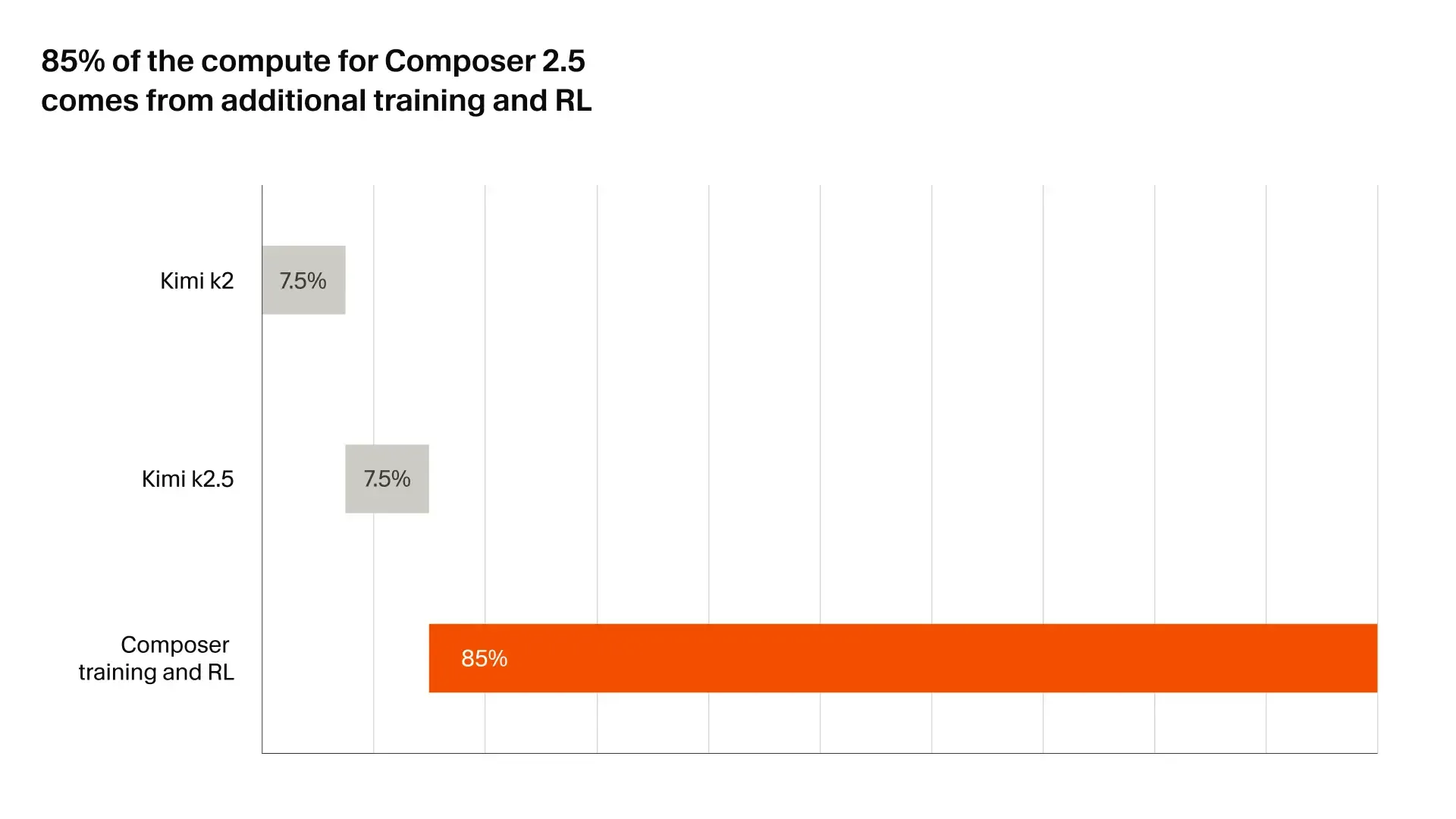
5. Foundation and reinforcement training Composer 2.5 remains based on kimi 2.5 as its foundation, but incorporates extensive reinforcement learning training, leveraging SpacXAI's millions of Colossus 2 units for large‑scale RL training.
Performance Metrics and Real‑World Results
According to Cursor's official benchmarks and developer community feedback, Composer 2.5 leads on several coding‑related benchmarks:
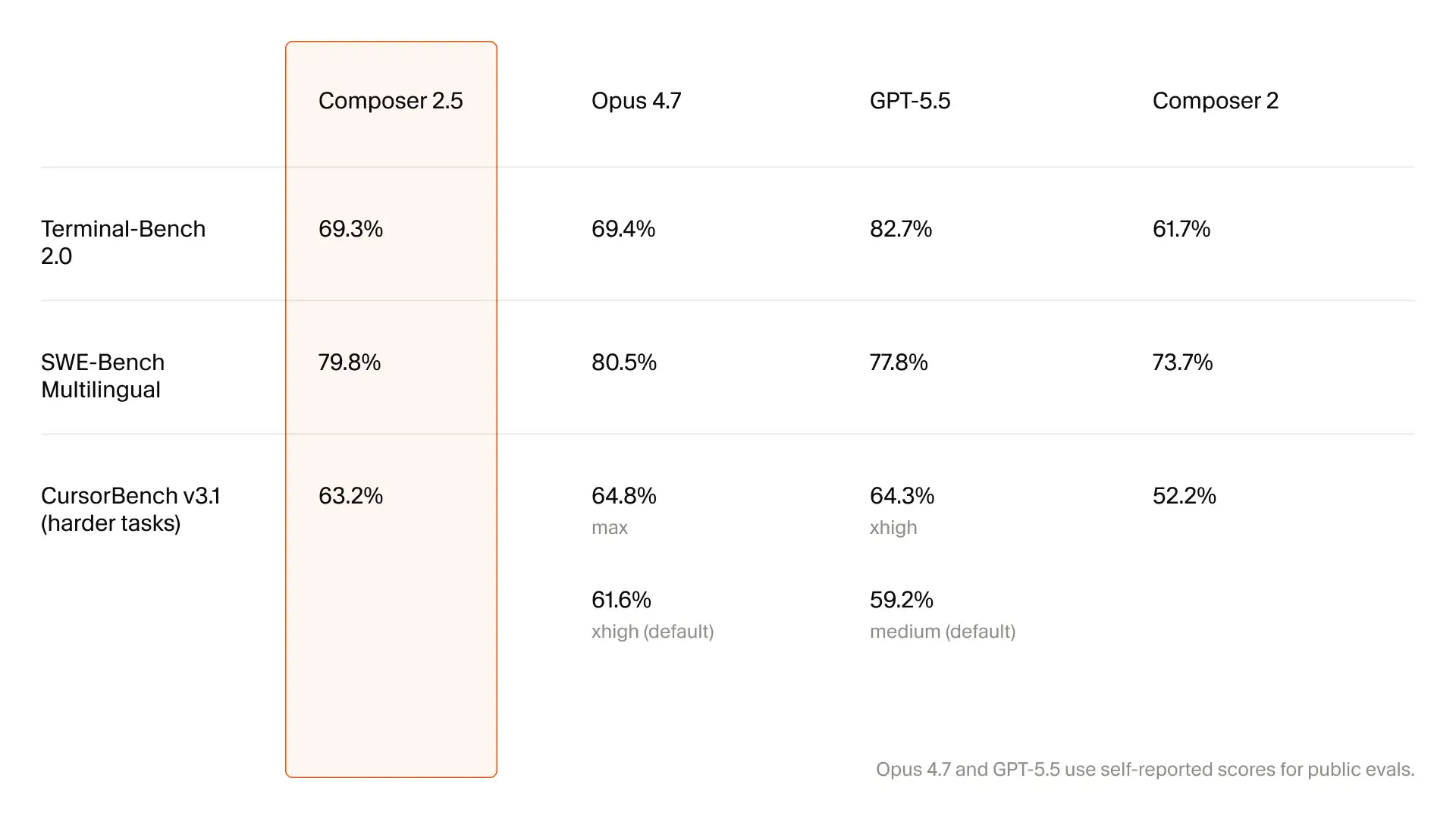
- SWE‑Bench Verified: 78.4%, approaching the level of Claude 5 Fable and GPT‑5.5.
- Terminal‑Bench: Agentic task completion rate 86.7%, showing strong performance in real engineering scenarios.
- Multi‑File Editing Bench: multi‑file collaborative editing accuracy 91.2%, significantly ahead of competitors.
- User Satisfaction Survey: Over 78% of test users reported a "marked improvement in development efficiency."
Multiple technology companies have integrated Composer 2.5 into internal tests to accelerate code reviews, legacy system refactoring and new‑hire onboarding processes.
Industry Significance and Impact
The release of Composer 2.5 further intensifies competition in the AI coding tools market. Cursor, GitHub Copilot, Claude Code, Antigravity and others are forming a fierce competitive landscape. With a strong local editor experience and Agentic capabilities, Cursor maintains high stickiness among developers.
This upgrade also reflects the trend of AI coding tools evolving from "code completion" to "autonomous engineering partners." In the future, AI will increasingly participate across the full software development lifecycle, including requirements analysis, architecture design, implementation, testing, deployment and maintenance iterations.
For developers, Composer 2.5 lowers the barrier to handling complex projects; for enterprises, it promises to significantly improve R&D efficiency and code quality; for the industry as a whole, this iteration accelerates AI's deep integration into software engineering.
Conclusion
The release of Cursor Composer 2.5 is a significant advance in the AI coding tools space in 2026. With enhanced Agentic capabilities and multi‑file understanding, it provides developers with a more powerful, smarter programming assistant.
As AI rapidly changes software development paradigms, Cursor is consolidating its leading position in the AI IDE market through continuous iteration. With more Agentic features to come, AI coding tools will further reshape development workflows and drive software engineering into a new era of human‑machine co‑creation.
▶️ Enjoyed this article? Creating content is hard work!
Follow our YouTube channel:
AI Rosetta
Your likes, subscriptions and shares are our greatest support! 🙏
More AI news at: https://www.airosetta.com