
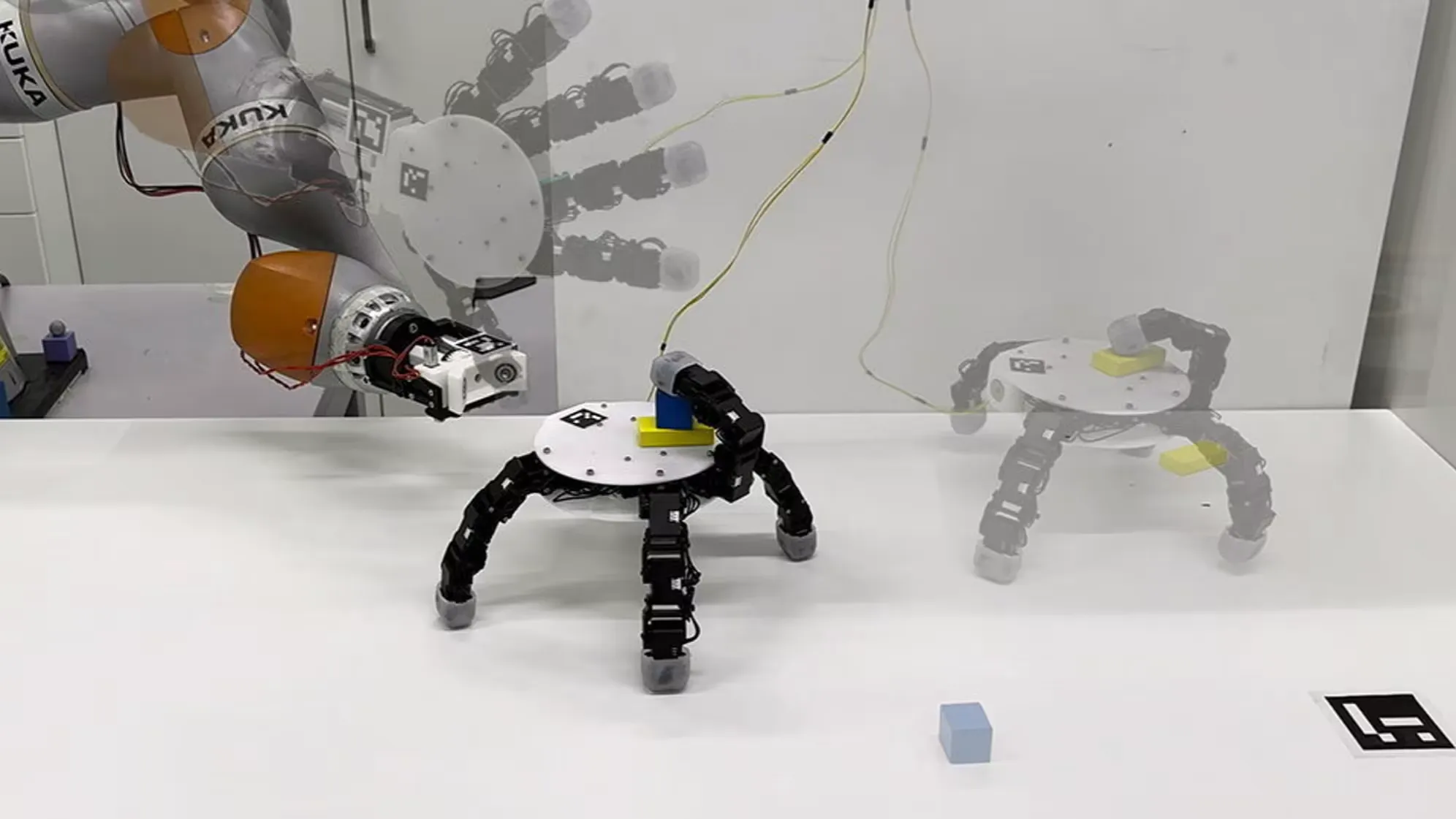
Financial Times published a report showcasing a "crawling" robotic hand that differs from traditional manipulators. Rather than relying on large‑scale arm movements, it uses multiple finger‑like elements that alternately fix and release to perform surface "crawling" displacement, enabling continuous grasping and transfers in confined spaces.
The report notes the team attributes the design's key features to two points: one is multi‑finger parallel regrasping ability, which can transfer contact points from one finger to another without releasing the object; the other is that by rotating anchor points, one or two hands can advance stepwise on the same plane, similar to insect crawling. This motion allows the manipulator to perform continuous operations from one object to another without large arm swings typical of traditional robotic arms.
In demonstrations, the device handled objects of various shapes and materials: the team had the hand contact and transfer smooth spheres, containers with handles and thin flat parts. The report emphasizes that the key is not single‑grasp force but the device's continuity in maintaining stable grip, repositioning and continuing operation under complex poses.
- Regrasp ability: Through distributed fingertip control, the hand can adjust grip position while keeping the object controlled.
- Crawling displacement: Without whole‑arm movement, the device advances along surfaces by alternating finger contacts, suited for confined spaces or densely packed items.
- Compared with human hands: The report cites researchers saying the device shows greater stability and consistency than human hands in some constrained environments and repetitive micro‑operations.
Financial Times also examined potential industrialization paths: researchers believe that if such hands can be integrated with existing vision systems and sorting software, they could replace or supplement traditional industrial arms in electronic component assembly, fine sorting and high‑density storage. The article points out that key challenges remain durability, robustness of control algorithms and compatibility with existing production‑line equipment.
The report did not disclose full technical parameters but mentioned that the researchers carried out multiple rounds of experiments to verify repeatability, precision and speed of regrasping. Analysts speculate that if the "crawling+regrasp" concept is industrialized, it could alter automation layouts that currently rely on large arm segments—allowing more tasks to be completed in smaller spaces with lower energy consumption.
Financial Times focused on the technology's practicality and commercialization prospects and raised ethical and employment discussions: will more dexterous automation replace additional manual jobs? The report cited researchers responding that in the short term the focus remains on moving laboratory prototypes into stable production, and genuine large‑scale deployment will require time and further industrial validation.
In any case, this "crawling robotic hand" breaks the conventional notion that robotic hands only "pick and place", demonstrating a relocation strategy closer to biological methods and offering new ideas for industrial automation design.
▶️ Enjoy this article? Creating takes a lot of work!
Follow our YouTube channel:
AI Rosetta
Your likes, subscriptions and shares are our greatest support!🙏
More AI news at: https://www.airosetta.com