
In the early hours of March 31, 2026, Anthropic's flagship AI programming tool Claude Code (CLI version v2.1.88) accidentally published a 59.8MB source map file (cli.js.map) with its production package due to an npm package configuration error, causing about 512,000 lines (exactly 512,000 lines) of unobfuscated TypeScript full source (roughly 1,900 files) to spread across the internet. This "human‑level mistake" quickly evolved into one of the most dramatic events in AI open‑source history.
Within hours of the leak being revealed, South Korean developer Sigrid Jin (online @realsigridjin / instructkr) moved immediately. Rather than simply mirroring or archiving the leaked code, he used a clean‑room reimplementation strategy: first reproducing the core architecture in Python from scratch, then rapidly porting it to Rust, and publishing it on GitHub under ultraworkers/claw‑code (originally instructkr/claw‑code). The project surpassed 100,000 stars within 48 hours, becoming the fastest‑growing repository in GitHub history and far outpacing prior AI Agent projects such as OpenClaw. The repository has since reached 150,000 stars and over 100,000 forks, with maintenance moved to the parity branch (https://github.com/ultraworkers/claw‑code‑parity).
Sigrid Jin: from "heavy Claude user" to "48‑hour creator"
Previously profiled by The Wall Street Journal as an extreme user who reportedly consumed 25 billion Claude Code tokens in a year, Jin was intimately familiar with Claude Code's agent architecture. The night of the leak, he woke at 4 a.m. to X researcher Chaofan Shou's disclosure and immediately took action. Jin wrote in the README: "Worried that directly hosting leaked code would create legal risk, and worried my girlfriend in Korea would be upset, I decided to perform a clean‑room rewrite assisted by AI."
He initially used his in‑house AI workflow tools oh‑my‑codex (OmX) and oh‑my‑opencode (OmO) to port the core functionality to Python within hours. The team (including contributors such as @bellman_ych and @code‑yeongyu) then migrated key modules to Rust, achieving significant gains in performance and portability. The entire process avoided copying any original source, only referencing architectural patterns to ensure protection from DMCA takedowns. Jin emphasized: "This is not copying, but re‑engineering a better Agent Harness system."
Technical details: a Rust+Python dual‑core "better harness"
Claw Code positions itself as "Better Harness Tools that make real things done," closely aligned with the original Claude Code but more open:
- Language composition: Rust accounts for 92.9% (core CLI claw‑cli, runtime, plugin system, memory management), Python 7.1% (early prototypes and test framework). The Rust build produces a single‑file binary (213MB ELF), supports cross‑platform execution, and runs far faster than the original TypeScript implementation.
- Core feature inheritance and enhancements:
- Interactive REPL and Markdown rendering: native terminal TUI with real‑time streaming output.
- Multi‑agent coordination and planning modes: built‑in MCP (Multi‑Agent Collaboration Protocol) orchestration, session state compression, and automatic prompt construction.
- Plugin system and 40+ tools: file operations, Git integration, browser automation, terminal command execution, and more—fully extensible.
- Multi‑LLM compatibility: abstract API client supporting OpenAI, Anthropic, Gemini, Groq, local Ollama, and other backends with no vendor lock‑in.
- Persistence and security: session state persistence, OAuth support, and hook pipelines.
- AI‑assisted development: the Rust port was largely produced with the help of AI (oh‑my‑codex), with humans providing architectural oversight and final review—setting a new example of AI‑assisted development of AI tools.
The project provides clear install instructions: Rust version via cargo build --release, Python version via python3 -m src.main. It also includes a parity auditing tool to verify functional consistency with the original architecture while containing no original code. The license is not explicitly stated, and the repository stresses that it is "not Anthropic official, and does not imply endorsement."
Record growth: GitHub's fastest 100K stars
On the night of the leak, the claw‑code repository hit 50,000 stars within two hours of going live and exceeded 100,000 stars within 24 hours, setting a new GitHub record for speed of growth. Previous projects like OpenClaw took weeks to reach similar attention. The community praised it as "not a simple mirror but a genuinely better Agent framework." The Discord server (instruct.kr) quickly gathered tens of thousands of developers discussing LLM harness engineering and agent workflows.
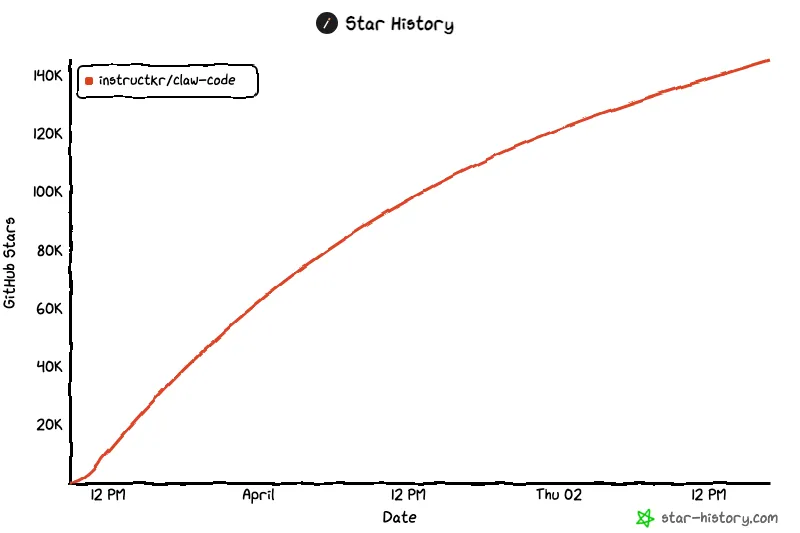
Far‑reaching impact: a "nuclear" moment for the open‑source AI Agent ecosystem
- On Anthropic: short‑term reputational damage. As Claude Code is a high‑margin company product with annualized revenue exceeding $2.5 billion, exposure of internal architecture may weaken competitive barriers. Although the company quickly issued DMCA notices and removed mirrors, a clean‑room reimplementation cannot be easily taken down. Anthropic engineer Boris Cherny publicly acknowledged that "this is a process, culture, or infrastructure issue, not an individual mistake," indicating internal reflection on release practices.
- On the open‑source community: it has directly produced an "open‑source dividend" for AI coding agents. Developers can now study production‑grade multi‑agent coordination, tool invocation, and memory management designs and rapidly iterate backend versions supporting any LLM. Claw Code has inspired projects such as OpenClaw, Cline, and Aider, accelerating the migration of AI agent infrastructure from closed to open.
- On the AI industry: it again demonstrates the productivity unleashed by "accidental open‑sourcing." Past leaks of AI tools are pushing the industry from "closed‑source moats" toward "open architectures plus model performance competition." The Rust+Python dual‑language implementation also offers a new paradigm for high‑performance agent tools, lowering the barrier for developers. It also warns AI companies that supply‑chain security and release controls are now a baseline; any low‑level mistake can enable a global developer community to "create a star in 48 hours."
- Legal and ethical aspects: the clean‑room rewrite strategy has become an industry consensus—"copyright protects creative expression, not functional architectures." This provides a legal path for similar cases in the future but also raises intellectual property debates.
Conclusion: from leak to rebirth — the open‑source AI Agent era has arrived
Sigrid Jin and his team produced Claw Code in 48 hours, a technical feat and a vivid expression of open‑source spirit in the AI era. They turned Anthropic's operational mistake into a shared resource for global developers. Behind 150,000 stars lies the community's collective appetite for a "better harness"—to make AI less of a black box and a genuine productivity partner that gets real things done.
The Claw Code surge signals that the AI Agent track is moving from vendor monopolies toward ecosystem co‑creation. High‑performance Rust rewrites may become commonplace, and companies like Anthropic will need to accelerate embracing open‑source thinking. At this critical moment as AI tools move from labs to widespread use, this "48‑hour creation" episode may mark the true beginning of a golden age for open‑source AI Agents.
▶️ Enjoyed this piece? Creating content is hard!
Follow our YouTube channel:
AI Rosetta
Your likes, subscriptions, and shares are our biggest support! 🙏
More AI news at: https://www.airosetta.com