
Introduction
In February 2026, AI giants Anthropic and OpenAI nearly simultaneously released their latest flagship reasoning models: Claude Opus 4.6 and GPT‑5.3‑Codex. The coincidence sparked wide debate in the developer community and was dubbed the "dual summit" of the AI coding battle. Claude Opus 4.6 was released first on February 5, followed by OpenAI's GPT‑5.3‑Codex less than an hour later, highlighting intense competition in agentic coding and reasoning capabilities. According to Anthropic's official blog and OpenAI announcements, both models are optimized for complex programming, multi‑step reasoning and long‑context handling, aiming to evolve from "chatbots" to "autonomous engineers." Tech outlets including Medium and Every.to reported that this "synchronized upgrade" marks a shift from general conversation models toward specialized workflows, making benchmarks and user tests key for evaluation. The AI Rosetta YouTube video "Testing Claude Opus 4.6 and GPT‑5.3‑Codex in OpenClaw" tested seven dimensions and provided a typical user‑perspective report; the video has surpassed one million views. This report draws on official Anthropic and OpenAI announcements, Medium, Every.to, DataCamp, NxCode, The Neuron, eWeek, IBM Think and community feedback on Reddit and LinkedIn to compare both models' core performance, benchmark data and user tests, ensuring factual accuracy and reliability.
Model specifications and core features
Claude Opus 4.6 is the latest iteration in Anthropic's Claude series; its parameter count has not been disclosed. The focus is on "deep thinking" and "agent teams." The model introduces a one‑million‑token (1M) context window and supports multi‑agent collaboration, allowing multiple Claude instances to divide labor on complex tasks such as code migration and large project planning. Anthropic emphasizes Opus 4.6's optimization for knowledge work, reporting an Elo score of 1606, and positions it for professional domains like finance and law. Pricing is via Claude Pro subscription (USD 20/month); API calls are relatively expensive but support enterprise deployment.
GPT‑5.3‑Codex is OpenAI's dedicated model for coding and agent tasks, with an estimated parameter size of around one trillion and support for long‑running workflows. Response speed is improved by about 25%. OpenAI says the model "first participates in its own creation," highlighting autonomous execution for tasks such as file editing, Git operations and build system management. Pricing is via the OpenAI Frontier enterprise platform (custom), with API fees lower than Opus, though access requires a ChatGPT Plus subscription (USD 20/month).
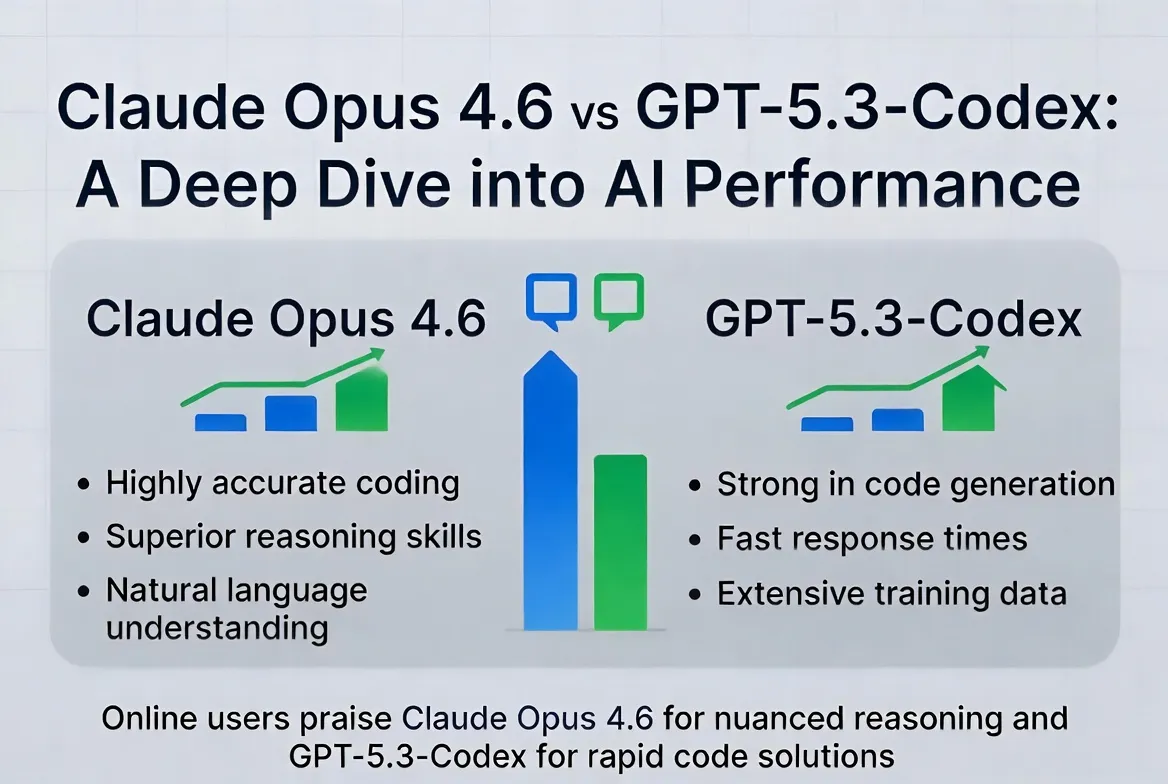
Both models support tool calling, multimodal inputs and long contexts, but Opus emphasizes "depth of thought" while Codex focuses on "execution persistence."
Benchmark performance comparison
Benchmarks are central to evaluating the two models. The following comparison is based on official announcements and third‑party verification:
- Terminal‑Bench 2.0 (agent‑coding benchmark): GPT‑5.3‑Codex scored 77.3%, ahead of Claude Opus 4.6's 65.4%. This benchmark measures autonomous coding in terminal environments—file operations and build systems—where Codex's advantage comes from execution speed and stability.
- SWE‑Bench Verified (software engineering benchmark): Claude Opus 4.6 scored 81.42% (with edits), slightly higher than GPT‑5.3‑Codex's 80.0%. This test evaluates code generation and repair; Opus is stronger on complex legacy code.
- OSWorld‑Verified (desktop usage benchmark): Claude Opus 4.6 scored 72.7%, above GPT‑5.3‑Codex's 64.7%. This benchmark simulates desktop operations where Opus leads in navigation and multitasking.
- GDPval‑AA (economic‑value task benchmark): Claude Opus 4.6 has an Elo score of 1606, ahead of GPT‑5.3‑Codex. This benchmark evaluates financial and legal tasks; Opus performs better on professional knowledge work.
- MRCR v2 (long‑context retrieval): Claude Opus 4.6 achieved 76% accuracy at 1M tokens; GPT‑5.3‑Codex has not disclosed comparable figures, but Opus leads in long codebase understanding.
Overall, GPT‑5.3‑Codex wins on execution and speed (25% faster), while Claude Opus 4.6 has the edge in depth of thought and long‑context handling. IBM Think reported that the two models "borrow from each other": Codex adopts Opus's warmer style, and Opus enhances execution capabilities.
User test reports
User tests provide practical insight beyond benchmarks. The AI Rosetta video compared the two models across seven tests, showing:
- Context window: Claude Opus 4.6's 1M window dominates GPT‑5.3‑Codex in long code handling.
- Base64 decoding: Both respond at similar speed, but Opus is more accurate.
- Chinese Song poetry composition: GPT‑5.3‑Codex is slightly stronger in creativity, while Opus focuses more on structure.
- Complex reasoning: Opus performed better on lamp‑prefix encoding and river‑crossing puzzles; Codex made occasional errors.
- Frontend UI recreation: Codex is faster at drawing SVG architecture diagrams; Opus is more precise on details.
- Bug hunting: Opus is more thorough in global search; Codex produces higher‑quality code but enforces stricter reviews.
- Pygame animation and Manim visualization: Codex is faster; Opus provides deeper reasoning.
The video summary: Opus is suited for deep thinking while Codex is suited for rapid execution.
Reddit r/ClaudeAI posts reported Codex's advantage in production code quality, but Opus is faster in bug hunting. Medium user tests: Codex outperformed Opus on Rust CRUD tasks in code quality, speed and comments. LinkedIn developer shares: Opus leads on long‑context migration while Codex is more reliable for long‑running tasks.
Overall, users see complementary strengths: Opus is more "thinker" and Codex more "executor."
Industry impact and challenges
The releases accelerate AI's shift from chat to agents. eWeek reported surging enterprise AI demand and fierce competition between Opus and Codex in knowledge work. IBM Think noted infrastructure is the key, not just the model. Challenges include ethics (Codex enforces stricter review) and costs (high API fees).
Conclusion
The successive releases of Claude Opus 4.6 and GPT‑5.3‑Codex mark a new era for AI coding. Benchmarks show Codex leads in execution while Opus excels in depth of thought; user tests corroborate these strengths. The competition will drive enterprise agents forward but requires addressing cost and ethical issues. In the future, both models could reshape developer workflows.
▶️ Enjoyed this piece? Content creation is hard!
Follow our YouTube channel:
AI Rosetta
Your likes, subscriptions and shares are our greatest support!🙏
More AI news at:https://www.airosetta.com