
Global information services provider Clarivate has released the 2025 "Highly Cited Researchers" list. This annual ranking recognizes researchers who have had substantial influence in their fields. The list is based on the Web of Science Core Collection and evaluates citation impact for papers published from 2014 to 2024. Entrants must be authors of papers ranked in the top 1% by citations in at least one of the 21 Essential Science Indicators (ESI) fields. A total of 6,868 researchers from more than 1,300 institutions across 60 countries and regions were named, accounting for 7,131 entries in total (some researchers are listed in multiple disciplines), representing 0.1% of the global research community. Compared with previous editions, this year's list emphasizes research integrity and introduces an exclusion mechanism to remove researchers involved in retractions or inappropriate co‑authorship.
Clarivate's Institute for Scientific Information (ISI) bibliometric experts noted that the list serves not only as a barometer of research impact but also as a mirror of the global innovation ecosystem. The 2025 results show the United States remains the top country, though its dominance has slightly eased. Mainland China has surged to a 19.7% share of global entries, doubling its 2020 count and signaling the rapid rise of Asia‑Pacific research capacity. At the institutional level, the Chinese Academy of Sciences (CAS) leads with 258 entries for the third consecutive year, surpassing Harvard University, reflecting a collective leap in Chinese research institutions. The release comes amid a recovery in global research investment and may offer valuable insights for policymakers and institutional leaders to foster more international collaboration.
Overview: A Reshaped Global Research Landscape
The 2025 Highly Cited Researchers list covers 21 ESI fields, including physics, chemistry, engineering, and medicine, with strict selection thresholds: only researchers who have consistently produced high‑impact work over the past decade qualify. Total entries of 7,131 represent a 3.6% increase from 6,886 in 2024, indicating steady global research output growth. Notably, this edition introduces an "integrity‑driven" standard, excluding about 432 researchers affected by co‑authorship disputes or retractions, making the selection more focused on genuine contributions.
Regionally, the top ten countries and territories account for 86% of total entries, underscoring concentration of research activity. The United States leads with 2,670 entries (37.4% of the global share), though its relative influence is gradually declining. Mainland China follows with 1,406 entries (19.7%), emerging as a clear rising power. European countries such as the United Kingdom and Germany remain stable, while emerging Asia‑Pacific players like Australia and Hong Kong show strong momentum. Institutionally, CAS's 258 entries mark a historical high and highlight the success of the national laboratory model.
Country Rankings: U.S. Hegemony Challenged as China Accelerates
Clarivate's analysis lists the top ten countries by entries. The United States retains the top spot thanks to its extensive research ecosystem and funding, but its share fell from 41.5% in 2020 to 37.4% in 2025, reflecting intensifying competition. Mainland China's rise is striking, climbing from 770 entries in 2020 to 1,406 in 2025, with an average annual growth exceeding 15%, supported by initiatives such as the "Double First Class" project and targeted funding from the National Natural Science Foundation.
Table 1: Top 10 Countries/Regions by Number of Highly Cited Researchers (2025)
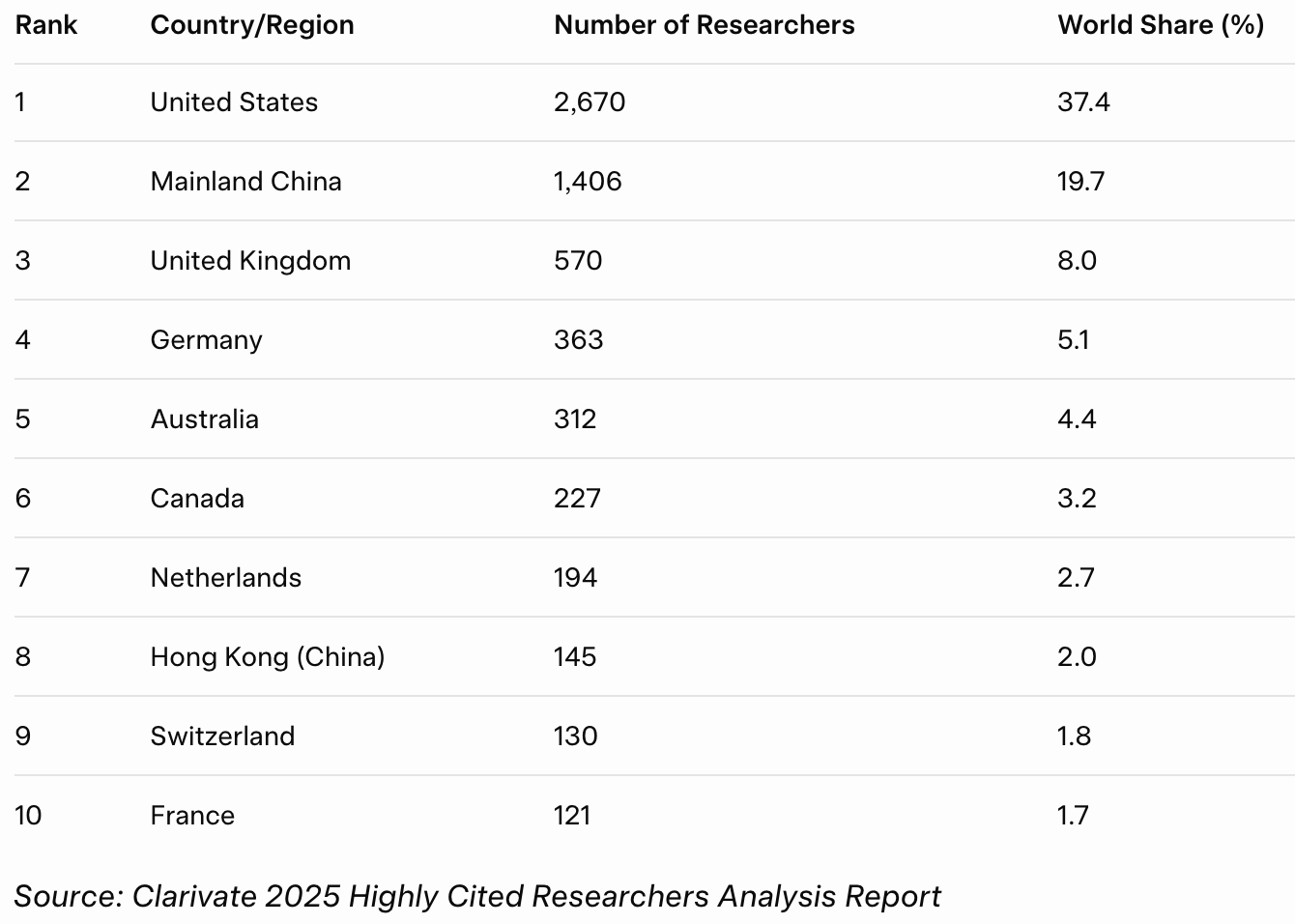 table illustrates subtle shifts in the geopolitical research landscape: North American and European traditional powers saw slight declines in share while Asian countries collectively gained. Hong Kong led emerging markets with an 8.2% annual growth rate, benefiting from internationalization and breakthroughs in fintech and related fields.
Institution Rankings: CAS Three‑Peat, Harvard Falls to Second
Institution rankings also reflect the strong performance of Chinese research organizations. The Chinese Academy of Sciences retained first place with 258 entries for the third consecutive year, surpassing Harvard University. CAS entrants span physics, chemistry, earth sciences, and other fields, demonstrating broad‑based strength. Harvard ranked second with 170 entries, yet its dominance in medicine and biology faces growing competition from Tsinghua University, which rose to fourth with 91 entries, a year‑on‑year increase of more than 20%.
Below is the top ten institutions for 2025 (by entries):
Table 2: Top 10 Institutions by Number of Highly Cited Researchers (2025)
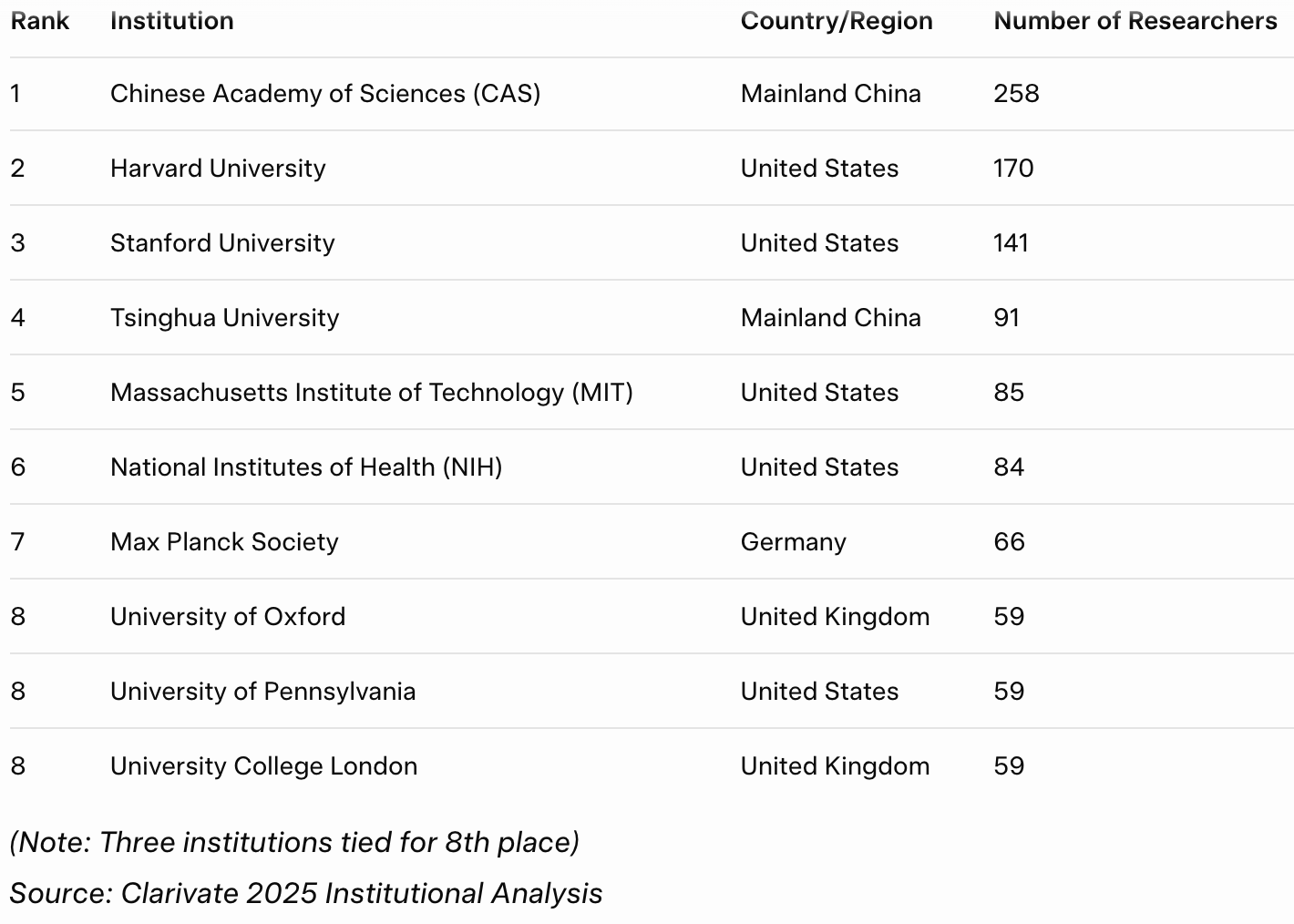
(Note: The Max Planck Society, representing Europe, ranked seventh with 66 entries, highlighting Germany's resilience in basic research. Overall, among the top ten institutions, two are from mainland China and five are from the United States, reflecting a Sino‑American duopoly in high‑impact research.
Five‑Year Changes: China Up 1.5×, U.S. Share Slightly Down
Reviewing 2020–2025 data, changes in the Highly Cited Researchers list reflect a shift eastward. Focusing on the U.S. and China, China's share rose from 12.1% to 19.7%, a cumulative increase of 62.8% and a compound annual growth rate of about 12.6%. The U.S. share declined from 41.5% to 37.4%, a cumulative drop of 9.9%, though 2025 saw a 1.0% rebound.
Table 3: Changes in World Share of Highly Cited Researchers (U.S. vs. Mainland China, 2020–2025)
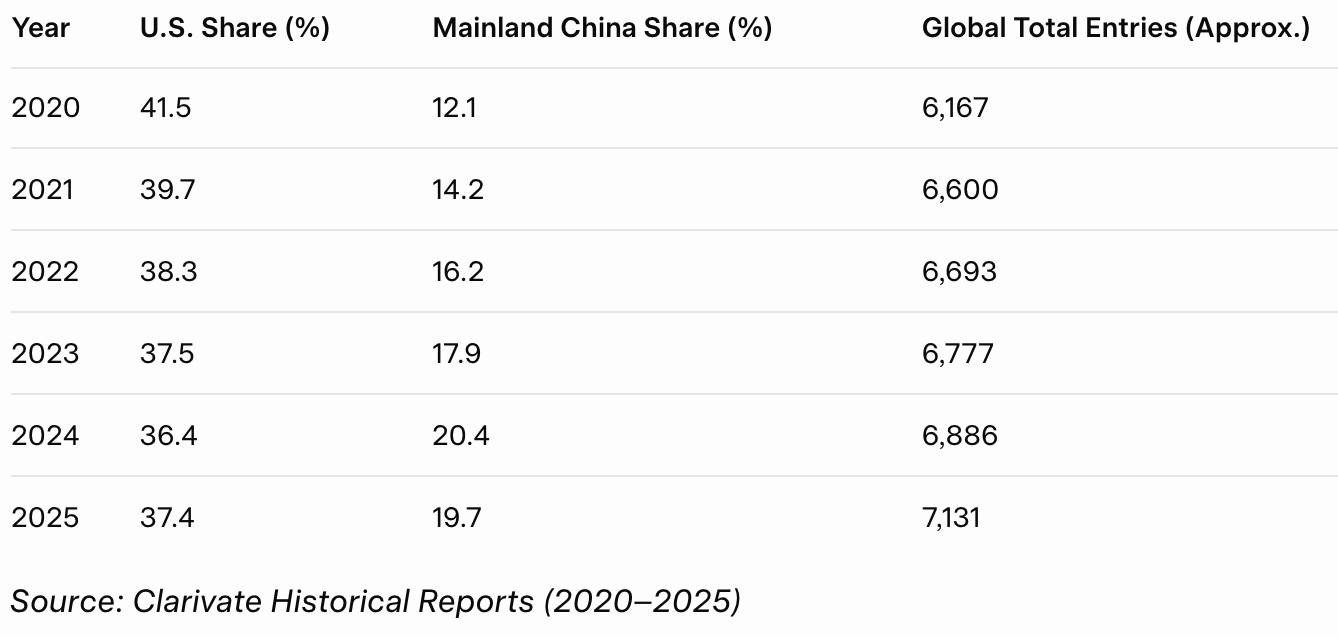
The table shows China's citation "impact share" grew roughly 1.5 times over five years, driven by increased publication output and deeper international collaboration. After peaking at 20.4% in 2024, China's share dipped 0.7% in 2025, possibly influenced by post‑pandemic recovery and integrity screening. The U.S. decline partly reflects domestic funding allocation pressures, though its absolute entries rose from about 2,650 in 2020 to 2,670 in 2025, showing continued base advantage.
Historical institutional changes are more fragmented, but the rise of CAS is clear: about 150 entries in 2020, surpassing Harvard around 2023 with roughly 220 entries, and reaching 258 in 2025, an average annual growth of 15%. Harvard remained around 170 entries, with limited growth. Tsinghua University emerged as a dark horse, climbing from about 40 entries in 2020 to 91 in 2025, reflecting explosive growth in engineering and AI.
In‑Depth Analysis: Drivers and Global Implications
The five‑year trends reflect multiple factors. The U.S. share contraction is linked to slower research funding growth (NIH budget rising about 2% annually) and talent outflows, while China benefited from doubled R&D investment under the 14th Five‑Year Plan, with total research expenditure reaching RMB 3.3 trillion in 2024. The rise of open access publishing and Belt and Road collaborations also increased the international visibility of Chinese papers. European countries such as the U.K. (stable at about 8% share) rely on EU framework programs to stay competitive, while the Max Planck Society's 66 entries stem from a long‑tail strategy focused on basic science.
The trend has broad implications for the global research ecosystem: the rise of emerging countries fosters diversification but can intensify the "Matthew effect," where top institutions concentrate resources. Clarivate experts urge stronger cross‑border ethical norms to address challenges from AI‑generated content and retraction waves. For Chinese researchers, the list signifies both honor and responsibility: sustaining high‑quality output is key to consolidating the shift from follower to leader.
Conclusion: Looking Ahead to the Next Wave of Innovation
The 2025 Highly Cited Researchers list reflects a new chapter in research globalization. China's transition from participant to leader enhances national soft power and contributes Chinese perspectives to global sustainable development. Looking to 2026, breakthroughs in quantum computing and climate science may bring further surprises. Clarivate says it will continue refining selection methods to balance research integrity and impact. The road of research is long and arduous; we can look forward to more moments of high citation impact.