
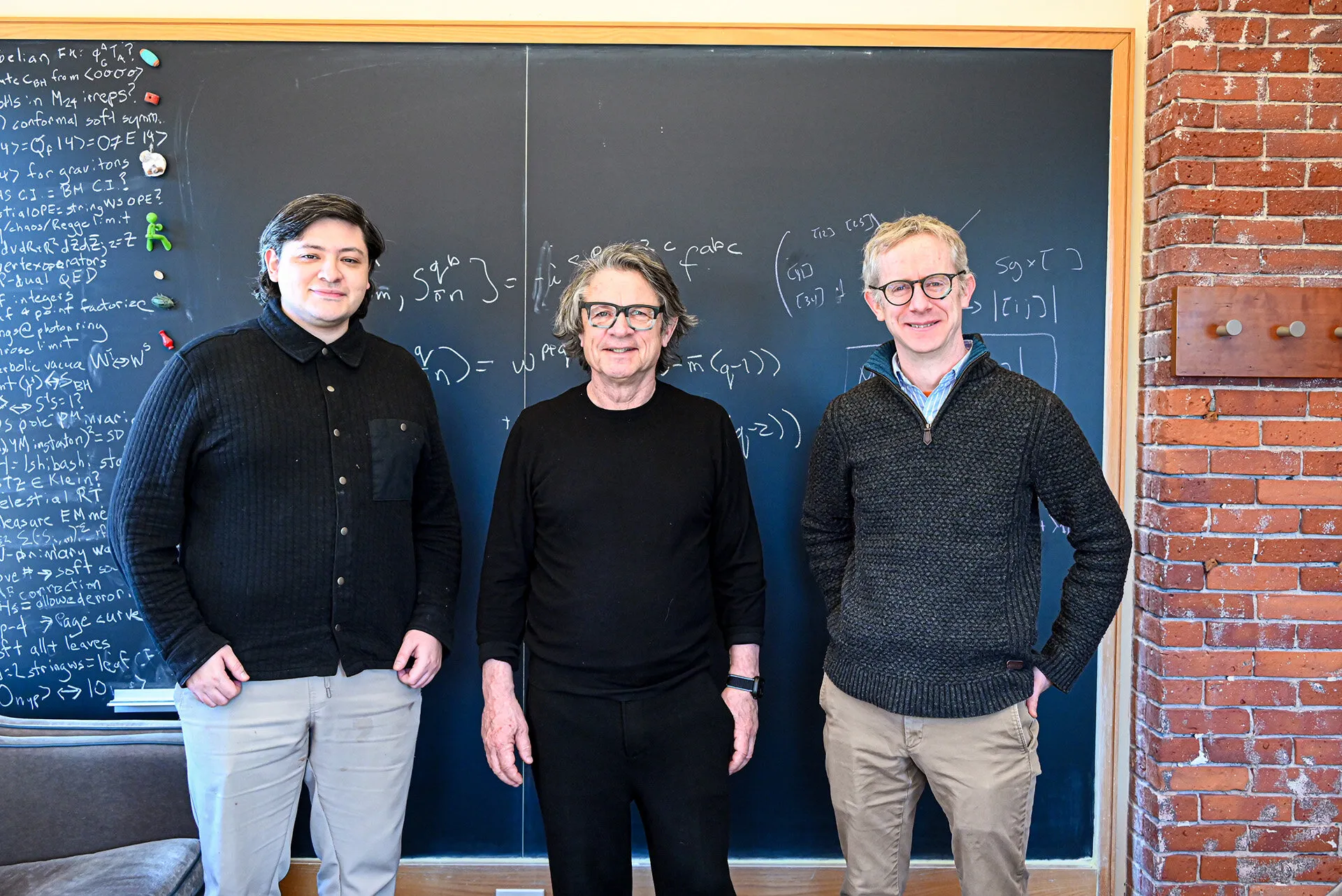
In February 2026, a notable turn occurred around a long‑stalled proof of a gluon scattering amplitude: a research team brought a chatbot into the workflow as a tool to guide and accelerate the proof, prompting broader academic‑ethical debate over whether AI can be named as a coauthor.
The report notes that Harvard theoretical physicist Andrew Strominger was skeptical of early attempts to use ChatGPT in research—early models often produced answers that seemed clever but did not withstand scrutiny. This breakthrough began with an attempt by an experienced former doctoral student on the team: when hand derivations bogged down in repetitive calculations and algebraic errors, the team introduced a chatbot as an "algebra assistant" and "proposal generator."
The researchers did not treat the AI as a black box but repeatedly cross‑checked its outputs under strict human supervision. The chatbot was used for three concrete tasks: first, quickly checking mechanical errors in complex algebra; second, generating candidate proof steps or alternative routes to inspire human researchers; third, identifying hidden combinatorial patterns from many examples that helped reconstruct the proof framework. The report emphasizes that the AI's suggestions did not directly become the final proof but in multiple iterations triggered key human insights.
On the technical side, the team focused on multi‑particle gluon scattering amplitudes in quantum chromodynamics (QCD)—a complex problem involving symmetries, renormalization and combinatorial structure. For a long time, proofs in certain high‑order cases were stuck because of algebraic blowup and difficulties in pattern recognition. The chatbot shortened the time window for researchers to find "viable routes" by generating many candidate computational paths in parallel.
However, AI's involvement immediately raised questions about authorship and responsibility. Several journals and research organizations have explicit limits on non‑human entities as paper authors: only human individuals able to accept academic responsibility and be accountable for a paper's content may be listed. Even though AI played a key assisting role in this work, the team ultimately reserved authorship for human researchers and documented the AI's participation and verification steps in the methodology section.
This case also attracted the attention of early‑career researchers outside academia: for them AI is no longer a "black box that speaks well" but a tool that can be embedded into daily research workflows to improve efficiency; at the same time, how to disclose AI assistance transparently and maintain reproducibility and auditability has become a more urgent question. The report notes that future academic norms may lean toward mandatory disclosure of AI use details rather than listing AI as a coauthor.
Researchers interviewed emphasized that this breakthrough was not "AI alone" but a product of "human intelligence working with machine tools." For the younger generation of scientists, this is both a methodological shift and a test of professional ethics: how to embrace efficiency gains while preserving academic rigor and traceable responsibility.
The debate around the gluon‑amplitude proof and the chatbot's role may push journals, research institutions and funders to revisit norms on AI‑assisted research—from authorship rules to verifiability clauses—requiring finer‑grained policies to adapt to the new reality. For the physics community, the significance of this single case is that controlled AI assistance has demonstrated practical value when complex mathematics and computational work require large‑scale search and pattern recognition.
▶️ Enjoy this piece? Creating content is hard!
Follow our YouTube channel:
AI Rosetta
Your likes, subscriptions and shares are our greatest support! 🙏
More AI news at: https://www.airosetta.com