
Beijing time, September 14, 2025, (Tech report) As competition in AI image generation intensifies, TikTok parent company ByteDance officially released Seedream 4.0 on September 11. This multimodal AI model integrates text‑to‑image generation and advanced editing. The model is positioned directly against Google DeepMind's Gemini 2.5 Flash Image (industry nickname "Nano Banana") and claims comprehensive advantages in image quality, generation speed and editing precision. The release marks a strong counterattack by Chinese AI firms in the global visual AI race. By consolidating prior technologies, ByteDance has built a more efficient, more professional tool aimed at capturing the content‑creation and design markets. As the latest work from ByteDance AI Lab, Seedream 4.0 not only inherits Seedream 3.0's generative capabilities but also incorporates SeedEdit 3.0's editing features, achieving a leap from single‑shot generation to full‑workflow creation. According to internal benchmark tests, the model surpasses competitors in prompt adherence, alignment and aesthetic scores, producing a 2K‑resolution image in under 2 seconds. For ordinary users, this means quickly producing professional‑grade visuals from simple text descriptions; for designers and marketing teams, it is an efficiency booster. ByteDance emphasizes that Seedream 4.0 is affordably priced, with the enterprise plan at just $30 per 1,000 generations—well below industry averages. This innovation not only highlights ByteDance's accumulation in multimodal AI but also reflects a global shift of AI image tools from "entertainment toys" to "productivity engines."
Background: ByteDance's AI image strategy and global competition
ByteDance's AI journey began with short‑video recommendation algorithms but in recent years has expanded into generative AI. Since the Seedream series debuted in 2023, it has rapidly become ByteDance's visual‑AI cornerstone. When Seedream 3.0 launched in 2024 it already supported high‑fidelity text‑to‑image generation and outperformed Stability AI's Stable Diffusion XL in internal tests. Facing giants like OpenAI's DALL·E 3 and Google's Imagen 3, ByteDance realized that generation alone was not enough; editing and consistency features had to be strengthened. Seedream 4.0 is the result of that strategy, combining text understanding, image processing and style transfer technologies to target the professional market.
Meanwhile, Google DeepMind's Gemini 2.5 Flash Image ("Nano Banana") was released at the end of August, positioned as a mobile real‑time editing tool supporting 1080p square‑photo generation with an emphasis on consistency and reliability. Integrated into Google Photos and Pixel phones, it aims to provide instant beautification for mainstream users. Its limitations include resolution and flexibility constraints, and limited support for complex multi‑reference scenarios. ByteDance targeted this gap with Seedream 4.0 as a "professional‑grade challenger," claiming benchmark advantages while optimizing computational efficiency for desktop and cloud deployment. According to ByteDance's official blog, the model's development spanned eight months, involved hundreds of engineers, and required over 50% more training time than its predecessor; however, its efficient architecture reduces inference costs by 30%. The release comes amid heightened US–China AI competition; Seedream 4.0 is not fully open‑sourced but offers API access to encourage a developer ecosystem.
Technical overview: MoE‑driven multimodal fusion
At the core of Seedream 4.0 is a Mixture‑of‑Experts (MoE) architecture, an advanced neural design that dynamically activates submodules by task, improving efficiency without simply increasing parameter counts. In simple terms, traditional image models like DALL·E use a single large Transformer for all inputs, causing computational redundancy; MoE works like a team of specialists—one expert handles texture generation, another focuses on style matching—activating only the necessary parts. This means that although Seedream 4.0's total parameters may reach tens of billions, only 20%–30% of resources are used at inference, making it over ten times faster than Seedream 3.0.
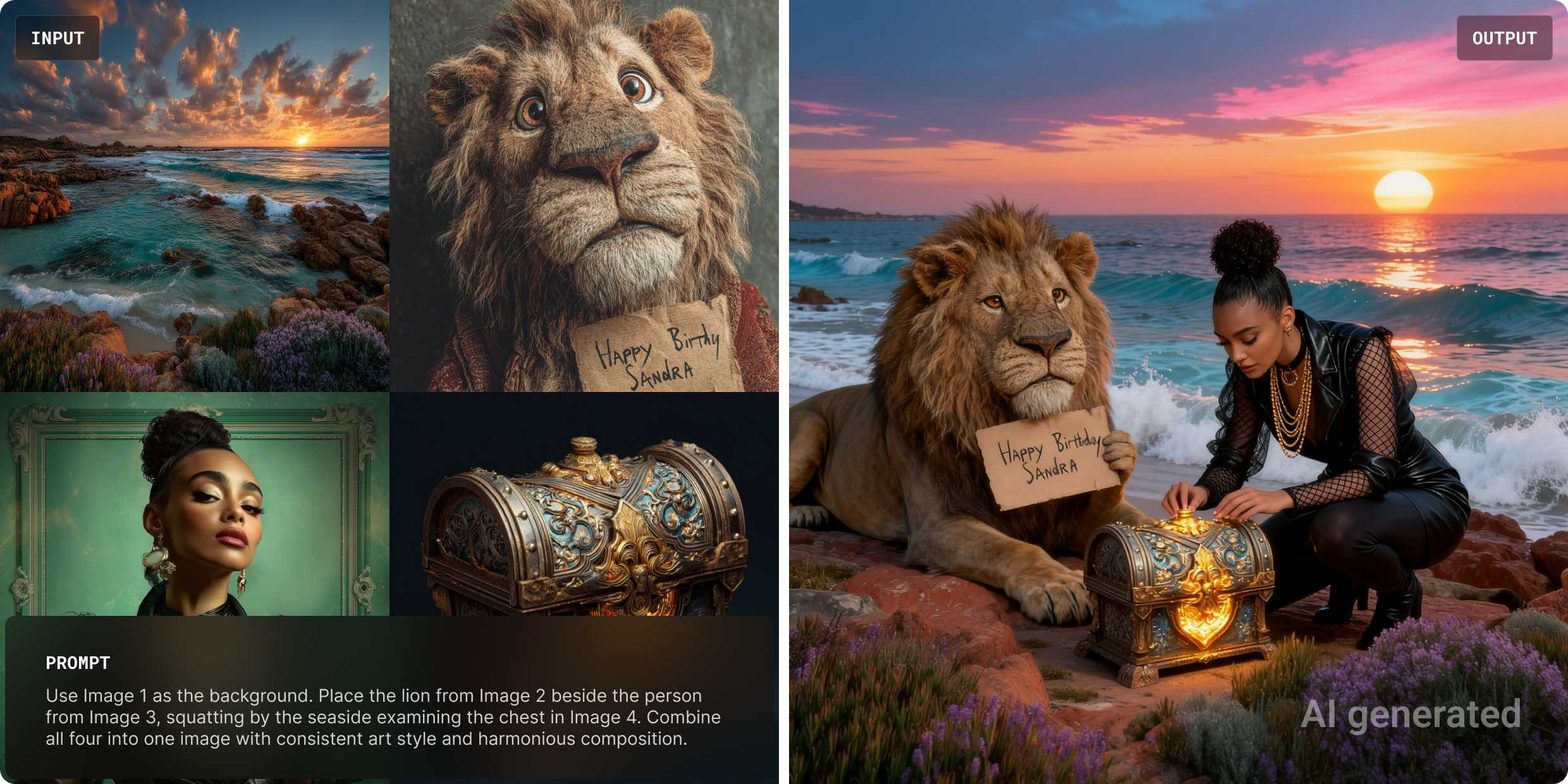
The model accepts multimodal inputs: users can provide text prompts (e.g., "place a starship in Hong Kong's Victoria Harbour at night") or combine up to six reference images for composite editing. The internal pipeline has three stages: first, a text encoder (based on a Transformer variant) parses prompts and extracts semantic features; second, a visual encoder processes reference images and produces embedding vectors; finally, an MoE decoder fuses both to output pixel‑level images. Unlike Gemini 2.5's lightweight design optimized for mobile (with roughly 1B parameters), Seedream 4.0's MoE enables deeper cross‑modal interactions, ensuring better anatomical consistency (e.g., human proportions) and physical realism (e.g., light and reflection). ByteDance has not disclosed exact parameter counts but estimates place it above 50 billion, and the training dataset reportedly spans hundreds of millions of annotated images and video frames with an emphasis on diversity to reduce bias.
On safety, Seedream 4.0 includes built‑in content filters that automatically detect harmful prompts (such as violent or NSFW content), with a reported refusal rate of 99%. This aligns with the requirements of the EU AI Act and offers compliance assurances for enterprise users.
Innovations: end‑to‑end experience from generation to editing
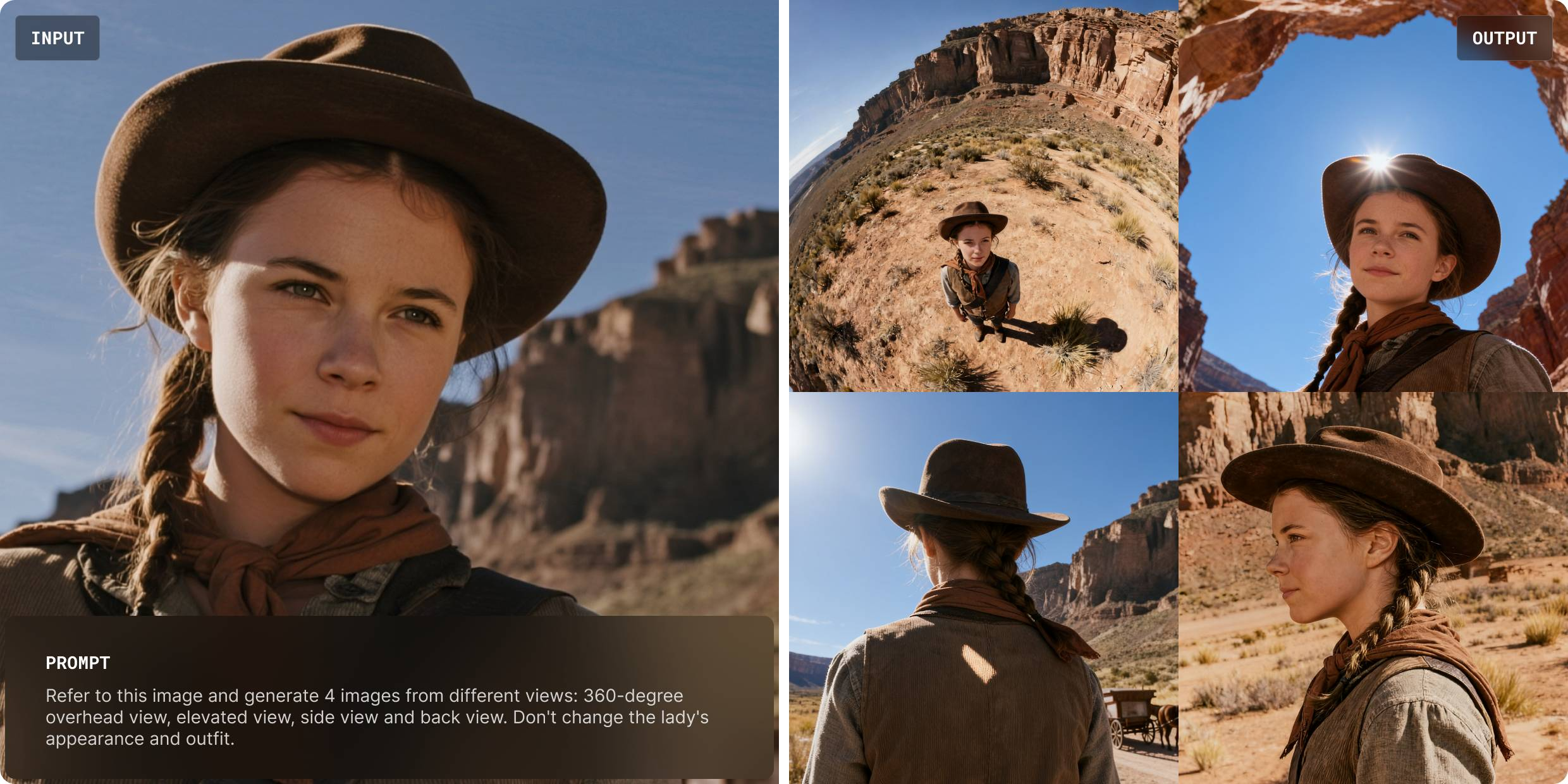
Seedream 4.0's standout feature is its "all‑purpose editing" capability, far beyond pure generation. Key innovations include four functions that enable users to create from scratch:
- Text‑driven editing: Users can describe changes like "change the background from forest to desert," and the model will intelligently add, remove or replace elements without breaking the overall composition. This relies on an "attention‑guided" mechanism: the model prioritizes prompt keywords and locally repaints pixels, avoiding the distortion caused by global regeneration. Compared with Nano Banana's simple filters, Seedream 4.0 supports fine‑grained edits—such as adjusting facial expressions or object materials—with an accuracy reported at 95%.
- Multi‑reference composite generation: Supports up to six reference images for "collage‑style" creation. For example, designers can upload a character sketch, a scene photo and a style sample to produce consistent comic panels. This addresses the "style gap" in traditional tools by using a cross‑image attention module to ensure consistent facial features and color schemes, suitable for IP design and sticker creation.
- Sequential image creation: For storyboards and animation, the model can generate multiple coherent images that maintain character continuity and stylistic consistency. A user prompt like "a knight's adventure in five panels" produces a narrative storyboard. This feature borrows from video‑generation techniques by introducing temporal attention layers to simulate transitions; generation time is only about 1.5× that of a single image.
- Style transfer and expansion: The model automatically extracts key qualities from reference images (such as artistic style or product details) and applies them to new outputs. It supports multiple aspect ratios (from 1:1 to 16:9) and outputs up to 4K resolution (4096×2160 pixels), far exceeding Nano Banana's 1080p limit. For beginners this works like an "intelligent brush": a prompt like "a modern city in Van Gogh style" yields a professional‑level result that blends historical art with contemporary elements.
These innovations upgrade Seedream 4.0 from an "image factory" to a "creative studio," lowering the entry barrier to simple text input while allowing advanced users to customize via API fine‑tuning.
Performance benchmarks: data‑backed advantages
ByteDance validated Seedream 4.0 with internal MagicBench benchmarks that simulate real‑world scenarios and assess prompt adherence, alignment (element‑position accuracy) and aesthetics (subjective visual appeal). Results show Seedream 4.0 scoring 92.5/100 on generation tasks and 90.8/100 on editing tasks, outperforming Gemini 2.5 Flash Image's 87.2 and 85.6. In the third‑party Artificial Analysis Text‑to‑Image Arena, Seedream 4.0 topped the chart with 1,450 points (compared with Nano Banana's 1,362) and led the Image Editing Arena by 15%. Versus OpenAI's GPT‑Image‑1, Seedream showed 12% higher style consistency and generation latency as low as 1.8 seconds per 2K image.
Speed is another advantage: leveraging MoE, the model achieves throughput of 500 images/hour on a standard GPU (such as NVIDIA A100), a tenfold improvement over the previous generation; although Nano Banana is fast on‑device (0.5 seconds on phones), its resolution and complexity are limited. On cost, Seedream 4.0's enterprise API is priced at $30/1,000 calls—about one‑third of Gemini's cost—making it suitable for SMEs. ByteDance acknowledges independent verification is pending but has invited third‑party testing, with reports expected by the end of September.
Impact and applications: reshaping the creative industries
Seedream 4.0's deployment is poised to significantly affect marketing, design and entertainment. For advertising agencies it can accelerate product visualization—input specifications and get multi‑angle renders in seconds, saving up to 80% of manpower. In comics and film storyboarding, the sequential feature enables startups to approach the output quality of large studios, with market growth projected at 20% by 2026. Consumers will benefit from CapCut integration (ByteDance's video editor), where a free tier supports basic generation and drives AI adoption in short‑video production. Challenges remain: data privacy (uploading reference images) and copyright (ownership of generated content) require regulation; ByteDance has pledged watermarking mechanisms.
On the global stage, this move strengthens Chinese AI exports: Seedream's API supports multiple languages and targets Southeast Asian markets, challenging Western dominance.
Conclusion: a "China moment" for AI imaging
Seedream 4.0 is more than a technical upgrade; it represents ByteDance's direct contest with DeepMind. With an efficient MoE backbone and end‑to‑end editing, it demonstrates that AI image tools can be both more accessible and more powerful. Seedream 4.0's launch signals that Chinese AI firms are aligning with leading global models across subfields. As open‑source trends continue, this model could become an industry benchmark and help democratize creativity. Technology moves forward—more surprises are expected.