
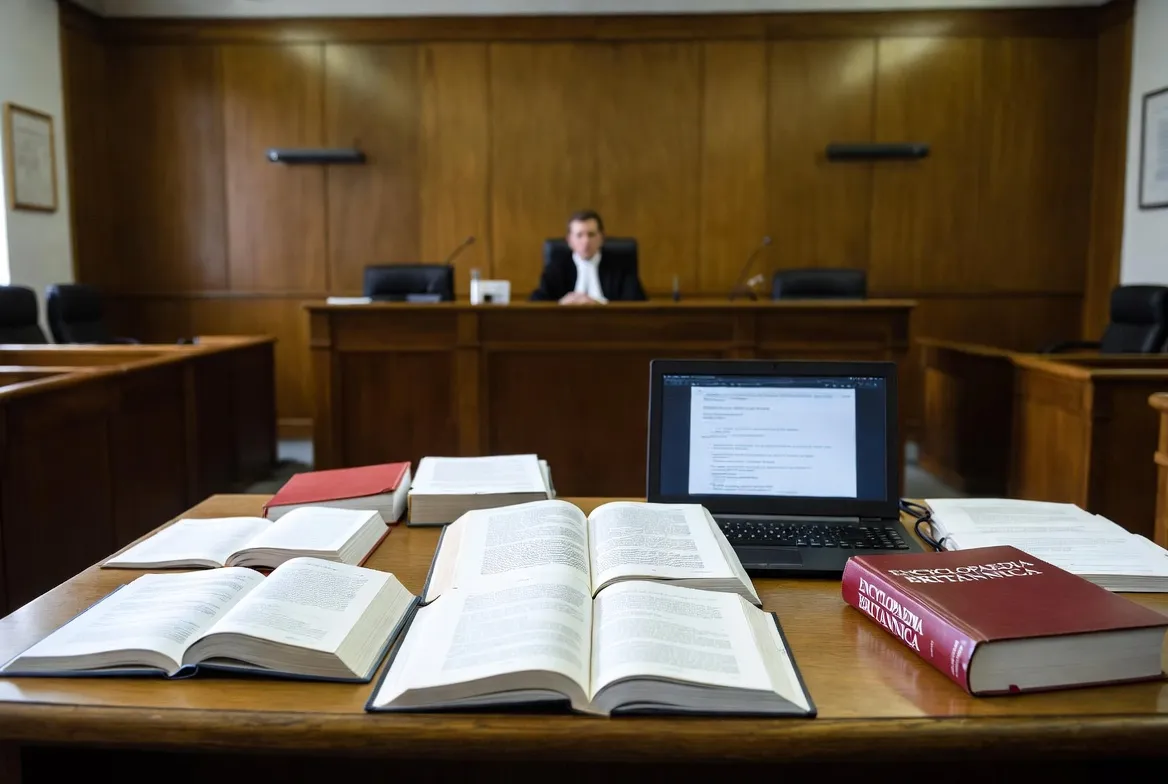
On March 13, 2026, the U.S. District Court for the Southern District of New York formally accepted a high‑profile copyright suit: Encyclopædia Britannica, Inc., the authoritative reference publisher with more than 250 years of history, and its subsidiary Merriam‑Webster, Inc. filed suit against OpenAI and several related entities, alleging that the defendants copied nearly 100,000 online articles without permission to train the GPT series of large language models (LLMs) and that ChatGPT produced outputs that were "virtually verbatim," thereby "eroding" the plaintiffs' website traffic and misleading the public. Industry observers view the suit as the latest climax in the copyright battle between AI creators and content owners, following lawsuits by The New York Times, several newspaper groups and authors’ collectives, and refocusing debate on whether training data qualifies as fair use.
Why did the longtime encyclopedia take action? Details of the core allegations
Founded in 1768, Encyclopædia Britannica is the oldest continuously published general encyclopedia in the English language and has long been known for rigorous fact‑checking and high‑quality content. In the digital era its online platform accumulated a large body of copyrighted collective works, including encyclopedia entries, feature articles and Merriam‑Webster dictionary definitions. The complaint alleges that OpenAI systematically copied the plaintiffs' nearly 100,000 online articles (covering at least 13 collective works registered for copyright) via publicly scraped datasets such as Common Crawl and WebText to train GPT‑3, GPT‑3.5, GPT‑4 and subsequent models.
The plaintiffs set out three specific forms of infringement:
- Mass copying during the training phase: OpenAI used the plaintiffs' content as training input to create model parameters that can "emulate" the plaintiffs' style and content.
- Ongoing infringement via RAG (retrieval‑augmented generation): ChatGPT, when responding to user queries, allegedly retrieves and incorporates the plaintiffs' recent content as context, further perpetuating the infringement.
- Direct copying in outputs: ChatGPT frequently generates content that is a "complete or partially verbatim reproduction," "close paraphrase," or an abridged summary, and in some cases reproduces the plaintiffs' unique ordering of lists and quotations.
The complaint includes multiple screenshots as evidence: for example, when a user prompts "Education," ChatGPT's output closely mirrors Encyclopædia Britannica's "Education" entry (omitting only some paragraphs); the "Tourism" entry likewise shows near‑copying with added hallucinations; a query for "plagiarize" returned Merriam‑Webster's precise definition; and in a feature on the "Hamilton–Burr duel," ChatGPT reportedly reproduced the plaintiff's carefully curated sequence of ten quotations in full.
In addition, the plaintiffs allege violations of the Lanham Act trademark provisions: ChatGPT allegedly attributes content falsely to Encyclopædia Britannica in hallucinated outputs or omits attribution in a way that misleads users into believing the output is officially authorized, constituting trademark dilution and false designation of origin.
Relief sought and wider impact: beyond money, the credibility of information is at stake
The plaintiffs ask the court to order OpenAI to pay actual and statutory damages, disgorgement of unjust enrichment, and to permanently enjoin the infringing conduct. The complaint argues that this "erosion" has caused substantial commercial harm—the users who would have visited the plaintiffs' sites for authoritative information are instead served free AI summaries, resulting in lost traffic and advertising revenue. A deeper concern is that AI hallucinations may spread misinformation, threatening the public's long‑term reliance on high‑quality, trusted sources.
The allegation is not isolated. In September 2025, Encyclopædia Britannica sued AI search engine Perplexity AI on nearly identical grounds; that case remains pending. Previously, The New York Times sued OpenAI seeking billions in damages, and several U.S. newspapers (including the Chicago Tribune and The Denver Post) and Canadian outlets have joined similar actions. Groups of writers (including Sarah Silverman and others) have also filed collective suits, all focused on the alleged unauthorized use of training data.
OpenAI's likely response and the fair‑use debate: technical innovation vs. intellectual property protection
As of this filing, OpenAI has not issued a formal public response to this particular case. In prior disputes, OpenAI's consistent position has been that its models are trained on publicly available data and that such training constitutes fair use that promotes innovation and knowledge dissemination. The defense centers on the claim that the training process is a "transformative" use and that model outputs are not simple reproductions but newly generated patterns learned from massive datasets, analogous to human reading and subsequent creation.
However, case law remains unsettled. In a 2025 case against Anthropic, a judge found that illegally downloading books for training was unlawful, but took a more open view toward training on publicly available data; Anthropic ultimately reached a $150 million settlement with authors. Legal experts note the key issue in the current case will be whether OpenAI can satisfy the four‑factor fair‑use test (purpose and character, nature of the work, amount and substantiality, and market effect). The plaintiffs emphasize that commercialized ChatGPT directly replaces their content and has a substantial market impact, arguing this undercuts a fair‑use defense.
Industry shockwaves: is a "copyright barrier" era for AI training data arriving?
The suit highlights a core industry pain point—the legality of training data sources. As model parameter counts continue to grow (with GPT‑4o exceeding trillions), publicly available internet data may no longer meet demand. Content creators fear that if AI companies can freely "digest" vast copyrighted works, the business models of traditional publishers, news organizations and encyclopedias could collapse; conversely, strict licensing requirements would sharply raise AI training costs and could slow technological progress.
Optimists say such litigation could spur the creation of a content licensing market in which publishers and AI firms negotiate paid agreements (OpenAI has already reached deals with some media outlets), achieving mutual benefit. Pessimists warn that a plaintiff victory could trigger a wave of lawsuits worldwide or force models to rely on synthetic data or aggressively filtered training sets.
For everyday users, the case matters. Tools like ChatGPT have become staples for information retrieval, but if output quality relies on unauthorized authoritative content, a long‑term trust crisis may emerge. The public will need clearer source‑attribution mechanisms for AI systems rather than vague or misleading hallucinated attribution.
Conclusion: the boundaries of copyright in the AI era need clarification
Encyclopædia Britannica's lawsuit against OpenAI is not only a defense of its 250 years of intellectual property but also a stand by traditional knowledge keepers against an era of perceived "free lunches" for AI. The court's ruling could become a milestone: a win for the plaintiffs may usher in a "pay to train" era for AI; a win for OpenAI could expand the boundaries of fair use, accelerating innovation while deepening tensions with content creators.
As AI capabilities continue to leap forward in 2026, this lawsuit is a reminder to industry and regulators that technological progress must not come at the expense of intellectual property rights and the information ecosystem. Whatever the outcome, the case will profoundly shape the future relationship between AI and human knowledge creation.
▶️ Enjoy this story? Creating content takes real effort!
Follow our YouTube channel:
AI Rosetta
Your likes, subscriptions and shares are our greatest support! 🙏
More AI news at: https://www.airosetta.com