
Around October 24, 2026, Jack Dorsey’s Block officially unveiled a new voice model, Dessa. Developed by a small internal AI research lab at Block, the model’s central claim is clear: it was trained from scratch solely on human conversational audio, does not rely on any text corpora, nor uses a pretrained large language model as a base; it supports full‑duplex real‑time dialogue, can run locally on consumer devices, and demonstrates rich emotional and prosodic behaviors such as laughter, pauses, crying and sighs.
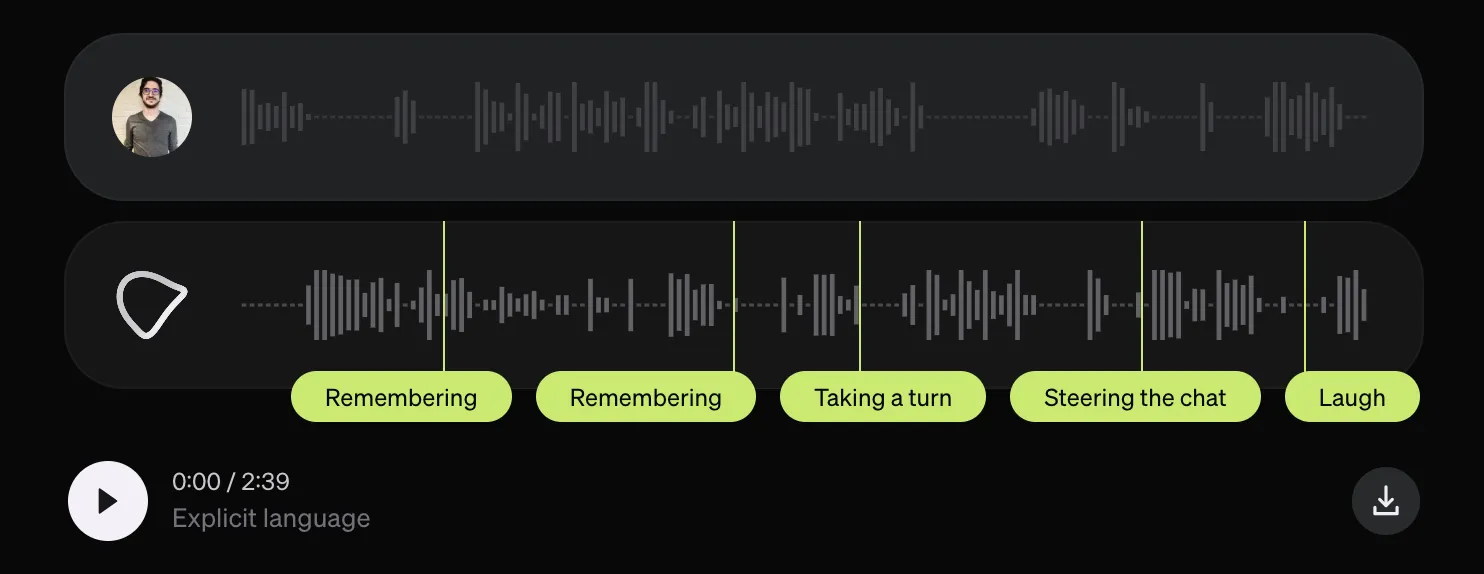
Dessa is currently released as a research preview, with early access prioritized for AI security researchers and a public waitlist available. The company has not published model weights, API endpoints, or commercial pricing.
Technical positioning: speech‑to‑speech, bypassing text intermediaries
Unlike mainstream voice assistants, Dessa uses a genuine speech‑to‑speech architecture—audio in, audio out—without the traditional pipeline of “speech→text→large model→text→speech.” Block emphasizes that this design better preserves emotional cues, sarcasm, pauses and paralinguistic information that are often lost in text intermediaries, causing existing voice AI to sound stiff and noticeably delayed.
The model supports full‑duplex communication—continuously listening while speaking—allowing it to naturally interject and emit feedback tokens like “yeah” or “got it,” emulating the interactive rhythm of real human conversation. In official demo audio, Dessa produces laughter, choking up, tone variations, and some exchanges were described as “a bit awkward but more human‑like.”
According to Block, Dessa was trained from scratch on human conversational recordings using “hundreds of times fewer tokens than large language models,” and training was completed on a single NVIDIA GB200 NVL72 rack (approximately 72 Blackwell GPUs). Inference can run locally on a MacBook Pro with M4 Max or higher, and Block claims it runs faster than real‑time.
Team background and release approach
Dessa comes from a very small internal research lab at Block, formed by former members of Dessa (a Toronto deep‑learning startup acquired by Square/Block in 2020). Lab lead Ragavan Thurairatnam said the team has worked in deep learning since 2012 and has focused on generative voice models for over eight years, reporting directly to Dorsey. Dorsey himself reposted on X, calling it “the most realistic full‑duplex voice model ever,” while emphasizing its small size—capable of running on a MacBook.
In terms of release, Block did not simultaneously publish a technical report, parameter counts, training data volume, or public benchmarks; instead, the announcement consisted mainly of official demo recordings and a waitlist. Early access is prioritized for security researchers to surface potential risks (such as voice spoofing or emotional manipulation).
Objective assessment and potential implications
Dessa’s core selling points are “purely voice‑based training” and “on‑device operation.” If the claims hold, it represents a fundamentally different technical route from the mainstream “text large model + TTS” approach: learning language and interaction patterns directly from speech, which could offer advantages in emotional expression and naturalness while reducing reliance on cloud large models.
For users and developers, local deployment means lower latency, greater privacy and offline availability, which has practical value in payments, customer service and personal assistant scenarios. As the parent company of Square and Cash App, Block could potentially integrate such capabilities into its financial and social products.
However, there remain clear information gaps:
- Lack of independent benchmarks and third‑party verification; true dialogue quality, robustness and multilingual capabilities remain to be tested;
- Parameters, training data scale and specific architecture have not been disclosed, making it difficult to assess its level relative to existing voice models;
- Currently limited to a research preview and still far from wide availability;
- While pure speech training may preserve more emotional cues, it may lag behind text‑pretrained models in knowledge breadth, logical reasoning and factual accuracy.
Highly realistic emotional speech also raises new safety and ethical concerns—such as voice cloning, emotional manipulation or fraud. Block’s outreach to security researchers acknowledges this potential risk.
Industry context and outlook
Voice AI is evolving from merely being able to listen and speak toward being more natural, more emotionally expressive and more real‑time. Full‑duplex models like OpenAI’s GPT‑Live have advanced real‑time interactions, while Dessa takes the path of completely bypassing text, aiming to address emotional loss and latency at a fundamental level. The claim that a small team with relatively modest compute achieved usable dialogue capabilities has also sparked debate over whether voice models require massive text datasets.
Overall, Dessa is a release with a clear technical proposition: trained on purely human speech data, pursuing on‑device operation and emotional realism. Whether it can truly change the voice interaction paradigm depends on subsequent disclosure of technical details, independent evaluations, and progress from research preview to product deployment. In an increasingly crowded AI voice field, Block’s choice to compete on a “smaller, more local, more human‑like” differentiation is itself a signal worth watching.
▶️ Like this article? Creating it takes a lot of work!
Subscribe to our YouTube channel:
AI Rosetta
Your likes, subscriptions and shares are our greatest support! 🙏
For more AI news visit:
https://www.airosetta.com