
July 23, 2026, German AI startup Black Forest Labs (BFL) announced the Early Access launch of FLUX3, a multimodal foundation model. The model uses a unified architecture to jointly learn image, video and audio, building on an extended Self‑Flow (self‑supervised flow matching) framework. Following the FLUX.1 and FLUX.2 series, it further achieves deep integration of multimodal generation and understanding. FLUX3 can output videos up to 20 seconds with native audio in a single generation, supports various creative modes, and showed comprehensive advantages over leading models in human evaluations.
Core technologies and architectural innovations
The core of FLUX3 is a unified multimodal representation. Unlike conventional approaches that handle image, video and audio with separate models, it trains the three modalities synchronously within the same weights and architecture, aiming to learn a unified representation of the "world" rather than treating signals in isolation.
Its technical basis is BFL's Self‑Flow framework. Self‑Flow combines a flow‑matching objective with self‑supervised feature reconstruction, enabling efficient alignment of multimodal generation and understanding without relying on external models or extra supervision. By substantially scaling compute and data, FLUX3 trains video, image and audio jointly, making the leap from single‑modality to truly joint multimodality.
The model supports rich creative modes, including:
- Text‑to‑Video
- Image‑to‑Video
- Video‑to‑Video
- Video and audio continuation
- Keyframe‑to‑Video
- Multilingual dialogue‑driven generation
- Multi‑shot sequential storytelling
Single‑generation outputs can reach up to 20 seconds with native audio, with practical resolutions such as 720p, significantly improving content coherence and immersion.
Performance: leading in human evaluation
In human evaluations of 10‑second 720p videos with audio, FLUX3 performed strongly:
- Vs Grok Imagine Video: win rate 69%
- Vs Seedance 2.0 and Gemini Omni Flash: win rate 52% each
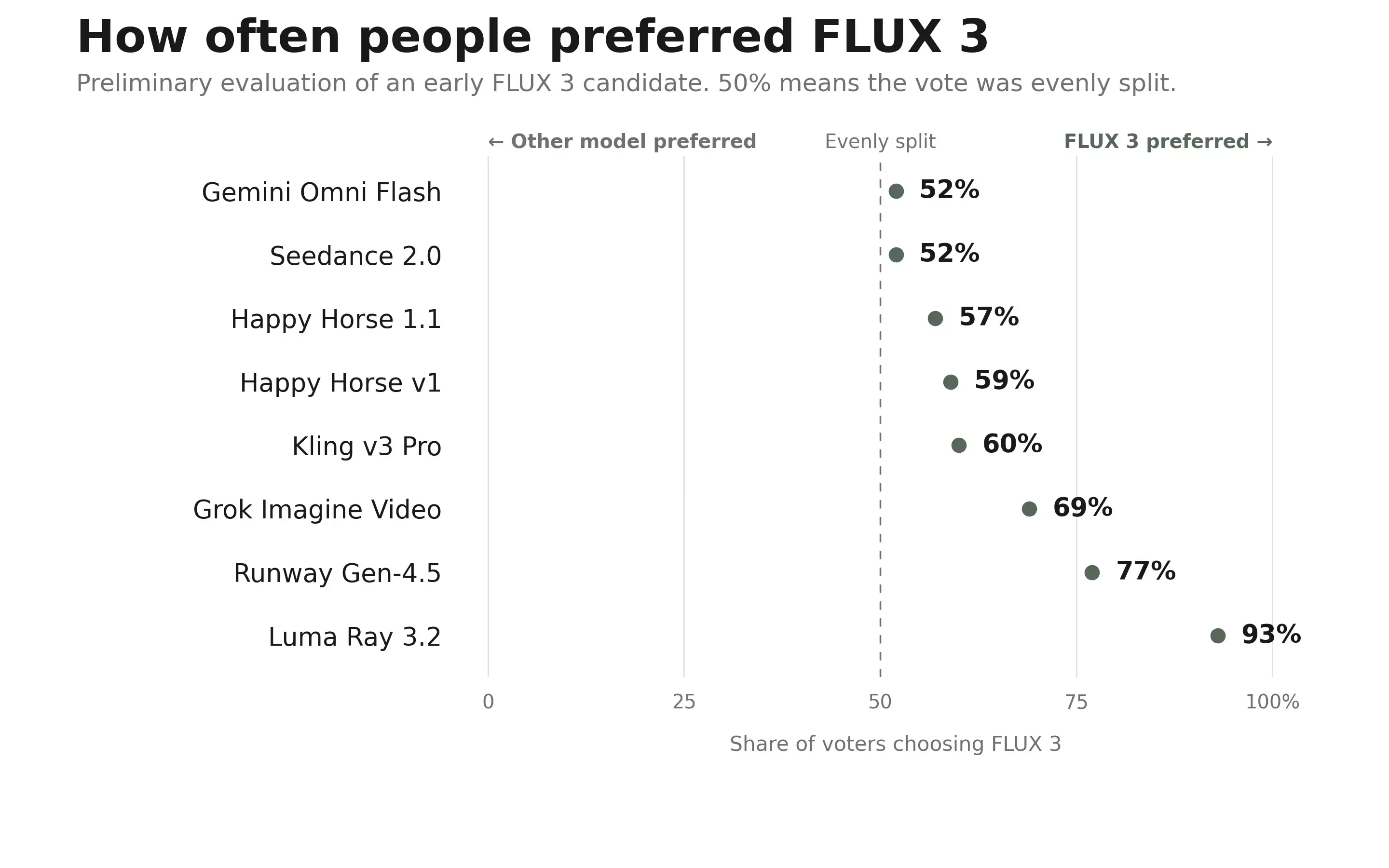
These results reflect its comprehensive advantages in video quality, audio‑visual synchronization, motion coherence and overall realism. BFL emphasizes that all capabilities come from the same underlying multimodal flow‑matching model, rather than patching together multiple specialized systems, which yields stronger cross‑modal consistency.
Details and release strategy
FLUX3 is currently available as Early Access for developers and creators. BFL simultaneously published a technical blog and related research detailing Self‑Flow implementation, and open‑sourced part of the reference code (Apache‑2.0). The model is also extended toward action prediction, laying groundwork for robotics and embodied intelligence applications.
As the third generation of the FLUX series, FLUX3 continues the series' strengths in generation quality and controllability while addressing the common 'modal separation' problem in previous multimodal systems. The unified architecture uses the same representation space when understanding inputs (image/video/audio) and generating outputs, helping reduce cross‑modal hallucination and improving controllability for creators.
Potential impact: reshaping the multimodal generation landscape
1. Impact on content creation industry FLUX3 will significantly lower the barrier to producing high‑quality audio‑video content. Advertising, film previsualization, short video, and game cutscenes can generate coherent clips with native audio directly from text or reference material, reducing post‑production voiceover and editing costs. Multi‑shot sequencing and continuation are particularly suited for narrative content creation.
2. Impact on AI model competition In the video generation track, FLUX3's unified architecture challenges the prior landscape dominated by specialized video models (including some closed‑source systems). Its leading performance in human evaluations may push competitors to accelerate multimodal fusion development. Open‑sourcing parts of Self‑Flow will also encourage academic and open‑source community follow‑up.
3. Impact on developers and the application ecosystem Early Access enables rapid feedback and iteration. Developers can build more complex applications (e.g., interactive video dialogue, real‑time continuation tools) on a single unified model without maintaining multiple modality‑specific pipelines. Adding action prediction expands potential use in robotics, simulation and embodied AI.
4. Potential challenges and risks
- Compute and cost: Joint multimodal training and long‑video generation are compute intensive and deployment costs will need ongoing optimization.
- Controllability and safety: Native audio and long‑video generation may introduce new misuse risks; content moderation and watermarking mechanisms will become more important.
- Ecosystem maturity: Features and stability in Early Access still need validation; large‑scale commercial deployment will take time.
Industry takeaway: unified multimodality is the next key step
Black Forest Labs demonstrates with FLUX3 that a true multimodal foundation model should not be a simple "image model + video model + audio model" stack, but should jointly learn world representations within a unified architecture. The self‑supervised flow‑matching path provided by Self‑Flow offers a replicable paradigm for efficiently scaling multimodal capabilities.
With FLUX3 entering Early Access, multimodal generation is moving from "can generate" to "generate more realistically, coherently and controllably." For creators, developers and the AI industry, this is both a tooling upgrade and the start of a shift in creative paradigms. In future, unified multimodal models may become core infrastructure for content generation and embodied intelligence.
▶️ Enjoy this article? Creating content is hard!
Follow our YouTube channel:
AI Rosetta
Your likes, subscriptions and shares are our biggest support! 🙏
More AI news at: https://www.airosetta.com