
On the morning of April 19, 2026 at 7:30, the 2026 Beijing Yizhuang Humanoid Robot Half Marathon, jointly organized by the Beijing Municipal Government, China Media Group and others, fired the starting gun at Kechuang 17th Street by Tongming Lake in Yizhuang. This is the world’s first large‑scale humanoid robot half‑marathon, attracting more than 100 teams and over 300 humanoid robots to compete, and was held concurrently with the Beijing Yizhuang Half Marathon for “human‑machine co‑running.” Honor Robot Team’s “Lightning” crossed the line first with a net time of 50 minutes 26 seconds, sweeping the top three and substantially surpassing the human half‑marathon world record (56 minutes 42 seconds), becoming the event’s biggest highlight.
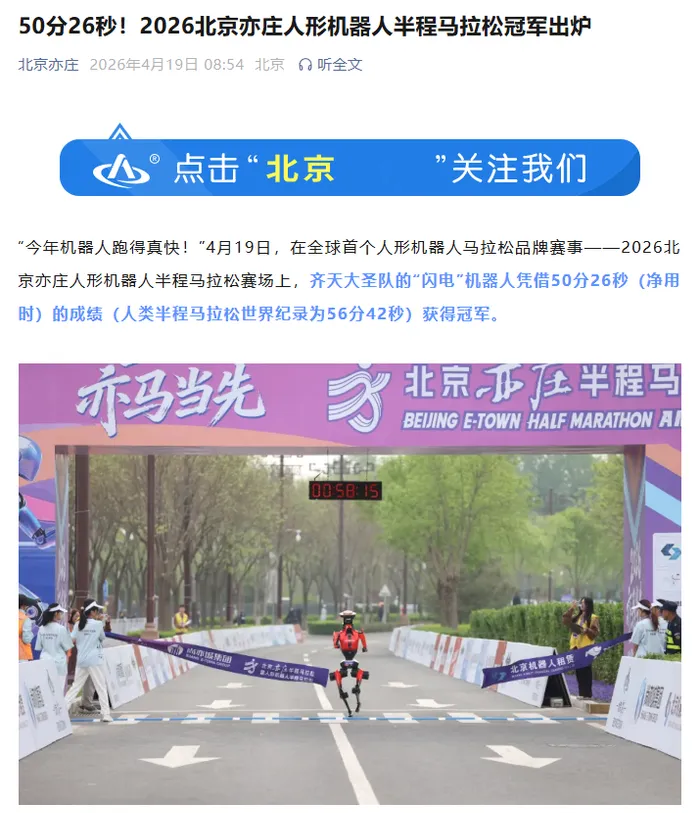
The event, themed “Yima Leads the Way,” covered a 21.0975 km course incorporating city arteries, an international car racing circuit and parkland, featuring slopes and turns that placed high demands on robots’ balance control, motion planning and environmental adaptability. The competition was divided into autonomous navigation and remote‑control categories, ranked jointly and weighted with coefficients of 1.0 and 1.2 respectively, aiming to advance humanoid robots from laboratories to real‑world applications.
Honor “Lightning” technical highlights: high‑dynamic locomotion system and autonomous perception and navigation
The Honor “Lightning” stands 169 cm tall, featuring a mech‑inspired design that balances aerodynamics and visual impact. Its core strengths lie in a proprietary high‑dynamic locomotion system and autonomous perception and navigation. During the race, “Lightning” demonstrated high‑speed running and strong terrain negotiation, stable motion and rapid responsiveness, robust power and long endurance. It also interacted with spectators via light strips and signature gestures, showcasing a positive human‑machine interaction experience.
According to Honor’s technical team, “Lightning” is equipped with multiple advanced technologies:
- High‑dynamic locomotion system: Advanced servo drives and joint control algorithms enable quick starts, abrupt stops and adaptation to complex terrain, significantly improving running efficiency and stability.
- Autonomous perception and navigation: Integrated high‑precision sensors and real‑time decision modules allow autonomous path planning, obstacle avoidance and posture adjustment on complex courses without external remote control.
- Liquid‑cooling thermal management: A “mini backpack” design houses liquid‑cooling ducts reaching deep into the motors, with heat‑exchange flow exceeding 4 liters per minute, effectively addressing cooling under high‑intensity operation and ensuring long‑term stable performance.
These innovations had already shown “Lightning” could complete 21 km in about an hour in full‑element test runs, and the official race time of 50:26 validated Honor’s accumulated technologies in embodied intelligence.
Event significance: from technical validation to industrial implementation
This humanoid robot half‑marathon is the world’s first large‑scale humanoid road race, with nearly five times as many teams as last year and a notable increase in international participation. The event not only tested robots’ mobility, endurance and interaction capabilities in real and complex environments, but also provided important data references and directions for standardization within the industry.
As a national‑level economic and technological development zone, Beijing Yizhuang is actively laying out the humanoid robot industry. Hosting the event further highlighted Yizhuang’s industrial advantages in robotics and offered a platform for global robot companies to showcase their work. Honor, as a leading domestic company, demonstrated the rapid rise of Chinese firms in embodied intelligence by sweeping the podium with “Lightning.”
Industry impact: acceleration of humanoid robot commercialization
Lightning’s strong performance marks an important step from “laboratory demonstrations” to “real‑world applications” for humanoid robots. After the event, multiple companies said they would accelerate commercialization efforts, focusing on logistics, manufacturing, healthcare and emergency response. Industry observers noted that breakthroughs in high‑dynamic locomotion systems and autonomous navigation will significantly reduce deployment costs and drive the sector from technical validation toward scaled production.
At the same time, the event also exposed common challenges facing current humanoid robots: endurance, adaptation to complex terrain and cost control still require further optimization. In the future, with more companies joining and standards gradually established, humanoid robots are expected to achieve large‑scale application in a wider range of scenarios.
Conclusion: a milestone for China’s robotics industry
The successful hosting of the Beijing International Robot Half Marathon and Honor “Lightning”’s podium sweep and human‑record‑breaking performance are not only a highlight for China’s robotics industry but also offer a Chinese approach to embodied intelligence development globally. They demonstrate that with policy support, technological accumulation and industrial collaboration, Chinese companies have made the critical leap from following to leading in humanoid robotics.
Going forward, with more similar events and continuous technological iteration, humanoid robots will gradually enter households and become an important part of production and lifestyles. Honor “Lightning”’s victory is only the starting point for China’s robotics industry setting sail; more innovations and breakthroughs are on the way.
▶️ Enjoy this article? Creating content is hard work!
Follow our YouTube channel:
AI Rosetta
Your likes, subscriptions and shares are our greatest support! 🙏
For more AI news please visit: https://www.airosetta.com