
On the evening of August 22, 2026, the 2nd World Humanoid Robot Games officially opened at Beijing National Speed Skating Oval (the "Ice Ribbon"). Co‑hosted by the Beijing Municipal People’s Government and China Media Group, the event attracted 666 teams from 16 countries across six continents, with a total of 2,056 humanoid robots competing. The competition runs through August 26 and features 51 events and 1,301 matches, a substantial increase from the inaugural edition. During the opening ceremony and early competitions, several Chinese humanoid robots repeatedly broke human world records, drawing global attention.
Event Details and Record‑Breaking Performances
The program expanded from 26 events in the first edition to 51 events this year, including 30 competitive events and 21 scenario‑based events. Competitive events added high‑intensity confrontational items such as long jump, weightlifting, tug‑of‑war, and table tennis; scenario events simulate real‑world applications such as households, hotels, logistics, and emergency rescue, focusing on robots’ autonomous perception, decision‑making, and service capabilities. The number of participating teams rose 138% year on year and the number of robots quadrupled. Domestic companies, universities, and research institutes dominated, while international teams from the United States, Germany, Japan, Brazil and others also took part.
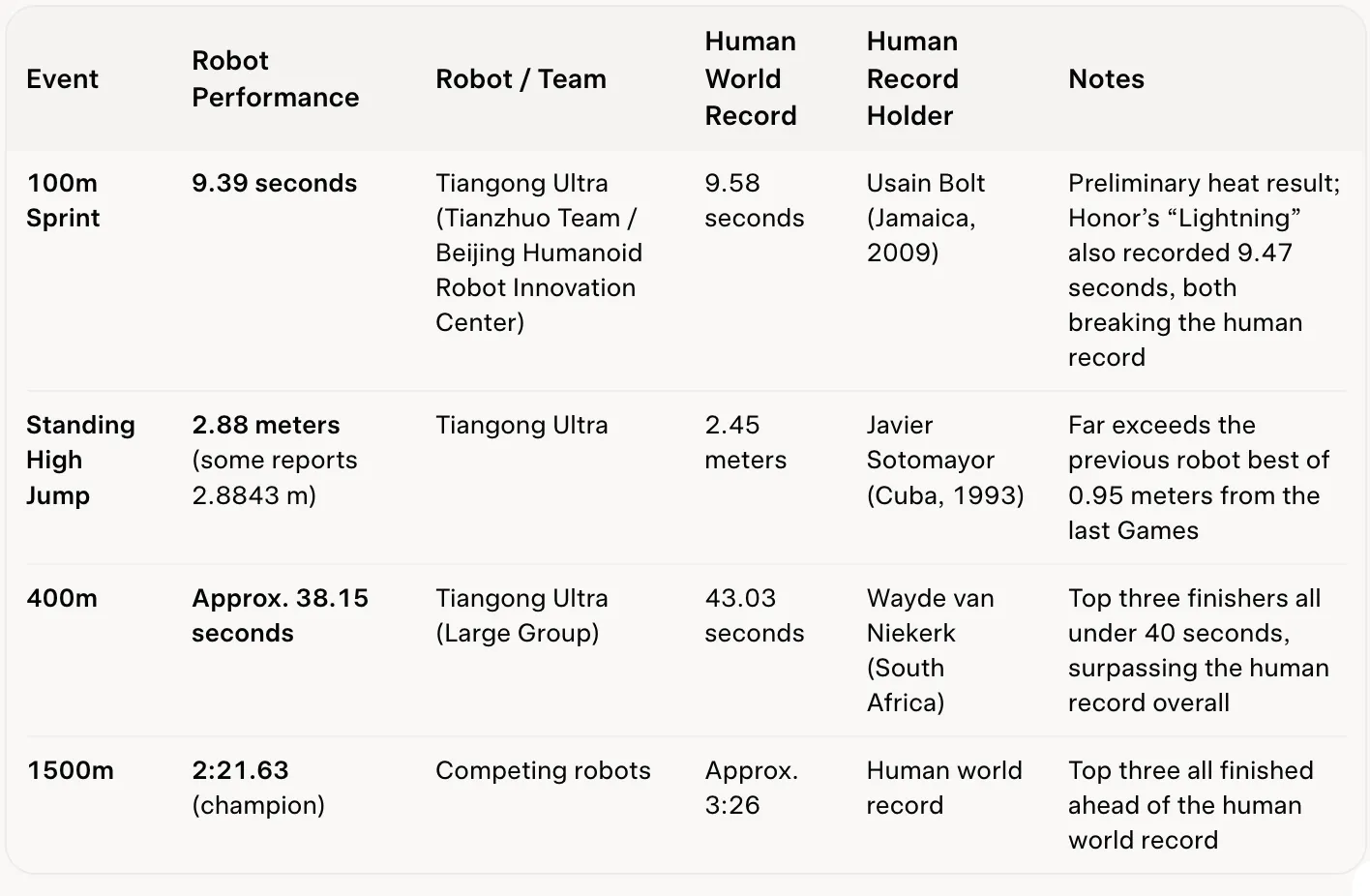
Record‑breaking performances in track‑and‑field‑like events were particularly striking. To date, the records broken include:
- 100 meters: The Tiangong Ultra robot from Team Tiangong ran 9.39 seconds in the heats, surpassing Usain Bolt’s human world record of 9.58 seconds. Honor’s "Lightning" robot also completed the race in 9.47 seconds, likewise breaking the human record. This is a marked improvement compared with the best result of 21.50 seconds from the first edition.
- Standing high jump: Tiangong Ultra jumped 2.88 meters (reported in some outlets as 2.8843 m), far exceeding the human men’s standing high jump record of 2.45 meters and greatly surpassing last edition’s best of 0.95 meters.
- 400 meters: In the large‑group final, the top three all finished under 40 seconds, with the winner clocking about 38.15 seconds, faster than the human world record of 43.03 seconds.
- 1500 meters and other events also saw robot results ahead of human records.
These results were achieved under fully or highly autonomous control, with some race segments judged and executed independently by the robots, demonstrating integrated progress in joint motors, reducers, balance control, and AI decision‑making.
Technical Background and Industrial Significance
The Humanoid Robot Games follow the principle of "promote research and production through competition," advancing large models in environmental perception, independent decision‑making, and embodied execution. Scenario events directly connect to household services, commercial applications, and emergency responses, accelerating technology transfer from laboratories to real‑world deployment. During the event, robots competed not only on speed and strength but also on coordination, dexterity, and practicality, marking China’s shift from follower to partial leader in the humanoid robot field.
Models such as Tiangong Ultra were developed by institutions including the Beijing Humanoid Robot Innovation Center. By optimizing mechanical design, core components, and control algorithms, they have improved both explosive power and stability. The leap from roughly 21‑second 100m performance to breaking human records within a year reflects the rapid co‑evolution of hardware iterations and software intelligence.
Potential Impacts: Technical Breakthroughs and Industrial Acceleration
1. Impact on robot technology development — The record‑breaking performances validate the feasibility of current humanoid robots in dynamic balance, high‑explosive movement, and autonomous control, providing confidence for tackling more complex tasks (such as difficult terrain traversal and fine manipulation). The Games serve as a testing ground for pushing the limits of algorithms and hardware, promoting further optimization of joints, sensors, and large‑model decision systems.
2. Impact on industry and application deployment — The event’s expanded scale and increased international participation help form technical standards, talent exchange, and supply‑chain collaboration. The practical orientation of scenario events will speed commercialization in household service, logistics, and manufacturing. The concentrated presence of Chinese companies and universities also strengthens domestic influence in the global humanoid robotics track.
3. Impact on the global competitive landscape — Multiple human records being broken demonstrates China’s rapid progress in embodied intelligence and may prompt traditional robotics powers in the U.S., Japan, and Europe to increase investment. At the same time, the Games’ openness and international participation encourage technical cross‑fertilization and cooperation.
4. Potential challenges
- The record‑breaking results are mainly concentrated in structured athletic events; performance in complex, unstructured environments and long‑term reliability still require validation.
- Energy consumption, cost, safety, and human–robot collaboration standards remain key barriers to large‑scale deployment.
- Public ethical concerns and social acceptance of robots "surpassing humans" will require ongoing guidance.
Industry Takeaway: From Competition to Practicality
The 2nd World Humanoid Robot Games were not only a technological spectacle but also a microcosm of China’s embodied intelligence industrialization. In just one year, robots progressed from "being able to walk" to "breaking records," reflecting systematic breakthroughs in algorithms, hardware, and system integration. Going forward, as scenario events deepen and technology iterates, humanoid robots are likely to deliver real value across more production and daily‑life domains.
The Games test limits through competition and align scenario applications with real‑world needs, providing a clear "competition‑to‑application" pathway for humanoid robot development in China and globally. The breaking of multiple human records is both a technical milestone and a new starting point for wider deployment.
▶️ Enjoyed this article? Creating great content takes effort!
Subscribe to our YouTube channel:
AI Rosetta
Your likes, subscriptions and shares mean the world to us! 🙏
For more AI news, visit:
https://www.airosetta.com