
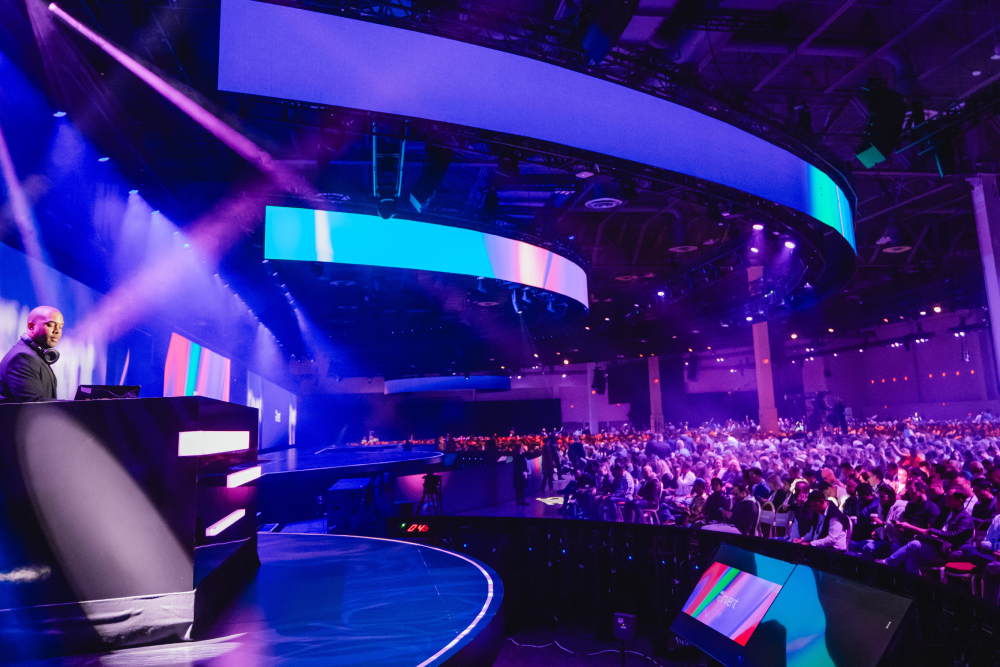
Under the neon lights of Las Vegas, AWS re:Invent 2025 ran from December 1 to 5 and concluded successfully. The cloud computing industry's marquee event drew over 60,000 developers, enterprise executives and partners, a record attendance. As the annual report card for Amazon's cloud strategy, this year's conference centered on the "Agentic AI" theme. AWS CEO Matt Garman said in the opening keynote: "AI agents will reshape enterprise productivity much like the internet or cloud computing did." During the event AWS unveiled more than 50 major innovations spanning AI models, chip infrastructure, agent frameworks and core service optimizations, with total investments reaching into the tens of billions of dollars. TechCrunch described this re:Invent as a pivotal move for AWS "from cloud provider to AI ecosystem architect," emphasizing enterprise customization and sustainable computing. On X, the #AWSreInvent2025 topic exceeded five million views, with users debating that the combination of Trainium3 and Nova 2 could upend large model training. Against the backdrop of U.S.–China tech decoupling and an intensifying global AI race, these announcements not only reinforce AWS's roughly 31% cloud market share but are also poised to significantly influence enterprise digitalization and sustainability pathways. This article analyzes the event's highlights, drivers and implications based on the AWS official blog, TechCrunch and real‑time feedback on X.
AI models and agent frameworks: the leap from "tool" to "autonomous entity"
The soul of re:Invent 2025 was the "autonomization" of AI agents. Swami Sivasubramanian (VP, Data and AI) introduced Amazon Bedrock AgentCore in a dedicated keynote. AgentCore is an open‑source framework that supports multi‑step decision‑making and autonomous execution. It integrates Policy evaluation (Preview) and Evaluations tools to simulate "days of autonomous work," such as automated supply‑chain forecasting or code review. Specifically, the Policy module lets enterprises set operational boundaries (for example budget thresholds or compliance checks), while Evaluations uses experiential learning to refine agent behavior while maintaining natural conversational flow. AWS claims this yields a 66% improvement in task accuracy over traditional LLM approaches. Kiro Autonomous Agent (Preview) is an enterprise deployment example that combines AWS Security Agent and DevOps Agent to enable zero‑trust deployment and CI/CD automation — for instance, agents can independently remediate vulnerabilities or optimize DevOps pipelines, reducing human intervention by 40%.
Model upgrades are the agents' "fuel." The Amazon Nova 2 series reached full GA, with Nova 2 Sonic as the flagship: a speech‑to‑speech model supporting multilingual conversations, dynamic voice control and cross‑modal inputs (such as text plus images). Compared with Nova 1, Sonic's context retention improves by 50%, making it suitable for call centers and real‑time interactions and reducing "forgetting." Nova 2 Omni expands into multimodal generation and integrates with Amazon Bedrock to support enterprise‑customized agent training. Nova Forge (GA) further opens training tools, allowing users to upload private data to fine‑tune models; pricing examples were given at $2 per million input tokens and $12 per million output tokens (with doubling beyond 200k tokens). In his keynote, Garman demonstrated that Nova 2 can shorten training time for a Llama 3.1 405B model by 40% and reduce cost by 30%. In addition, Amazon Bedrock Reinforcement Fine‑Tuning supports reinforcement learning fine‑tuning with an average accuracy improvement of 66%. Amazon SageMaker AI Serverless Customization and HyperPod introduce serverless training and elastic scaling, reducing recovery times from hours to seconds.
These innovations stem from AWS's strategic bet on the "agent era." Garman stressed that agents will "unlock AI's true value," responding to competition from OpenAI and Google — the latter's Gemini 3 parallel inference has already encroached on market share. An X user @hashishrajan posted: "AWS's three AI bets are a heavy blow to Microsoft and Google." Technical maturity is another driver: AWS training datasets exceed 10 trillion tokens, and Bedrock's multi‑model choices aim to ensure agents are "plug‑and‑play."
Infrastructure innovation: the twin engines of chips and factories
Infrastructure was a hard‑core highlight at re:Invent. AWS introduced the Graviton5 processor, its most powerful and energy‑efficient custom CPU to date, delivering a 30% price‑performance gain over Graviton4 for EC2 instances and HPC workloads. Graviton5 is ARM‑optimized and reduces power consumption by 20%, suitable for AI inference and large‑scale data analytics. Peter DeSantis (SVP, Utility Computing) demonstrated that it can boost EC2 instance performance by 25% at the same price.
The Trainium chip family also stood out: Trainium3 UltraServers and Trainium4 reached GA, with the former offering six‑fold FP4 compute performance and four‑fold throughput, designed for large model training. Trainium4 delivers six‑fold FP4 performance and is positioned for Nova 2 training at roughly 40% lower cost than NVIDIA H100. AWS AI Factories (GA) are a transformative offering: customers can deploy dedicated AI infrastructure (for example NVIDIA GB300 GPU clusters) in their own data centers combined with AWS management services to enable hybrid‑cloud AI. The P6e‑GB300 instance reached GA and supports 8K video generation and real‑time inference with throughput exceeding five million tokens per second. AWS also deepened collaboration with NVIDIA: Garman announced multi‑hundred‑million‑dollar investments to expand GB300 capacity.
EC2 family expansions drew attention as well: X8i and X8aedz instances (Preview/GA) target high‑performance computing, C8a/C8ine/M8azn (GA/Preview) are optimized for AI workloads, and M3 ULTRA MAC & M4 MAX MAC (Preview) support Mac development. These upgrades respond to enterprise demand: global AI workloads have surged by 300%, and AWS infrastructure now spans more than 100 availability zones. An X post by @JamesKobielus said: "Frontier agents + Trainium = AWS's material AI infrastructure investment." The driver is chip autonomy: since entering chip design in 2018, AWS claims to have saved hundreds of billions in procurement costs.
Core service updates: a "lightning upgrade" for storage, databases and DevOps
Core services were the conference's "unsung champions." Amazon S3 Batch Operations is now 10 times faster and adds automatic replication and FSx for NetApp ONTAP integration to support massive data migrations. S3 Tables reached GA with intelligent tiering to optimize costs; S3 Storage Lens supports billion‑prefix analysis and can export to S3 Tables. Amazon EMR now supports storageless operation, GuardDuty expands to ECS threat detection, and CloudWatch provides unified data storage.
In databases, Amazon RDS for SQL Server and Oracle get additional storage volumes (up to 256 TiB) and CPU optimizations (M7i/R7i instances), with a Developer Edition GA that reduces costs by 50%. Database Savings Plans reached GA, offering up to 40% cost savings. AWS Lambda Durable Functions is GA, supporting long‑running tasks (up to one year) without idle billing. These updates target IT modernization: a Nutanix‑sponsored summit on December 16 will examine the "Top 10 AWS announcements and their impact on 2026."
Partner ecosystem and keynote highlights: community‑driven momentum
Partners provided the social high point of re:Invent. Ruba Borno (VP, Global Specialists) showcased AWS Partner Network collaborations with Adobe and Sony: Adobe uses Nova 2 to enhance Firefly generation, and Sony is building emotion‑aware AI on Bedrock. A session hosted by J.P. Morgan invited Netflix Co‑CEO Greg Peters and Perplexity CEO Aravind Srinivas to discuss AI applications in payments and search. More than 1,000 technical sessions and re:Play parties offered hands‑on guidance.
The keynote lineup featured many familiar faces: Garman opened, Sivasubramanian spoke on agents, DeSantis on infrastructure, and Werner Vogels closed on "developer curiosity." On X, @kong shared: "re:Invent 2025 highlight: the agent‑infrastructure sessions were packed; AI+API conversations were everywhere."
Drivers analysis: competitive pressure and endogenous technological momentum
The reasons behind these announcements are multi‑dimensional. First, intensifying competition: OpenAI's Garlic and Google's Gemini 3 Deep Think are capturing market share, prompting AWS to respond with agents and chips. Second, technological maturity: AWS reports cumulative infrastructure investments of $100 billion and Trainium has trained hundreds of models. Third, enterprise demand: Gartner forecasts that by 2026, 30% of enterprises will adopt AI agents, and AWS is positioning to meet that need with lower cost and higher performance. Fourth, sustainability: Graviton5's 20% energy reduction aligns with EU regulatory expectations.
Implications: enterprise transformation and a reshaped global landscape
re:Invent 2025 will have global repercussions. At the enterprise level, agent frameworks will accelerate automation and are expected to lift ROI by about 30%, as seen in examples like J.P. Morgan's payment agent. Lower‑cost infrastructure will drive cloud migration, benefiting small and medium enterprises most. At the industry level, AWS may capture share from NVIDIA and strengthen its "cloud+AI" moat; the open‑sourcing of AgentCore could spur ecosystem innovation. Chinese developers stand to benefit from Nova 2's multilingual support and Bedrock's global availability, though compliance and auditing of agents will be critical to avoid EU penalties. Over the long term, with the AI market potentially exceeding $500 billion by 2026, AWS could lead the "agent revolution."
Conclusion: a spark from Las Vegas to the global cloud
re:Invent 2025 has closed, but Garman's commitment to "trillions of dollars" in investment has lit a path forward. X user @asteris_ai summarized: "AWS is building the AI tooling; the agent era has arrived." For developers this was more than announcements — it was a call to action. As the AI wave advances, AWS is offering uncompromising tools. Expect more breakthroughs in 2026 as the golden age of cloud computing accelerates.