
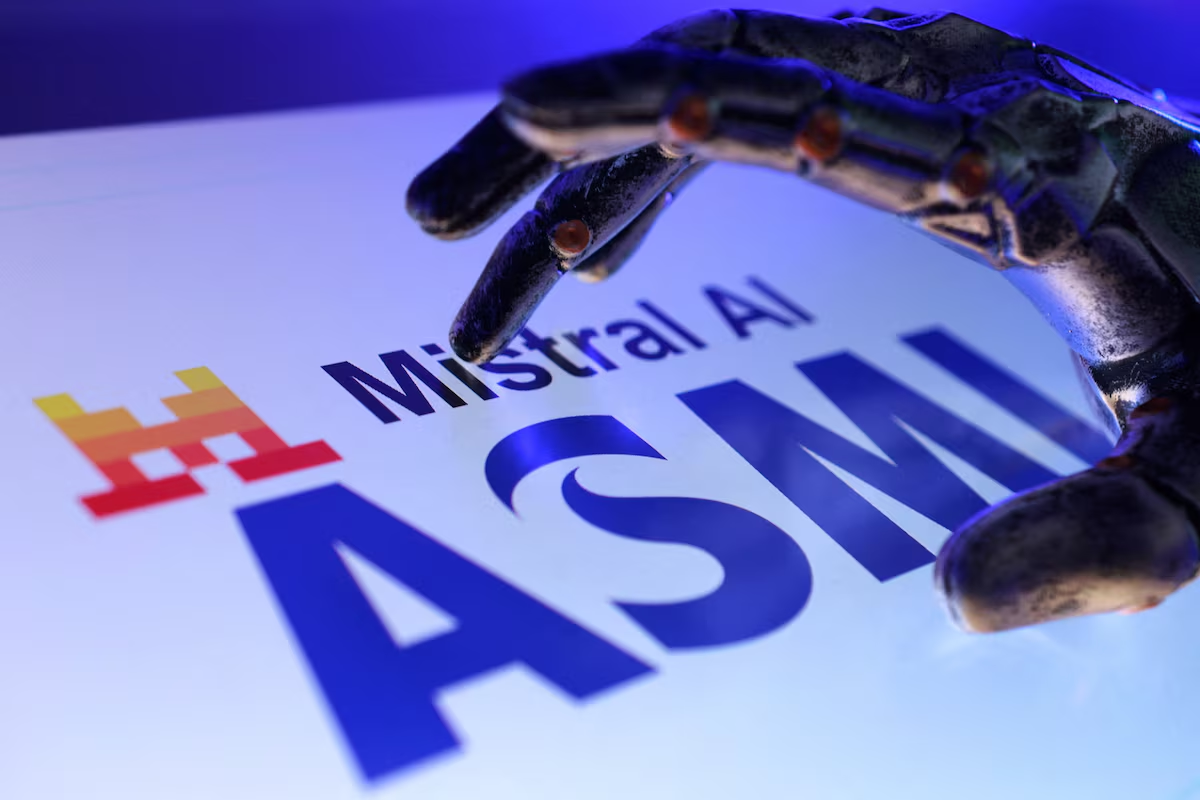
As the US–China AI "arms race" intensifies, Europe is quietly erecting a sovereignty barrier. On September 9, 2025, Dutch chip‑equipment giant ASML announced an investment of about €1.3 billion (US$1.5 billion) to take a stake in French AI startup Mistral AI, becoming its largest external shareholder. The move is the core of Mistral’s €2 billion C round, lifting the company’s valuation to €11.7 billion (about US$13.8 billion), a record for a European AI firm. European Commission President Ursula von der Leyen quickly called the investment a "milestone for European AI sovereignty," and reiterated the EU’s plan to inject €50 billion (about US$51.6 billion) to support the domestic AI ecosystem. Reuters analysts say the cross‑border alliance not only bridges chip hardware and AI software but also signals Europe’s strategic shift from "technology consumer" to "innovation leader," aimed at countering the global dominance of the US’s OpenAI and China’s DeepSeek.
Mistral’s rapid rise stems from a wave of European AI "localism." Founded in 2023 by former DeepMind engineer Arthur Mensch, the Paris‑based startup began with the open‑source chat model Le Chat and attracted investment from tech giants such as Microsoft, Nvidia and Salesforce. After a €5.8 billion Series B in 2024, Mistral launched the Mistral Large 2 model, which scored 84% on the MMLU multitask language‑understanding benchmark—comparable to OpenAI’s GPT‑4o. In the C round, ASML’s €1.3 billion accounted for 65% of the funding, giving it more than a 20% stake. ASML CEO Peter Wennink emphasized on an investor call: "Our investment in Mistral is not charity but strategic positioning—Europe needs an autonomous AI chip ecosystem to avoid being squeezed between the US and China." As the global monopoly provider of extreme ultraviolet (EUV) lithography machines, ASML’s involvement is expected to bring hardware optimization advantages to Mistral, with projected model‑training efficiency gains of around 30% and support for developing a trillion‑parameter 'European GPT.'
The EU’s investment logic is rooted in geopolitical realities. Long dependence on US cloud services (AWS accounts for around 40% of the European AI market) has created data‑sovereignty and supply‑chain risks. In February 2025, von der Leyen announced a "European AI continent" plan at the Munich Security Conference, allocating €50 billion to cover basic research, industrial applications and talent training. Mistral is among the first beneficiaries: the EU, via the European Investment Bank (EIB), provided an indirect €500 million to support global deployment of its open model Codestral. The Financial Times reports that the move stems directly from the EU AI Act (effective 2024), which requires localization for high‑risk AI systems to prevent data outflows to the US and China. "Europe cannot let AI become an appendage of US cloud platforms," France’s economy minister said at Paris Tech Week, calling for more national funds. Germany and the UK have followed with a combined commitment of an additional €10 billion for similar startups.
Mistral’s core strengths lie in its "European DNA": headquartered in Paris with a team of more than 300, it focuses on open source and privacy‑by‑design. Its Apache 2.0‑licensed models allow developers worldwide to fine‑tune freely; after the July 2025 open release of Mistral Nemo, downloads exceeded 5 million and the model ranked among the top three on Hugging Face. Unlike OpenAI’s closed approach, Mistral emphasizes "explainable AI," scoring 92% on the GSM8K math benchmark versus Meta’s Llama 3.1 at 90%. TechCrunch notes that ASML’s chip expertise will help Mistral develop efficient training frameworks, with a target to release a 10‑trillion‑parameter model by 2026 covering multiple languages and edge deployments. The alliance also extends across the ecosystem: ASML will provide EUV lithography support to Mistral’s hardware partners, such as Graphcore, to help develop a European alternative to Nvidia.
However, the path to European AI sovereignty is strewn with obstacles. Talent shortages are a primary concern: the MacroPolo global AI talent tracker shows Europe employs roughly 300,000 AI engineers—about one‑third of the US total. High Silicon Valley salaries and immigration barriers have driven significant brain drain, with France seeing an estimated 25% loss of AI experts. Strict regulation increases compliance burdens: the AI Act imposes fines of up to 7% of revenue for high‑risk systems, requiring additional investment by Mistral. Moreover, while dependency on ASML eases immediate chip needs, the global supply chain remains exposed to US–China dynamics—US export controls have already raised European AI training costs by about 20%.
Compared with the US and China, Europe’s "slow‑and‑steady" approach is emerging. The US’s OpenAI is valued at more than US$300 billion and relies on Nvidia GPU dominance; China’s DeepSeek trains open models at roughly 30% of US costs. Although the EU’s €50 billion pledge is ambitious, it is spread across 27 member states, which may hamper execution. The New York Times commented: "Mistral is a beacon of hope, but Europe needs a unified market or it will struggle against the US and China." Experts predict that Europe’s AI market share could rise from about 5% today to 15% by 2027, provided talent and funding fragmentation are addressed.
The global market reacted strongly: after the September 9 financing news, ASML shares rose about 3%, and Mistral’s valuation jump lifted European tech stocks. OpenAI CEO Sam Altman posted on X: "Investment in local European AI is welcome, but open‑source collaboration matters—Mistral’s Nemo is worth trying." China’s DeepSeek announced a new open model in response, intensifying competition. The Financial Times wrote: "A €11.7 billion valuation is Europe’s declaration against the US–China duopoly, but the road to sovereignty is long."
Looking ahead, Mistral’s proposed "European GPT" could be a decisive turning point. A 2026 model release will test the strength of the alliance: success could turn the EU’s vision of a European AI continent into reality and accelerate localization across automotive, finance and healthcare industries. But risks remain: open‑source models are easy to replicate, and US–China countermeasures or stricter controls could escalate. Whether von der Leyen’s vision of a "European AI continent" can be realized will depend on striking the right balance between innovation and regulation—Mistral’s investment is not just capital, but a bet on Europe’s technological revival.