
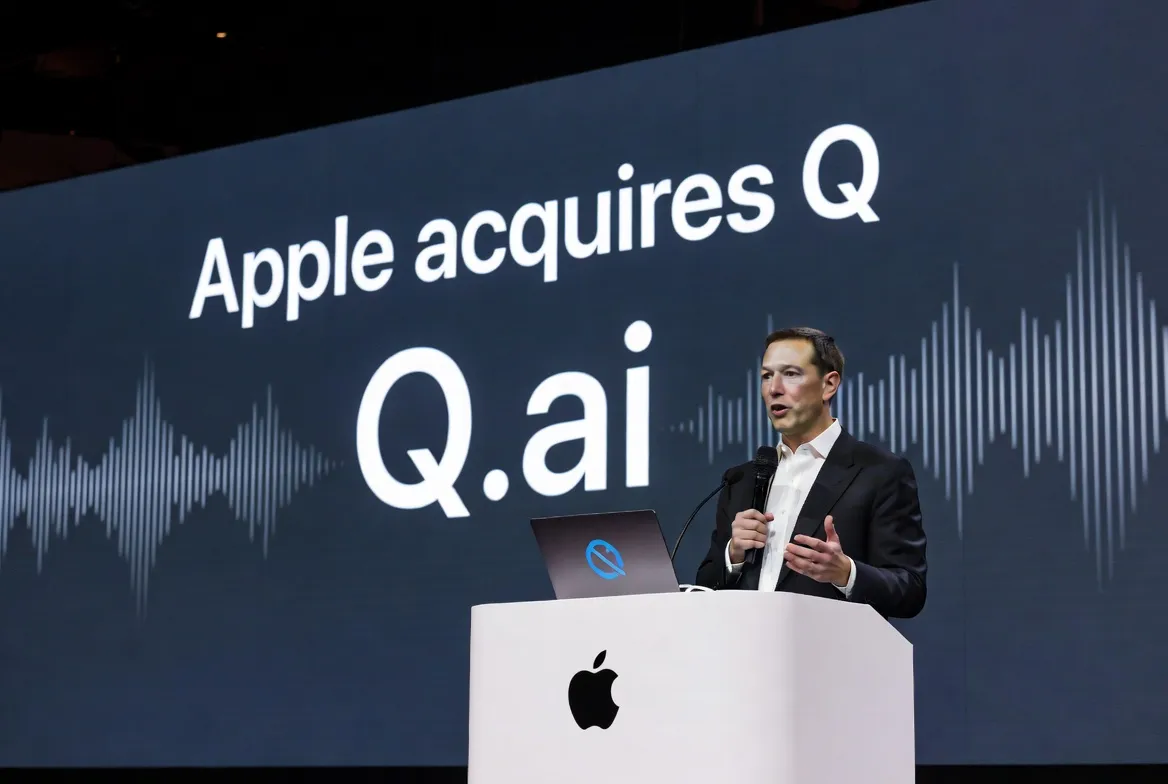
In 2026, amid the surging wave of artificial intelligence, Apple once again made a major move that shook the tech world. On January 29, Apple officially announced the acquisition of Israeli AI startup Q.ai for nearly $2 billion. This is not only Apple's second‑largest deal since purchasing Beats in 2014 for $3 billion, but also a strategic leap in its AI efforts. Q.ai's core technology focuses on "silent speech" recognition: by analyzing facial micro‑expressions and muscle movements, users can interact with devices without vocalizing. The technology could transform Siri, AirPods and Apple’s forthcoming AI glasses, pushing human‑computer interaction into a more private, non‑intrusive era. The acquisition highlights Apple’s interest in Israel’s "startup nation" and signals accelerating moves by tech giants in the AI race. We take a closer look at this milestone to explore its technical appeal and future potential.
Acquisition Details: a "Second Reunion" from PrimeSense to Q.ai
Q.ai was founded in 2022 and is headquartered in Tel Aviv. The low‑profile but high‑potential AI startup has about 100 employees; the entire team will be integrated into Apple’s hardware and AI divisions following the acquisition. The founding team is notable: CEO Aviad Maizels previously founded 3D sensing company PrimeSense and sold it to Apple in 2013 for roughly $360 million; that technology later became a core foundation for iPhone Face ID. Other co‑founders include Yonatan Wexler and Avi Barliya, who have deep experience in machine vision and AI audio. This marks Maizels’ "second handshake" with Apple and underscores Apple’s trust in this Israeli innovator.
The investor lineup is equally prominent: Q.ai counts Matter Venture Partners, Kleiner Perkins, Spark Capital, Exor and GV (formerly Google Ventures) among its backers. Apple has not disclosed an exact figure, but people familiar with the matter said the deal values the company at roughly $1.6 billion to nearly $2 billion. Unlike Apple’s typical smaller acquisitions, this large deal is second only to Beats (2014, $3 billion) and Intel’s modem business (2019, $1 billion), marking an unprecedented intensification of Apple’s AI investments.
Apple’s Senior Vice President of Hardware Technologies, Johny Srouji, praised Q.ai as "an extraordinary company that is pioneering novel imaging and machine learning applications," saying he is "incredibly excited about the future." Maizels responded, "Joining Apple opens up limitless possibilities. We will push boundaries, realize the full potential of the technology, and bring these experiences to users worldwide." The deal follows Apple’s long engagement in Israel: since 2011 Apple has acquired several Israeli companies such as Anobit (flash memory technology, 2012) and LinX (camera technology, 2015), investing billions overall. Israel’s innovation ecosystem has become a key pillar of Apple’s global R&D; Apple currently operates multiple research centers there with more than 2,000 employees.
Q.ai’s Core Technology: From Facial Micromovements to Silent Conversation
Q.ai’s technology is a showcase of cutting‑edge innovation. The company focuses on AI audio applications, especially using machine learning to help devices understand whispered speech and enhance audio quality in noisy environments. Its patented technology analyzes "facial skin micromovements" to detect subtle changes when a user mouths words silently or speaks softly, enabling the system to interpret speech content, verify identity, and even estimate emotion, heart rate and respiration. Unlike traditional voice recognition that relies on microphones, Q.ai uses visual data (such as camera‑captured images) combined with machine learning algorithms to enable "silent speech" interaction. The technology does not depend on large language models but emphasizes on‑device processing, aligning with Apple’s privacy‑first approach.
For example, a user can make slight lip movements and the device can capture intent to achieve a "nonverbal dialogue." This innovation stems from Q.ai’s patents on optical sensors that can be embedded in earbuds or glasses, enabling private interactions in public settings. In music and audio contexts, Q.ai’s technology can filter background noise and improve speech clarity, potentially reshaping the listening experience of AirPods. Although founded only four years ago, Q.ai has filed multiple patents, demonstrating the dynamism of Israeli AI startups. Compared with cloud‑centric AI from companies like OpenAI or Google, Q.ai’s edge‑computing orientation is a better fit for Apple’s ecosystem, ensuring local data processing and minimizing privacy exposure.
The technology is not purely speculative: users on the X platform discussed how it could let Siri "read your face," allowing silent commands on a crowded subway. Another post suggested Q.ai could enhance FaceTime by detecting emotions and adjusting virtual backgrounds or reaction stickers. Such social feedback highlights the technology’s appeal while also raising privacy concerns: would collecting facial data increase surveillance risks?
Potential Applications: Reshaping Apple’s Ecosystem and Human‑Machine Interaction
Apple has not specified integration plans, but analysts generally expect Q.ai’s technology to be incorporated into Siri, AirPods and the iPhone. AirPods introduced real‑time language translation in 2025; Q.ai’s noise filtering and whisper recognition could further improve performance in complex environments. For the iPhone, combined with an upgraded Face ID, the technology could enable silent unlocking or command input suitable for quiet places like libraries or meeting rooms.
Even more anticipated is Apple’s planned AI glasses (or an upgraded Vision Pro) slated for 2026. Q.ai’s optical sensors could be embedded in glasses, enabling users to interact with AR/VR interfaces via micro‑expressions and creating an "intent‑driven" experience. This would expand Apple’s wearables ecosystem and challenge Meta and Google in AR. X user @MomentumTrade12 wrote: "This will drive Apple’s human‑computer interaction revolution and boost the potential of AirPods and future wearables." Q.ai’s technology could also be applied to health monitoring, tracking heart rate via facial analysis and integrating with the Health app.
In music, Q.ai’s "quiet new paradigm" could improve Apple Music voice controls, allowing users to silently search songs at concerts. Overall, the acquisition helps Apple narrow the gap with AI leaders: in 2025 Apple had integrated Google’s Gemini model into Apple Intelligence, and this deal strengthens hardware‑side innovation.
Market Reaction: Opportunities and Concerns Coexist
Following the announcement, Apple shares rose modestly by 0.8%, reflecting investor optimism about AI investments. Wall Street analysts said the deal "fills a gap in Apple’s voice AI capabilities," particularly as Siri trails behind conversational agents like ChatGPT. Discussion on X surged: @ipfconline1 noted, "Apple acquired Q.ai to enhance silent speech and wearable ML," garnering hundreds of views. However, some expressed skepticism: a Reddit user joked, "Only $2 billion? That’s just the profit from selling a few MacBook chargers," and questioned facial data privacy. Some posts even called for boycotts, citing geopolitical sensitivities tied to Israel.
From a global perspective, the acquisition reinforces Israel’s status as an AI hotspot; Israeli AI startup funding exceeded $10 billion in 2025. Competitors such as Meta and Google may accelerate similar research, spurring industry‑wide innovation.
Looking Ahead: Apple’s Next Decade in AI
Apple’s purchase of Q.ai is more than a financial deal — it is a strategic investment. It signals a shift from technology that "hears you" to technology that "understands what you intend," foreshadowing a more intuitive, intelligent world. With AI glasses expected in 2026, this technology could become mainstream and alter everyday life. Apple’s "late‑mover, focused innovation" strategy is in play again: rather than chasing AI hype, it emphasizes practical innovation. Challenges remain: how to balance privacy and convenience? Who will lead the silent‑speech era? These are questions every tech enthusiast should consider. Apple’s next move might be written on your facial micro‑expressions.
▶️ Enjoy this article? Creating it takes real work!
Follow our YouTube channel:
AI Rosetta
Your likes, subscriptions and shares are our greatest support! 🙏
For more AI news, visit: https://www.airosetta.com