
In April 2026 the global mobile app market showed a clear recovery. According to TechCrunch and authoritative data from Sensor Tower and App Annie, in Q1 2026 global app releases on Apple’s App Store and Google Play rose year‑over‑year by 60%, with the iOS App Store up as much as 80%. Since April the trend accelerated further: cross‑platform app releases are up 104% year‑over‑year so far, and iOS is up 89%. This “app surge” is widely attributed to the spread of AI tools — AI has greatly lowered the barriers to app development, enabling many users without technical backgrounds to quickly create and launch apps, reigniting activity on the App Store.
Apple’s Vice President of Worldwide Marketing Greg Joswiak said in an interview: "Reports that the App Store is dead in the AI era are likely greatly exaggerated." His comment echoes industry observation: rather than replacing apps, AI has become a core engine driving the App Store’s revival.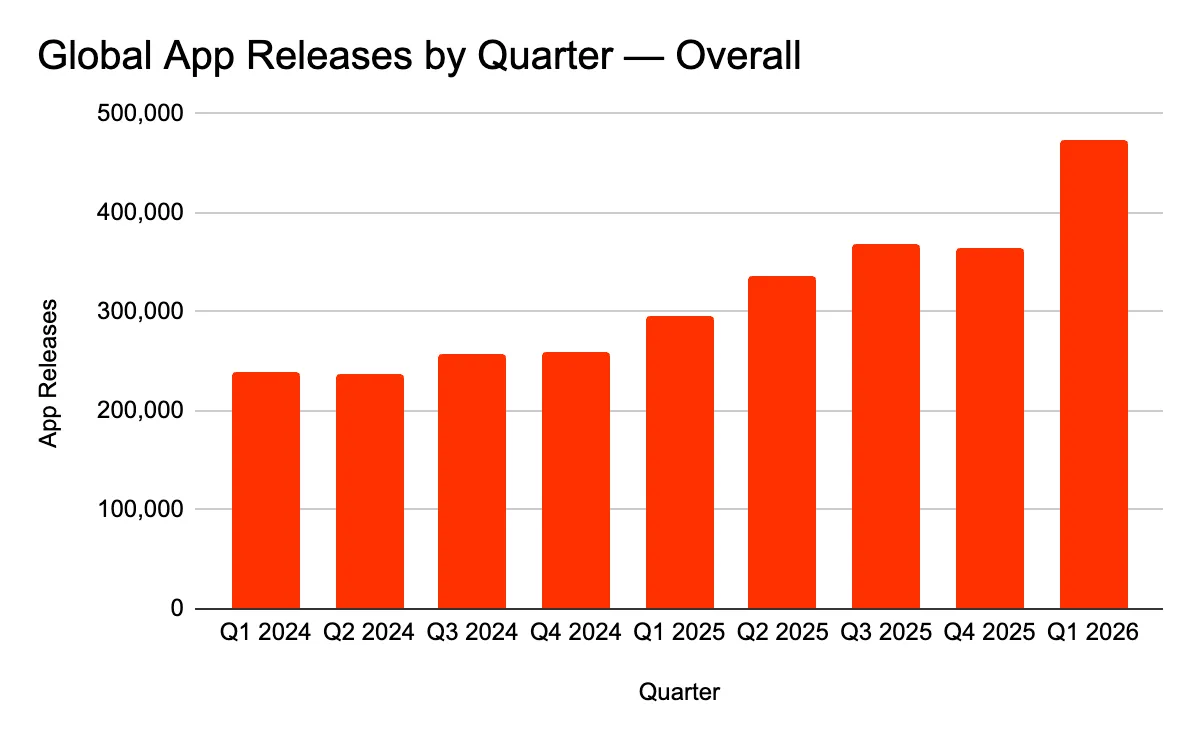
Image Credits: Appfigures
AI lowers the development barrier: from the "coding era" to the "prompt era"
In recent years many worried that generative AI (such as ChatGPT and Claude) would reduce usage of traditional apps or make some apps redundant. But 2026 data show the opposite. The maturation of AI development tools is a key driver.
Tools like Claude Code, Replit AI and Cursor let ordinary users generate complete app prototypes by describing requirements in natural language. Creators without programming backgrounds, designers and small business owners have become the new growth drivers. They use AI tools to turn ideas into products, greatly shortening the time from concept to release. Sensor Tower data show that in Q1 2026 over 35% of newly listed apps were flagged as "AI‑assisted development", with the most notable growth in productivity, utilities, lifestyle and health & fitness categories.
AI has also directly enhanced existing apps. Many apps have integrated models such as Gemini, Claude or the GPT series to offer intelligent summarization, personalized recommendations and automated content generation, further improving user retention and session length. This is shifting the App Store from a simple "download platform" toward an "AI‑augmented ecosystem."
Data‑driven boom: growth in both releases and revenue
According to Sensor Tower’s latest report, global App Store revenue in Q1 2026 grew about 18% year‑over‑year, with iOS contributing the bulk of the gains. The surge in new releases helped drive downloads and in‑app purchase revenue. Some AI‑powered utility apps (such as smart note apps, automation workflow tools and personalized fitness coaches) performed particularly well, with monthly revenue for individual apps increasing by more than 200%.
It is worth noting that the boom is not unchecked. Apple tightened app review enforcement in 2025–2026, rejecting over 320,000 junk submissions in 2025 and blocking 37,000 scam apps from going live. Analyst John Gruber noted on Daring Fireball that as AI tools spread, Apple may need to establish a dedicated anti‑fraud team (a "bunco squad") to handle low‑quality or malicious AI‑generated content.
Impact on developers, Apple and the broader ecosystem
For developers: AI lowers the entry barrier, benefiting small teams and individual developers. Apps that once took months or years to build can now appear in weeks. This stimulates innovation but also intensifies competition. High‑quality, differentiated offerings will be crucial; apps that rely solely on bulk AI‑generated templates will struggle to survive long term.
For Apple: the App Store’s revenue rebound helps consolidate its ecosystem advantage. AI‑driven growth not only revitalizes the platform but also provides more use cases for Apple’s future AI strategy (such as deeper Apple Intelligence integration). At the same time, Apple must manage review workload and fraud risks to maintain platform trust.
For the mobile ecosystem: AI is reshaping the App Store’s role. Moving from an "app marketplace" to an "AI‑enhanced content platform" could change how users interact with apps. In the future, AI agents, personalized services and automation tools may become mainstream, further blurring the lines between traditional apps and AI functionality.
Risks and challenges
Despite the upbeat trends, the AI‑driven app explosion brings new problems: widespread low‑quality content, more convincing scam apps and growing concerns about user data privacy. Some analysts warn that if Apple cannot effectively balance innovation and regulation, AI benefits could be offset by negative factors.
Conclusion: an AI‑driven renaissance for the App Store
The App Store’s recovery in 2026 is powered largely by AI. AI tools are enabling more people to create apps, while AI features are making existing apps smarter and more relevant to users. This trend not only boosts platform revenue but injects new vitality into the mobile internet.
From fears that "AI will kill apps" to the reality of "AI reviving apps," the industry is undergoing a paradigm shift. Giants such as Google, Apple and Meta are accelerating AI investments on mobile, and future App Store competition is likely to focus more on "AI capabilities" and "intelligent experiences."
For developers, this is a rare opportunity: use AI to lower barriers and improve efficiency, and seize the new wave of content creation and tool innovation. For the broader mobile ecosystem, AI is helping the App Store evolve from a "traffic platform" into an "intelligent services platform."
▶️ Like this article? Creating content is hard!
Follow our YouTube channel:
AI Rosetta
Your likes, subscriptions and shares are our greatest support! 🙏
More AI news at: https://www.airosetta.com