
On July 28, 2026, Anthropic officially published the Model Context Protocol (MCP) 2026‑07‑28 specification (v5). The project describes it as the largest and most systematic disruptive revision since the protocol's inception in November 2024. The core change is a comprehensive shift from stateful to stateless, alongside major updates such as an extensions framework, multi‑round request mechanisms, and MCP Apps, signaling a new phase for MCP that is easier to scale and better suited for cloud‑native deployments.
Latest changes: comprehensive architectural overhaul
MCP was originally designed as a stateful protocol requiring an initialization handshake (initialize/initialized) and maintaining sessions (via headers like Mcp‑Session‑Id) to support resource subscriptions, server‑initiated pushes, sampling, and other real‑time interactions. As deployments grew, long‑lived connections revealed clear limitations in serverless, edge computing, and large‑scale load‑balancing scenarios.
The main changes in the 2026‑07‑28 release include:
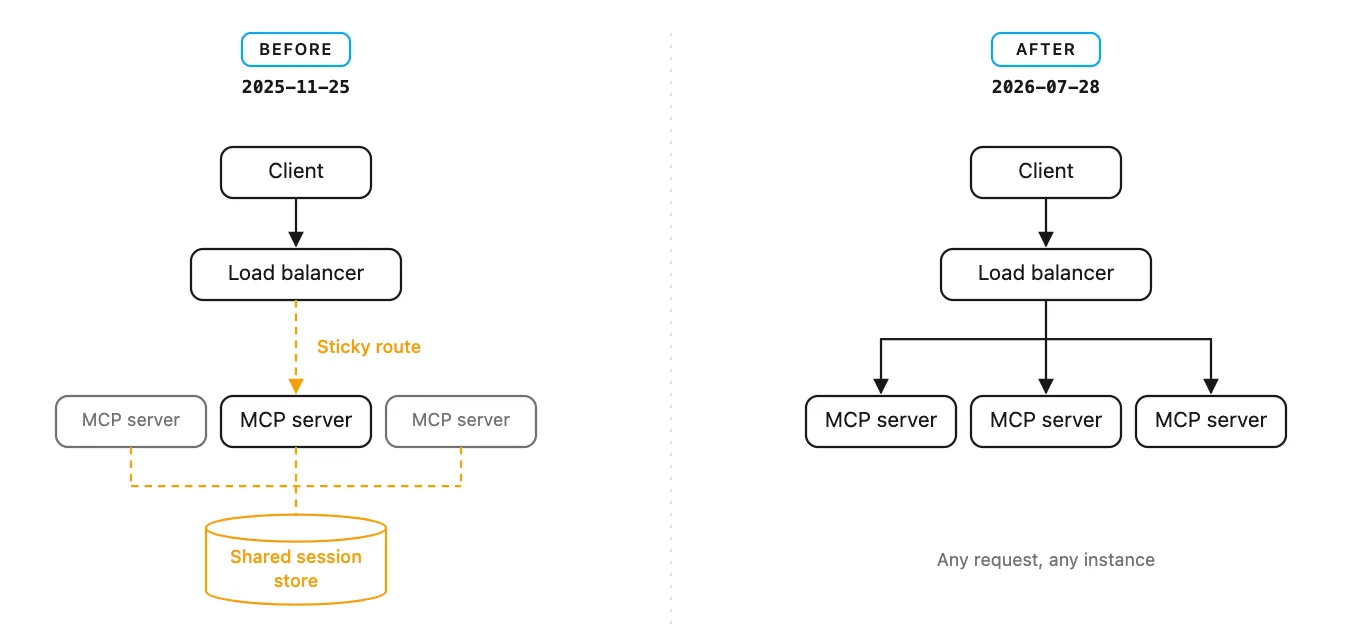
- Core protocol statelessness Removal of protocol‑level sessions and the Mcp‑Session‑Id header, and elimination of a mandatory initialization handshake. Requests now carry protocol version and capability information and use a new server/discover RPC for service discovery. Each request is handled independently, greatly simplifying deployment and scaling.
- Multi Round‑Trip Requests Introduction of the InputRequiredResult mechanism to replace previous server‑initiated requests (such as roots, sampling, elicitation). Clients can complete multiple rounds of information exchange within a single interaction, preserving interactivity while conforming to a stateless design.
- Formal extensions framework Establishment of a separate, versioned extension system based on reverse‑DNS identifiers. Tasks were moved out of the core protocol to become an official extension; MCP Apps (server‑rendered HTML UIs that run in sandboxed iframes) are the first official extension and have been available since January 2026.
- Stronger auth and deprecation policies Closer alignment with OAuth 2.0 and OpenID Connect to enhance security. A formal feature lifecycle and deprecation policy were introduced: deprecated features (e.g., Roots, Sampling, Logging) will remain available for at least 12 months to provide ample migration time.
- SDKs and ecosystem updates Tier 1 SDKs for Python, TypeScript, Go, C# and others have released prerelease versions supporting the new specification to help developers validate changes early.
Anthropic described these changes as "the most substantive revision since adding authorization," directly addressing community feedback over the past two years on scalability, serverless compatibility, and operational complexity.
Potential impacts: reshaping deployment patterns and the ecosystem
1. Impact on developers and server deployments The stateless design substantially lowers the operational barrier for MCP servers. Developers can more easily deploy services to serverless platforms, edge nodes, or auto‑scaling clusters without managing long connections or shared session storage. This is especially beneficial for small teams and independent developers and is expected to accelerate growth in the number of MCP servers (already in the tens of thousands).
2. Impact on AI agents and tooling ecosystem The addition of multi‑round requests and MCP Apps enables agents to achieve richer interactions and visual interfaces in a stateless environment. Tool calling, data source connections, and human‑in‑the‑loop scenarios will become more flexible while the protocol remains lean.
3. Impact on industry standards and competitive landscape As an open standard connecting large models to external systems, MCP's large‑scale revision further consolidates its position as a de facto standard. Cloud providers such as Cloudflare, AWS, Google Cloud, and Microsoft have announced support, accelerating ecosystem coordination. At the same time, legacy stateful implementations will enter deprecation cycles, driving industry migration to the new specification.
4. Potential challenges
- Migration costs: There are breaking changes; older clients may be incompatible with new servers, so organizations need to plan upgrade paths.
- Feature trade‑offs: Some advanced interactions that relied on strong state have been refactored or moved to extensions, which may affect complex agent workflows in the short term.
- Security and consistency: Efficiently providing subscriptions, logging, and similar features in a stateless environment will require further refinement of extensions by the community.
Industry takeaway: protocol evolution aligns with cloud‑native trends
The shift from stateful to stateless in MCP follows the evolution logic of modern Internet protocols (like HTTP and REST)—prioritizing scalability and deployment flexibility. Anthropic's systematic revision responds to real‑world deployment pain points and lays a stronger foundation for large‑scale connectivity between AI agents and external systems.
The release of MCP 2026‑07‑28 is not only a technical upgrade but also an important milestone in the maturation of AI tool protocols. As the final specification stabilizes and SDKs mature, a more open and easily extensible era of AI context connectivity is arriving.
▶️ Enjoyed this article? Creating content is hard!
Subscribe to our YouTube channel:
AI Rosetta
Your likes, subscriptions, and shares are our greatest support! 🙏
For more AI news visit: https://www.airosetta.com