
On June 30, 2026, Anthropic officially released Claude Sonnet 5, the latest iteration of the Sonnet series, positioned as “the most Agentic Sonnet yet.” Sonnet 5 delivers near‑Opus flagship performance in coding, tool usage and everyday knowledge work, while maintaining the Sonnet line’s speed and cost‑effectiveness. The release is viewed as a key step for Anthropic to capture the mid‑market AI space and accelerate commercialization, notably coming the day after U.S. export controls on Fable 5 and Mythos 5 were lifted, further consolidating the company’s competitiveness in the AI tools market.

Anthropic says Sonnet 5 represents “bringing performance previously achievable only with larger, more expensive models to Sonnet’s speed and price level.” It is now the default model for Claude platform Free, Pro, Team and Enterprise users, and supports a 1M token context window.
Performance highlights: markedly stronger agentic capabilities, leading on multiple benchmarks
The core breakthrough of Claude Sonnet 5 is the comprehensive enhancement of Agentic capabilities, reflected in the following areas:
- Coding and software engineering: Sonnet 5 scored 63.2% on the SWE‑bench Pro benchmark and 80.4% on Terminal‑Bench, significantly narrowing the gap with the Opus series. The model excels at autonomous tool usage, browser operations, terminal command execution and complex code refactoring, making it particularly well‑suited for building multi‑step agent workflows.
- Knowledge work and reasoning: Strong performance on long‑context comprehension, multi‑turn dialogue and professional knowledge synthesis tasks, with support for up to 128k output tokens—applicable to document analysis, report generation and research assistance.
- Tool use and computer interaction: Native integration of enhanced tool‑calling capabilities enables more reliable handling of browser, terminal and external API interactions, delivering a true “Computer Use” experience.
- Overall efficiency: Compared with its predecessor, Sonnet 5 improves inference depth and accuracy while maintaining fast response times. User feedback indicates noticeably better usability than competing mid‑tier models in everyday development and knowledge‑work scenarios.
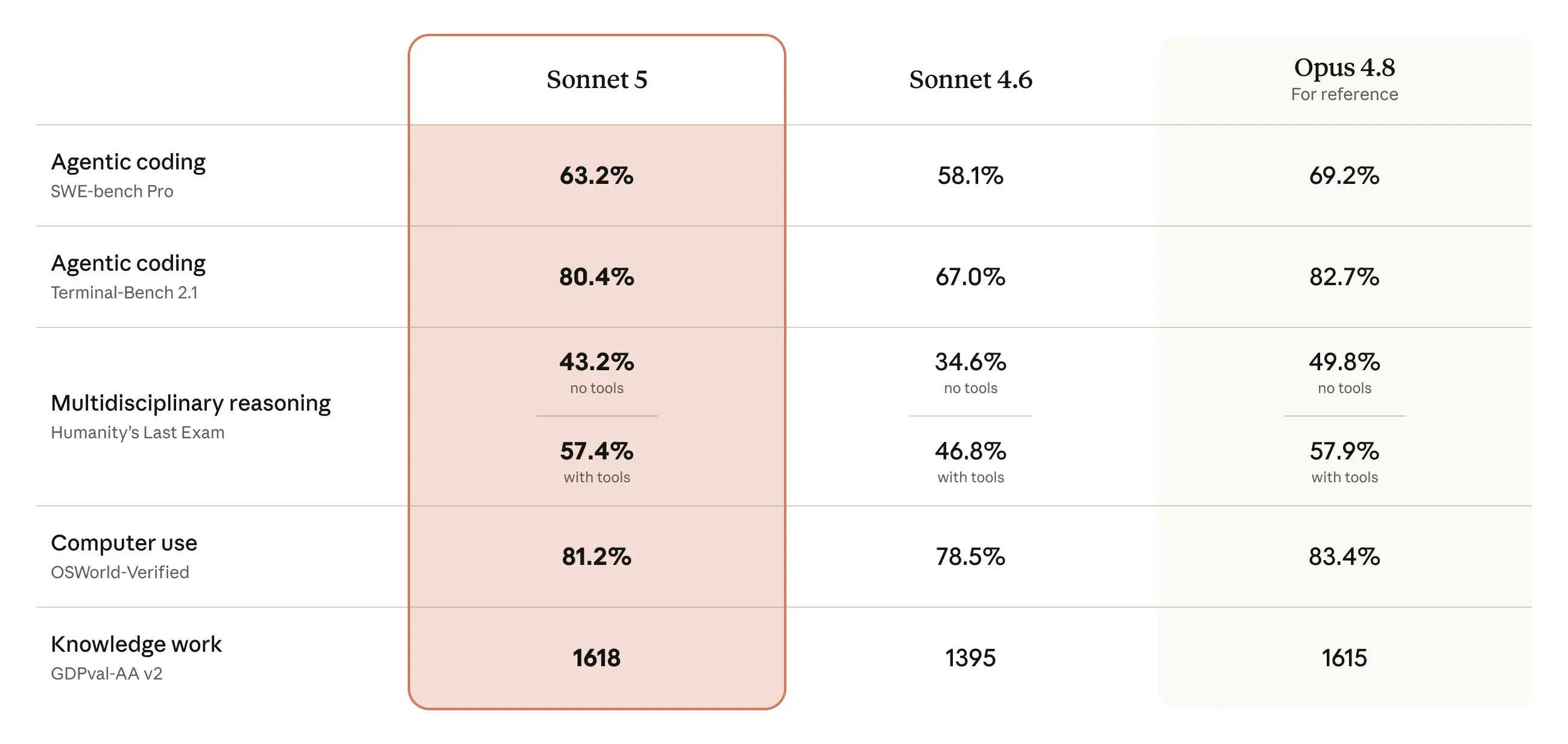
Anthropic emphasizes that Sonnet 5 is not a simple parameter bump but the result of optimized training strategies and alignment mechanisms that achieve “near‑flagship” intelligence density at a mid‑tier positioning. This design lets more users access powerful AI assistance without paying Opus‑level prices.
Pricing strategy: highly competitive to capture market share
One of Sonnet 5’s main selling points is its pricing:
- Input tokens: $3 per million (introductory pricing $2 per million until August 31).
- Output tokens: $15 per million (introductory pricing $10 per million until August 31).
These rates are roughly on par with the previous Sonnet 4.6 while delivering significant performance gains. Compared with Anthropic’s Opus series (typically at higher prices), Sonnet 5 offers strong cost‑effectiveness; relative to OpenAI’s GPT‑5 mid‑tier variants and Google Gemini mid‑tier models, it is especially attractive for agentic tasks.
Industry observers interpret this move as a deliberate push downmarket to capture enterprise AI automation and developer‑tool share. With low entry pricing and strong capabilities, Sonnet 5 could become the core backend choice for AI coding platforms such as Cursor and Windsurf, further expanding Anthropic’s ecosystem influence.
Release context: strategic complement after Fable/Mythos delisting of controls
The timing of Sonnet 5’s release is notable—it coincided with the day after the U.S. Commerce Department lifted export controls on Anthropic Fable 5 and Mythos 5. By rapidly iterating a mid‑tier Sonnet 5, Anthropic both alleviates revenue pressure from constrained high‑end models and continues to strengthen its full product lineup.
As a backbone of the Claude family, the Sonnet series has long been known for balancing performance and cost. The launch of Sonnet 5 further completes Anthropic’s coverage from consumer to enterprise tiers, delivering differentiated advantages particularly in agentic coding and everyday knowledge‑work scenarios.
Market impact: intensifying mid‑tier AI competition and accelerated ecosystem reshaping
Impact on Anthropic:
- Expanded market share: The high value positioning is likely to attract more small and medium enterprises and developers, accelerating a shift from “high‑end technology” to “accessible tools.”
- Revenue diversification: With high‑end models subject to regulatory constraints, Sonnet 5 can serve as a stable cash‑flow source.
- Brand strengthening: Ongoing mid‑tier iterations demonstrate Anthropic’s focus on practical AI tools and can help boost user loyalty.
Impact on the industry ecosystem:
- Mid‑tier market reshuffle: Sonnet 5’s strong entry will put direct pressure on mid‑tier variants of OpenAI’s GPT‑5 and Google’s Gemini, driving competition around mid‑tier AI cost‑effectiveness.
- Acceleration of agentic applications: More accessible, powerful agentic capabilities could speed up enterprise automation, code generation and intelligent workflow adoption.
- Open‑source and partnership opportunities: Having already exposed some capabilities through the Claude series, Sonnet 5’s release may further stimulate partner ecosystems (e.g., Cursor, Replit).
Potential challenges:
- Performance consistency: Mid‑tier models may still fall short of flagship versions on extremely complex tasks; users should choose based on scenario needs.
- Regulation and safety: As capabilities increase, Anthropic must continue strengthening safety alignment and compliance measures.
- Competitive responses: OpenAI, Google and other rivals are expected to accelerate mid‑tier optimizations, triggering a new wave of “price” and “performance” competition.
Conclusion: Claude Sonnet 5 ushers in a more accessible phase for AI tools
Anthropic’s Claude Sonnet 5 is an important step in its 2026 strategy. By combining strong performance with reasonable pricing, the model fills a mid‑tier market gap and delivers near‑flagship intelligence to a broader user base.
As AI moves from “lab technology” to “everyday productivity,” products like Sonnet 5 play a key role. They remind the industry that true competitiveness lies not only in parameter scale, but in making powerful capabilities affordable and widely usable.
▶️ Enjoy this article? Creating content is hard work!
Follow our YouTube channel:
AI Rosetta
Your likes, subscriptions and shares are our greatest support! 🙏
More AI news at: https://www.airosetta.com