
After OpenAI launched the ChatGPT 5.6 series (Sol, Terra, Luna) in July 2026, Anthropic quickly responded by repeatedly postponing the end of free access to Claude Fable 5. Fable 5 had been scheduled to switch to paid access on July 7; Anthropic first extended the free window to July 12 and then again to July 19. The adjustment is seen as a defensive move under intense competitive pressure and highlights the balance leading LLM providers face between user retention and commercialization.
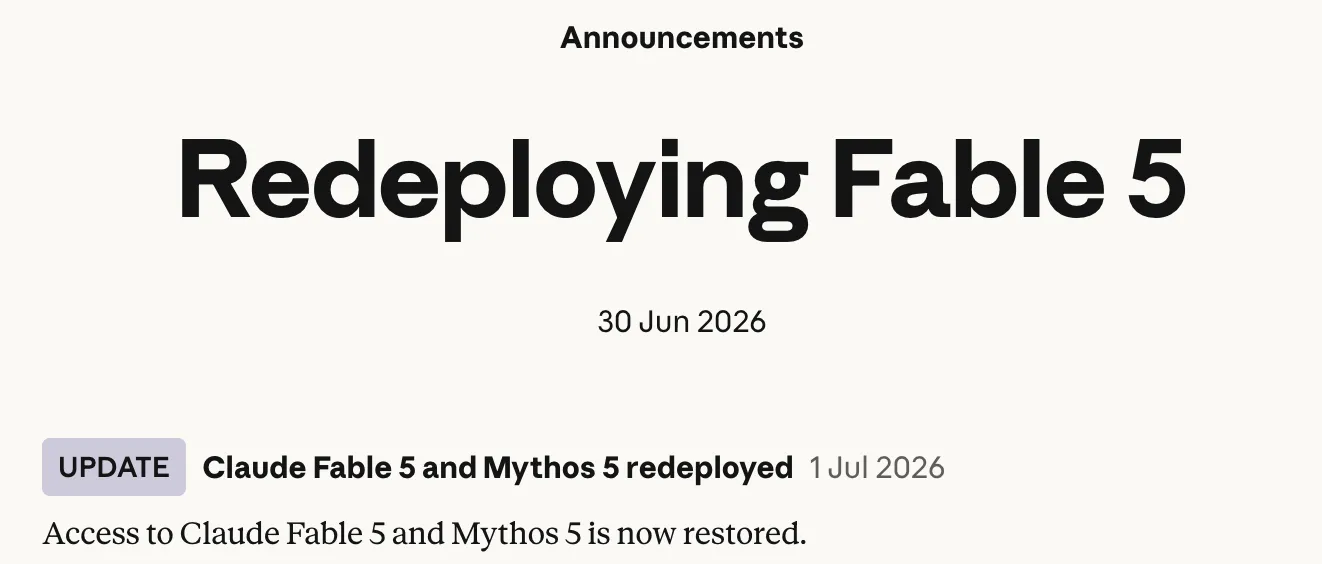
Timeline: Strategic Adjustments Under Competitive Pressure
After the release of ChatGPT 5.6, market attention quickly concentrated on OpenAI's flagship model Sol. In response, Anthropic extended the proportion of free usage for Fable 5 across Pro, Max, Team and certain enterprise plans (up to a 50% weekly quota). The move aims to maintain user activity and prevent a large number of users from switching to competitors due to new paywalls.
Anthropic said the extension decision was driven mainly by high demand and user feedback. The company pledged to restore normal subscription models as soon as possible while strengthening model availability and code‑related limits. Industry analysts view the delay essentially as a short‑term measure to mitigate the user churn risk triggered by OpenAI's new model release.
Underlying Reasons: Competition Landscape and Commercialization Trade‑offs
The core reasons for Anthropic's decision to delay Fable 5's paid transition can be summarized as follows:
- Direct competitive pressure — ChatGPT 5.6 Sol demonstrates strong performance in coding, Agents and complex reasoning, and is particularly attractive on pricing. Although Fable 5 remains ahead on benchmarks like SWE‑Bench Pro, OpenAI's new release directly affected Anthropic's user base. Extending the free period helps buffer against user loss.
- User retention and satisfaction — As Anthropic's flagship model, Fable 5 is a key tool for many professional users and developers. An abrupt switch to paid access could provoke dissatisfaction; extending the free window helps stabilize the existing subscriber base and buys time for further improvements.
- Adjusting commercialization pace — Anthropic has previously adjusted Fable 5 deployment timing due to external factors such as export controls. This delay is also a typical strategy to balance "user growth" and "revenue realization." An overly aggressive move to paid access could backfire.
- Market environment factors — With competition heating up, cost‑effective models like Grok 4.5 also siphon high‑end users. Anthropic needs flexible pricing strategies to remain competitive.
Multi‑dimensional Impact: Short‑term Defense and Long‑term Strategy
1. Impact on Anthropic
- Positive: Helps stabilize user sentiment, reduces short‑term churn, and creates a buffer for subsequent Fable 5 iterations and pricing optimization.
- Negative: Extending free access increases compute costs, slows near‑term revenue growth, and could affect quarterly financial results.
- Strategic adjustments: The company may accelerate the rollout of a new Opus version or enhance subscription value to meet long‑term competition.
2. Impact on users
- Professional developers and enterprise users: The extension is a practical benefit, allowing continued low‑cost use of a top‑tier model.
- General users: It increases stickiness to Anthropic's platform, though a paid transition remains likely in the future.
- More choice: Users can more thoroughly compare ChatGPT 5.6 and Fable 5, pushing vendors to keep improving.
3. Impact on the AI industry
- Heightened competition: Pricing and free‑access skirmishes among leading vendors may become the norm, accelerating access to AI but testing business‑model sustainability.
- User behavior changes: More users will trial multiple platforms and adopt mixed‑model usage (model routing) as standard practice.
- Pricing evolution: Anthropic's flexible response may prompt OpenAI, Google and others to adjust their own pricing and promotion strategies.
- Ecological effects: Extending free access helps Anthropic consolidate its developer community, but the long‑term challenge of high‑performance model costs remains.
4. Capital markets and regulatory perspective
- Investors may see the move as a proactive response to competition, but should monitor profitability closely.
- From a regulatory standpoint, pricing and equitable access to AI models could attract future scrutiny.
Industry Takeaway: Balancing Short‑term Tactics and Long‑term Strategy in a Competitive Environment
Anthropic's delay strategy is a typical defensive action among leading AI vendors under intense competition. It reminds us that technological leadership alone does not guarantee market success; user experience and pricing strategy are equally critical. The launch of ChatGPT 5.6 and Anthropic's response together sketch the fierce dynamics of today's large‑model market. Going forward, competition will shift from pure performance contests to end‑to‑end user value creation. Whoever best balances innovation and commercial sustainability will gain the upper hand in this round of competition.
▶️ Like this story? Content creation is hard work!
Follow our YouTube channel:
AI Rosetta
Your likes, subscriptions and shares are our greatest support! 🙏
More AI news at: https://www.airosetta.com