
Introduction
Between 2024 and 2025, developers reveled in the rush of "Vibe Coding"—relying on AI prompts to generate thousands of lines of code in minutes. However, this efficiency surge came with unprecedented costs: codebases filled with logical flaws, security risks, and hard‑to‑maintain redundancy.
In March 2026, AI giant Anthropic officially released a tool designed to address this pain point—Code Review. As a core component of the Claude Code ecosystem, the tool no longer limits itself to assisting code authorship; it acts as a "senior architect." This article offers an in‑depth analysis of the tool's technical approach, empirical performance, and the trade‑offs involved.
1. Origin: When AI Code Generation Becomes an "Efficiency Bottleneck"
Since the release of Claude 3.5 Sonnet and the subsequent 4.5 series, AI code generation accuracy improved significantly, but the number of internal pull requests (PRs) exploded exponentially.
"Developers are stretched thin," Anthropic said in its announcement. "Many PRs are skimmed and merged, seeding massive technical debt."
Code Review was created to break this bottleneck. Using a multi‑agent parallel system, it performs a deep "logical health check" on AI‑generated code before human reviewers intervene.
2. Core Technology: More Than Syntax Checking, It's Logical Reasoning
Unlike GitHub Copilot or traditional linters, Code Review demonstrates strong "System 2" (deliberative) reasoning.
1. Logic‑first "dehydrated" review
Anthropic product leads say developers dislike trivial suggestions about indentation or naming. Therefore, Code Review's algorithms are tuned to ignore style issues and focus on logic errors. It digs into loop boundaries, memory leaks, concurrency deadlocks, and inconsistencies in business logic.
2. Multi‑agent collaboration mechanism
When you submit a PR, Code Review dispatches multiple groups of AI agents to work in parallel:
- Scanning agents: identify potential bug patterns.
- Verification agents: attempt to prove whether a suspected bug is real, reducing false alarms.
- Assessment agents: grade issues by severity.
In the end, it doesn't hand users a chaotic list but a high signal‑to‑noise summary report with inline comments on code lines.
3. Tri‑color alert system
To visually represent risk, Code Review introduces a color grading:
- 🔴 Red (Critical): fatal logic flaws or security vulnerabilities that must be fixed.
- 🟡 Yellow (Potential): logical concerns recommended for developer review.
- 🟣 Purple (Historical): detection of preexisting bugs in the codebase triggered by this change.
3. Empirical Results: A Qualitative Leap from 16% to 54%
Anthropic disclosed several months of internal usage data. For large PRs involving more than 1,000 lines of code:
- Detection rate: 84% of reviews flagged issues worth attention.
- Average yield: each large PR found an average of 7.5 actionable issues.
- Feedback quality: the share of comments engineers deemed meaningful jumped from 16% to 54% compared with traditional tools.
- Accuracy: the false positive rate was under 1%, outperforming competitors.
4. Deep Analysis: Strengths and Weaknesses of Code Review
No technology is perfect. While enjoying AI‑assisted auditing, organizations must face new challenges.
✅ Major advantages
- High logical depth: Leveraging the Claude series' large context window, it understands the structure of entire codebases, not just the modified files—enabling detection of cross‑file logical breaks.
- Interactive fix suggestions: It not only points out problems but generates "fix instructions." Developers can click to confirm and Claude Code can automatically rewrite the snippet.
- 24/7 reliability: AI does not tire or rush through reviews when PR volume is high, adding a robust layer to continuous integration (CI) pipelines.
❌ Unavoidable drawbacks
- Costly "audit fees": Deep reviews consume many tokens. Estimates put the cost per PR between $15 and $25, a nontrivial expense for small and medium‑sized companies.
- Response latency: To ensure depth, a complex PR review typically requires about 20 minutes. Compared with "instant" traditional tools, this is more like a colleague carefully proofreading rather than providing immediate feedback.
- Privacy and compliance: Although Anthropic provides enterprise‑grade encryption, sending core code logic to the cloud for multi‑agent analysis can pressure compliance teams in highly sensitive sectors such as finance and defense.
5. Market Dynamics: Anthropic vs. GitHub Copilot vs. Cursor
In the 2026 AI programming market, a three‑way competitive landscape has formed:
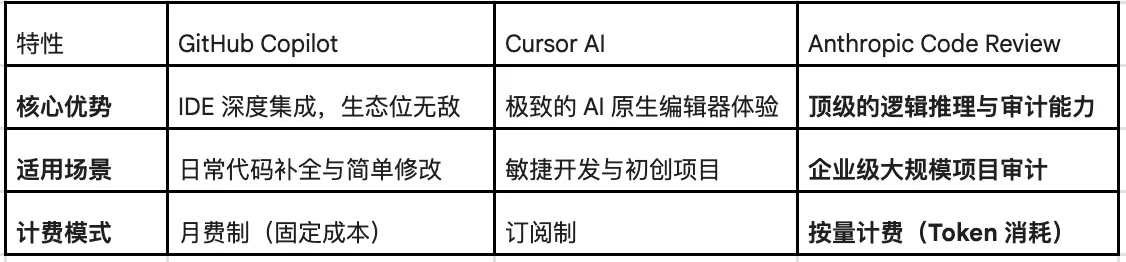
Anthropic's strategy is clear: it does not compete for "fastest generation" but for "most trustworthy." For enterprises with massive existing codebases, Code Review functions as a form of technical insurance.
6. A Disruptive Shock to the Security Audit Industry
The launch of Code Review triggered the biggest industry tremor in cybersecurity in 2026.
1. The "darkest hour" for traditional security vendors
On the day of the announcement, stocks of legacy security firms such as Snyk, Checkmarx, and Veracode fell to varying degrees. Markets feared: if AI can reason like security experts, what value remains in expensive traditional scanning licenses? Anthropic is using a "loss‑leader" approach by embedding this capability into Claude Code, effectively entering the security market at near‑zero marginal cost.
2. Security engineer role transformation
Traditional "code auditors" face job risk, while "verification specialists" become sought‑after. Future security workflows will evolve into: AI finds issues ‑> humans validate the logic and issue approval. Security engineers will shift from manually hunting buffer overflows to managing AI agent fleets and configuring more complex security boundaries.
3. The balance of offense and defense
This is a double‑edged sword. Anthropic emphasizes that Code Review's intention is to "empower defenders." However, if attackers adopt equally powerful reasoning models to discover vulnerabilities, exploit development could accelerate exponentially. That means the window from discovery to patch deployment could shrink from days to seconds.
7. Conclusion: The "New Normal" in Software Development
Anthropic's Code Review marks the entry of software development into a "supervision era." Human programmers' roles will continue to shift from "manual coders" to "quality supervisors" who review AI‑suggested changes.
Although token costs and a roughly 20‑minute wait are current drawbacks, improvements in model efficiency (for example, iterations in the Haiku series) should overcome these barriers. For any CTO committed to engineering quality, Code Review may become not an option but the only lifeboat against the flood of AI‑generated code.
▶️ Enjoy this article? Creating content is hard work!
Follow our YouTube channel:
AI Rosetta
Your likes, subscriptions, and shares are our greatest support! 🙏
More AI news at: https://www.airosetta.com