
On September 28, 2026, just before the OpenAI Dev Day event, Anthropic officially released Claude Sonnet 5.5, the second model in the Claude 5.5 family (the flagship Opus 5.5 launched last week). The company positions it as a "faster, lower‑cost everyday work partner": while maintaining the same pricing as the previous Sonnet 5, it achieves over a 30% speed increase and can reduce effective usage costs by about 30% on most tasks. The model is available on Claude.ai, via API, and on platforms including AWS Bedrock, Google Cloud and Microsoft Foundry, becoming a primary option for enterprise coding, documentation and lightweight agent tasks.
Details and Core Upgrades
Sonnet 5.5 continues Anthropic's mid‑tier approach of "balancing performance and cost," but delivers a notable leap in efficiency and practicality. The company says its runtime is over 30% faster than Sonnet 5, and the number of tokens required to complete the same work is significantly reduced; in token‑billed scenarios this can lower actual spending by roughly 30%. Pricing remains unchanged: input $2 per million tokens, output $10 per million tokens, cached reads $0.20 per million tokens. The context window is still 1M tokens, with a maximum output of 128K tokens.
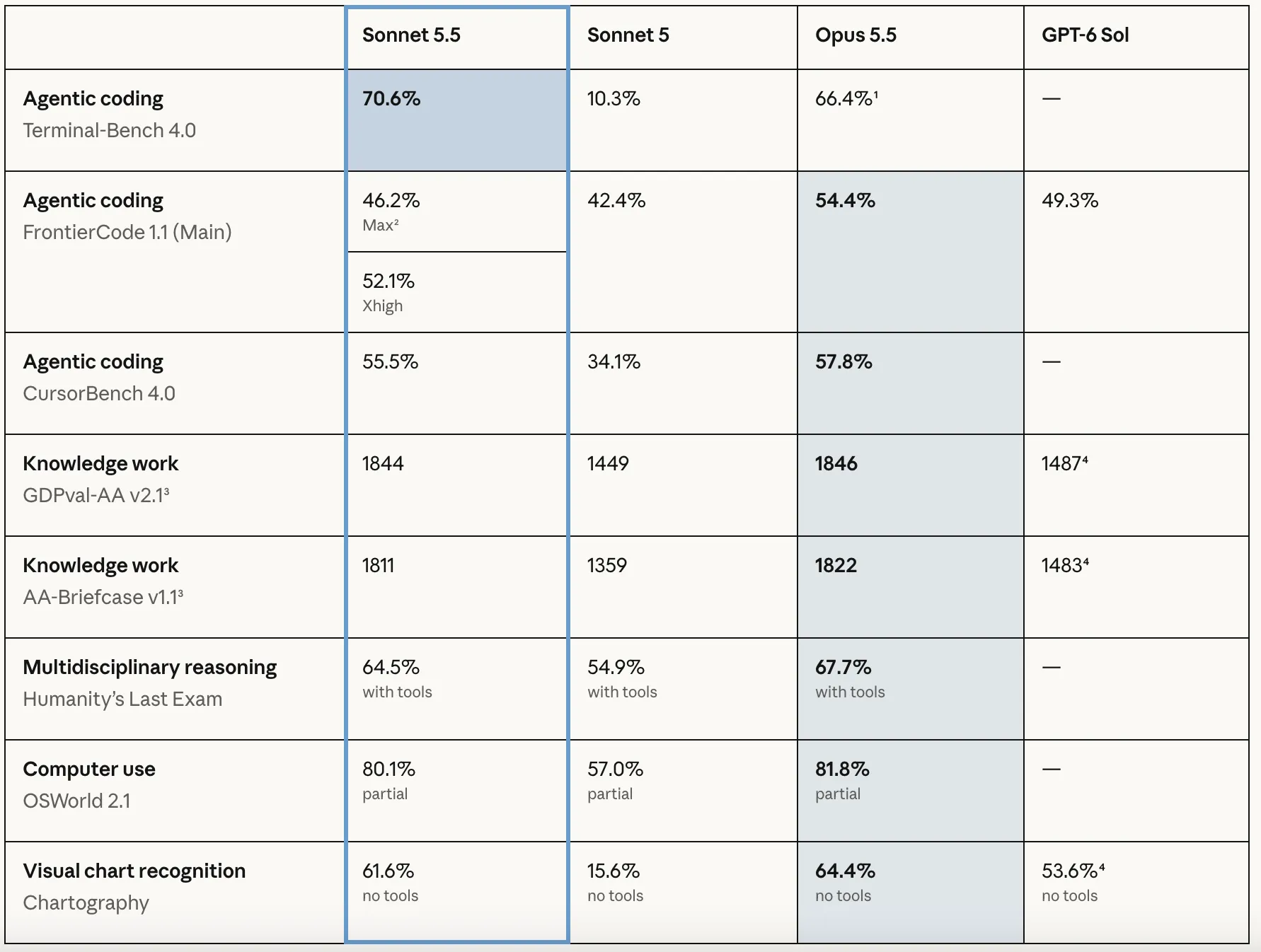
On capabilities, Sonnet 5.5 is specially optimized for "well‑scoped everyday tasks," including:
- Coding and software development: quickly understanding codebases, planning small‑scope changes, fixing bugs and performing code reviews. It scored about 70.6% on the Terminal‑Bench 4.0 agent programming test, substantially higher than the prior Sonnet 5 (around 10.3%), and in some settings outperformed the more expensive Opus 5.5.
- Knowledge work and office output: generating concise documents, slides and spreadsheets; supporting template‑based presentations, UI refinement and reducing manual post‑editing.
- Agent collaboration: suited as an efficient execution unit in multi‑agent systems, capable of parallel task handling while keeping costs controllable.
Early testers reported clearer, more human‑like writing and faster iteration speeds, making it suitable for rapid experimentation and collaboration. The model also brings network security protections previously reserved for flagship models (cyber safeguards), and for the first time in the Sonnet line includes classifiers to prevent extraction of the reasoning process (reasoning extraction classifiers), while retaining bindings between thought processes and accounts to improve safety and traceability. High‑risk network requests will explicitly fall back to Sonnet 5.
In composite evaluations such as the Artificial Analysis Intelligence Index, Sonnet 5.5 reached 56 points under maximum‑effort settings, second only to Opus 5.5, and on end‑user tasks and knowledge‑work benchmarks it approached or matched flagship performance, though with higher token consumption. Anthropic indicated that Haiku 5.5 (targeted at high‑throughput fast tasks) will be released soon, completing the 5.5 product family.
Availability: general users can access it on Claude.ai (web, iOS, Android); developers can connect via the Claude Platform, Amazon Bedrock and other cloud services. Inference within the U.S. can optionally be billed at 1.1x pricing.
Positioning vs. the Previous Generation and Competitors
Sonnet 5.5 is explicitly designed as a "faster, lower‑cost complement" to Opus 5.5. Opus 5.5 is priced at input $4 per million tokens and output $20 per million tokens and is better suited to complex, high‑difficulty tasks; Sonnet 5.5 offers near‑flagship daily‑task performance at roughly half the token price, making it cost‑effective especially in parallel‑deployable agent scenarios. Compared with contemporaneous models from OpenAI, Google and others, Anthropic emphasizes efficiency and collaboration experience in well‑scoped workflows rather than chasing the absolute top benchmark scores.
This release comes as Anthropic advances IPO preparations and amid heightened industry discussion about AI risk and safety. Bringing stricter safety limits down into a mid‑tier model reflects the company's strategy of balancing performance with safety.
Potential Impacts
1. Faster enterprise adoption
Lower effective costs and higher speed make it easier for small teams and large‑scale agent deployments to adopt the Claude family. Penetration of coding, document automation and office workflows is likely to increase, and for current Sonnet users upgrades will incur almost no extra cost.
2. Intensified mid‑tier competition
By delivering near‑flagship performance at mid‑tier prices, Sonnet 5.5 directly challenges other vendors' mid‑to‑high‑end model positioning. If benchmark and real‑world workflow results are validated, competitors may respond on speed, token efficiency or pricing.
3. Downward spread of safety standards
Introducing advanced cyber safeguards and reasoning‑extraction protections into the Sonnet line signals Anthropic's move to standardize higher safety requirements. This responds to concerns raised by recent agent overreach incidents and may push the industry to make such protections commonplace rather than flagship‑only.
4. Product‑matrix completion and commercial effects
Together with Opus 5.5 and the upcoming Haiku 5.5, Anthropic forms a clearer "flagship—mid‑tier—lightweight" stratification. For a company preparing to go public, a broader product line helps expand enterprise coverage and recurring revenue. More efficient models also help relieve inference‑cost pressure on corporate budgets.
5. Developer ecosystem and workflow changes
Faster responses and lower token usage suit frequent‑iteration development and collaboration. API users can more finely control the level of "thinking" effort, optimizing cost‑quality trade‑offs. Over time this may encourage more multi‑model routing practices—simple tasks handled by Sonnet, complex tasks escalated to Opus.
Conclusion
Claude Sonnet 5.5 is not merely a stacking of parameters or benchmarks but a targeted upgrade focused on practical work efficiency and cost. Delivering both speed and token‑efficiency gains while maintaining pricing, and simultaneously strengthening safety protections, makes it a highly competitive mid‑tier option. For developers and enterprises it provides a more economical solution for everyday agents and knowledge work; for the industry it reaffirms that mid‑tier models can approach flagship performance. With Haiku 5.5 following and more real‑world validation, the Claude 5.5 family is likely to further solidify Anthropic's position in enterprise AI workflows.
▶️ Enjoyed this article? Creating content is hard!
Follow our YouTube channel:
AI Rosetta
Your likes, subscriptions and shares are our greatest support! 🙏
For more AI news visit: https://www.airosetta.com