
September 30, 2025, one day after China’s prominent AI company Deepseek released the DeepSeek‑V3.2‑Exp version, Anthropic, a global leader in code generation, officially launched its latest model Claude Sonnet 4.5, positioned around "long‑term autonomous execution + enhanced coding + stronger reasoning" as its core strengths. Compared with its predecessor, 4.5 achieves multiple breakthroughs in code durability, tool collaboration, reasoning ability, and system ecosystem integration, and is positioned as the company’s most aligned and most powerful frontier model.
Key breakthroughs and highlights
1. Significant improvement in long‑duration autonomous operation capability
Anthropic noted in the announcement that in internal tests a customer ran the model for more than 30 hours of continuous, unattended coding to build a complete web application. This far exceeds its previous version (Opus 4, in some instances, sustained about 7 hours). This long‑run capability enhances Claude’s potential for long‑term task execution.
This capability means the model has greater endurance when facing complex tasks spanning hours or days (such as continuous data processing, automated script execution, or robotic control), and is less likely to lose coherence due to context fragmentation or internal state decay.
2. Evolution in coding capabilities and tool collaboration
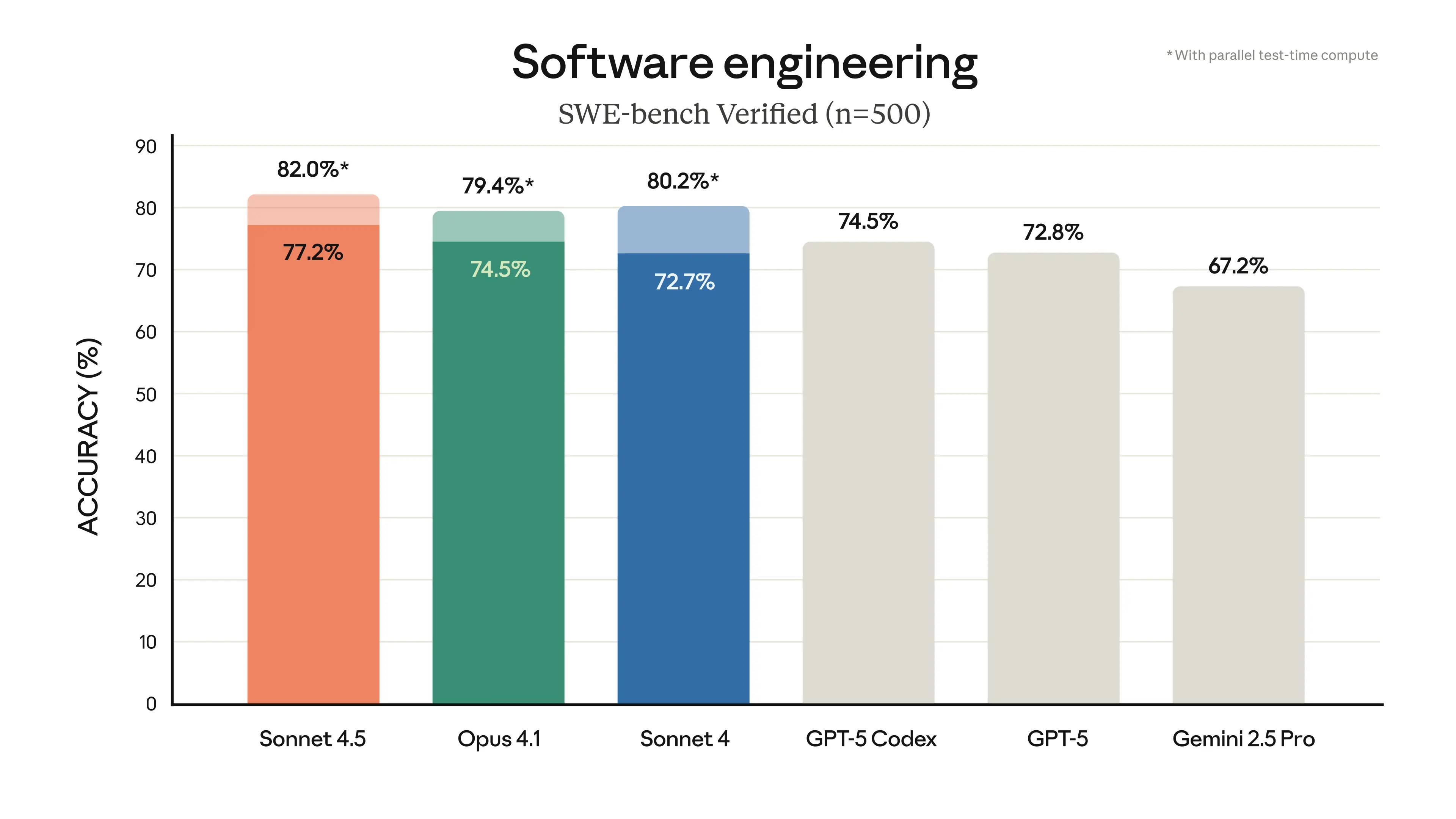
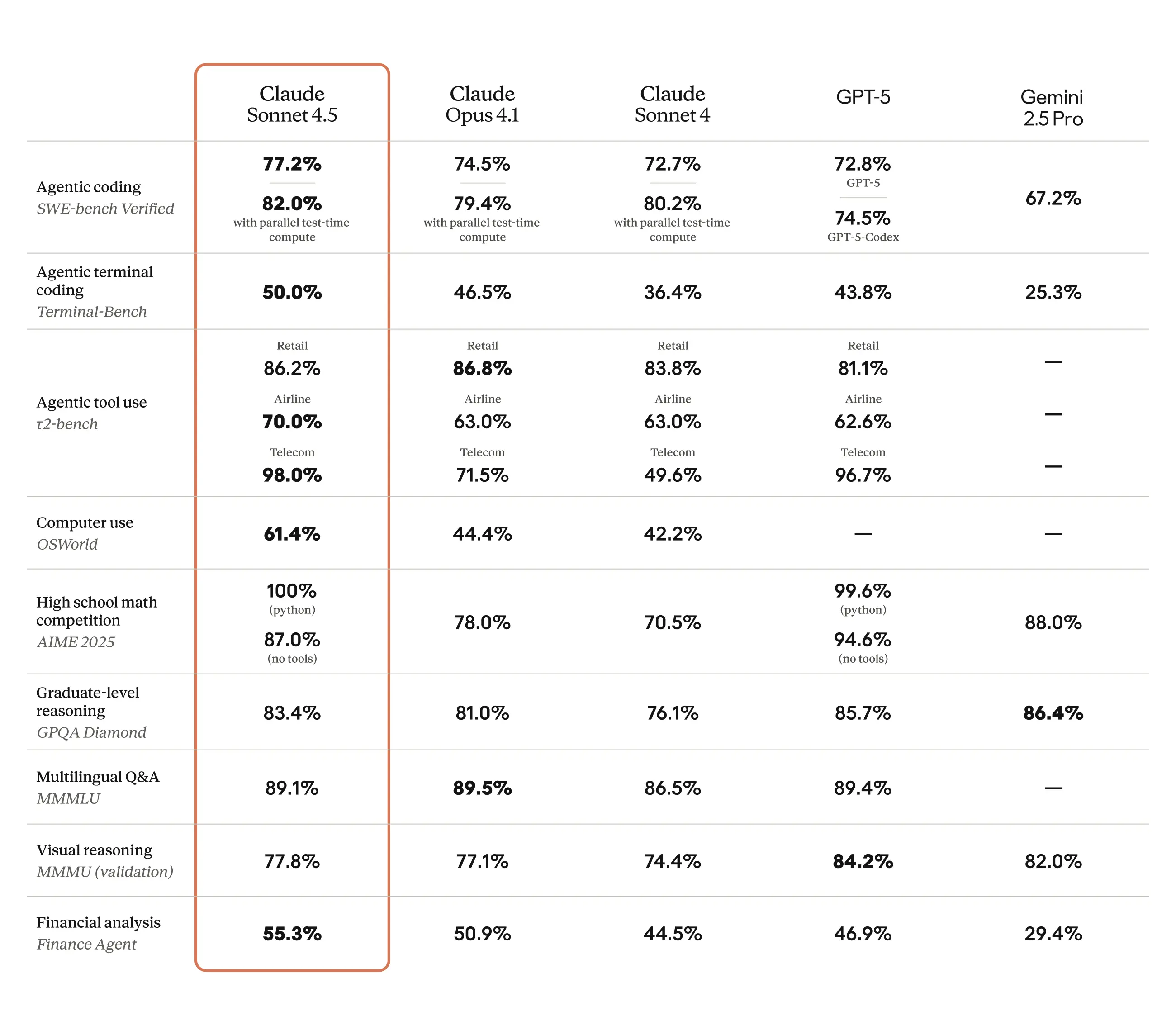
In the technical update, Anthropic emphasizes that Sonnet 4.5 is the "best coding model" in the world, particularly skilled at building complex agent systems and automation tools. The announcement states that 4.5 delivered top‑tier performance on SWE‑bench Verified (a benchmark measuring real‑world software engineering capabilities).
- "Checkpoints": Users of Claude Code can save progress and roll back states, a practical version‑control feature for long coding sessions. Anthropic
- Native VS Code extension and refreshed terminal interface: Enhances seamlessness and efficiency in the development environment.
- Claude Agent SDK: Anthropic is opening the internal framework and tools used to build agents to developers, making it easier to create composable, context‑aware agents.
These improvements enable Sonnet 4.5 to more smoothly coordinate across the chain of "understand intent → draft plan → call tools → execute actions."
3. Leap in OSWorld and real‑world operational tasks
Claude 4.5’s performance on the OSWorld benchmark is particularly notable: official data show its score on real computer tasks (such as interface operations, file manipulation, and software use) rose from Sonnet 4’s ~42.2% to 61.4%. This indicates a substantial enhancement in the model’s ability to control computer environments and perform system‑level operations.
In operating system and computer‑use capabilities, 4.5 is marketed as the "strongest model," able to navigate in a browser, fill forms, run scripts, and manipulate interfaces directly.
4. Improved reasoning, math, and alignment performance
Anthropic also emphasized that Sonnet 4.5 shows notable improvements in reasoning and math tasks and is the company’s most aligned frontier model to date. Compared with earlier versions, it includes multiple optimizations in behavioral alignment: reducing sycophancy, deception risk, power‑seeking tendencies, and hallucinations.
Additionally, on system safety, 4.5 is incorporated into the ASL‑3 (Artificial Intelligence Safety Level 3) protection framework, with inputs and outputs subjected to multi‑layer classifiers, particularly addressing chemical/biological/nuclear/radiological (CBRN) risk content. Anthropic says its classifier false‑positive rate has been significantly reduced.
5. Launch with unchanged pricing and backward compatibility
Notably, Anthropic claims Sonnet 4.5’s API pricing remains the same as Sonnet 4: $3 / $15 (input / output token) unchanged. In other words, users can upgrade to 4.5 without incurring higher costs.
Furthermore, 4.5 is backward‑compatible in deployment: whether you access it through Claude apps, the API, or Claude Code, claude-sonnet-4-5 is available as a direct option. Anthropic views it as a "seamless upgrade" to the Sonnet series.
Background and industry significance
This release is more than a routine version update; it represents a significant deployment in the battle over AI as agents and automation tools. In recent years, building AIs that can execute complex tasks over long durations has been seen as the next competitive frontier, with continuous runtime, coding, and tool collaboration typically bottlenecking progress. Sonnet 4.5’s multi‑dimensional advances could open clearer paths to deployment in enterprise AI, intelligent programming assistants, and automated agents.
In market competition, the launch of Claude 4.5 arrives amid an accelerated iteration cycle among AI model camps. OpenAI, Google, Anthropic and others are all doubling down on agent capabilities to compete for the coding/automation/agent market. From this perspective, 4.5 is not only a technical update but also a strategic move by Anthropic to consolidate its position among enterprise and developer users.
Summary
The release of Claude Sonnet 4.5 brings the following major breakthroughs:
- Autonomous execution capability extended to over 30 hours
- OSWorld score for real system‑operation tasks jumped to ~61.4%
- Enhanced coding capabilities with developer‑grade tools (checkpoints, Agent SDK, VS Code extension)
- Comprehensive upgrades in reasoning, math ability, and alignment performance
- Unchanged API pricing and downward compatibility to lower upgrade barriers
It is expected that, over the coming months, as developer and enterprise customer feedback and benchmark results emerge, Claude 4.5 will become an important benchmark in AI programming, agent applications, and task automation.