
The Riemann Hypothesis, long called the "crown jewel" of mathematics, is a deep conjecture about the distribution of prime numbers. In simple terms, primes are the basic "atoms" of the number world—numbers divisible only by 1 and themselves, such as 2, 3, 5, 7, 11. Although they appear scattered through the integers, they hide a deeper order. In 1859 the German mathematician Bernhard Riemann proposed that all the "nontrivial zeros" of a special function that encodes the distribution of primes (the Riemann zeta function) lie exactly on a specific vertical line in the complex plane (with real part equal to 1/2). If true, the distribution of primes would become highly predictable and many results in number theory would follow; if false, numerous results depending on it would need reevaluation. It is one of the seven Millennium Prize Problems announced by the Clay Mathematics Institute in 2000, with a $1 million prize, and remains formally unresolved.
Centuries of hard work
Since Riemann proposed the conjecture, mathematicians have never stopped trying. In the early 20th century, Hardy, Littlewood and others proved infinitely many zeros lie on the critical line; with the advent of computers in the mid‑20th century, trillions of zeros have been checked and found to satisfy the condition, but a proof for "infinitely many" in the required sense remains elusive. From the late 20th century into the 21st, tools from analytic number theory, algebraic geometry, and automorphic forms have been introduced, gradually raising lower bounds on the proportion of zeros provably on the line. In recent years, artificial intelligence has begun to assist research: in August 2026 Anthropic published progress by Claude that raised a certain lower bound from about 41.6% to 67.2%, while noting it did not expect these methods to directly resolve the full conjecture. Human mathematicians continue to work via traditional means, with proofs often requiring years or decades of sustained effort.
This episode: AI‑assisted and purely human proofs appear almost simultaneously
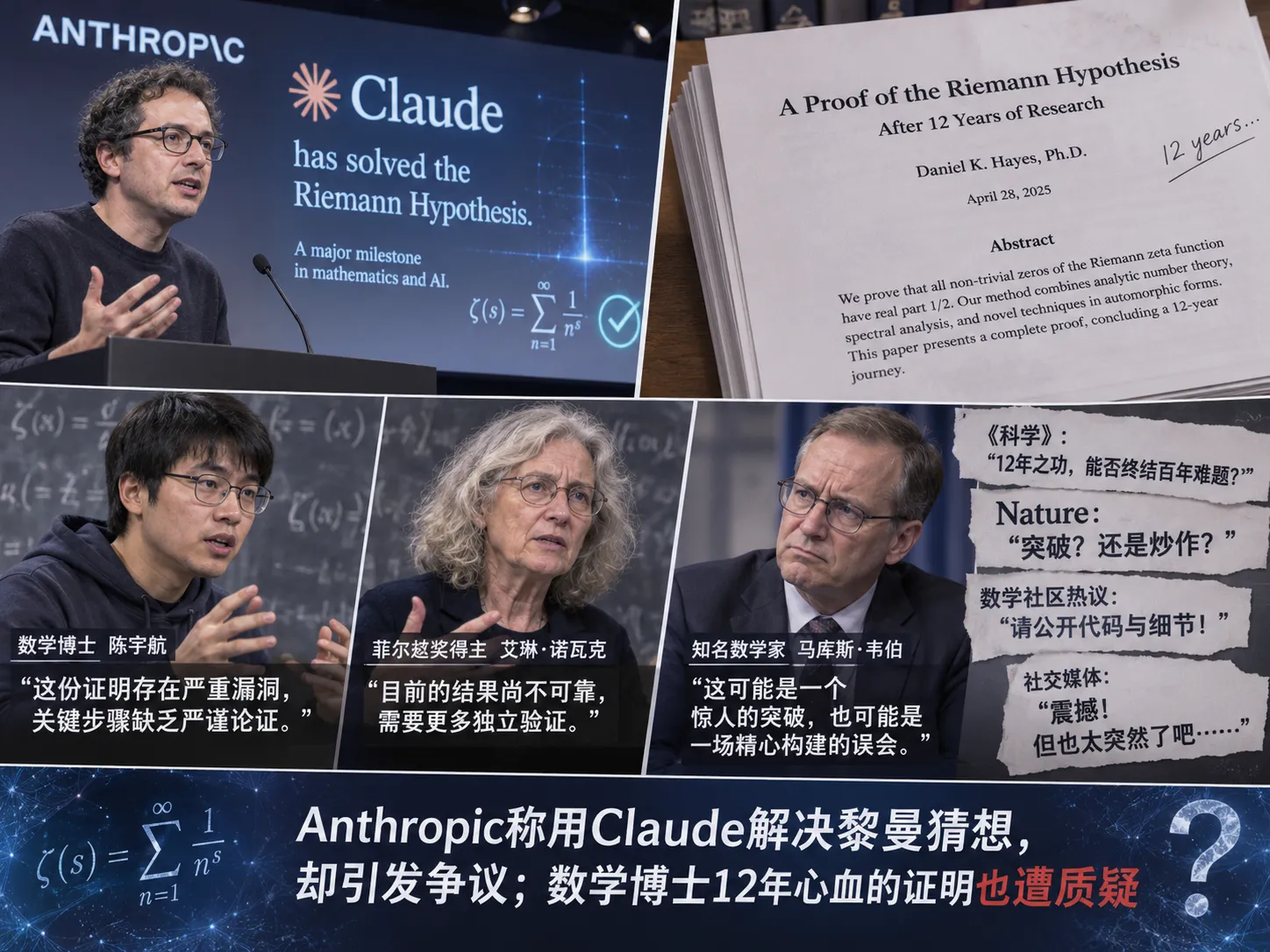
On November 20, 2026, Anthropic researcher Levent Alpöge posted a statement on his personal website claiming that he and the company AI model Claude had discovered a proof of the Riemann Hypothesis, and that the same approach could be extended to the Generalized Riemann Hypothesis. Alpöge, who holds a Ph.D. in mathematics from Princeton and works at Anthropic, said he guided the research direction while Claude "far exceeded him" in later stages and proposed crucial technical steps. The complete formal proof is said to exceed 250,000 pages and has not been released due to its size; instead, the proof is provided as Lean formalization code split into 14 compressed packages, totaling about 17 million lines for machine‑assisted, step‑by‑step verification of logical correctness.
The timing of the announcement followed Anthropic's largest‑ever IPO on November 19. Alpöge said that after completing a key step late on the night of November 15 to 16 he contacted company CEO Dario Amodei to discuss the timing of disclosure. Anthropic has not issued an official response.
Almost simultaneously, Stanford postdoctoral researcher Alessandro Masullo released an independent draft proof via American Mathematical Society president Ravi Vakil. That work, reportedly taking 12 years, is a fully human‑written draft without AI assistance, about 940 pages long, and chiefly addresses the Generalized Riemann Hypothesis. Vakil said the proof had already been reviewed for months by Stanford experts including Brian Conrad and was intended for further polishing before formal publication, but the emergence of the AI‑related announcement prompted early public release of the current draft. Masullo emphasized in his introduction: "We are still here, we are active, and we are not going away." The comment has been read as a response to the growing AI‑led atmosphere in mathematical research.
Reactions and points of controversy
The episode quickly sparked wide discussion across the mathematics and technology communities. Some experts reported optimism after preliminary compilation of Alpöge's Lean code: independent compilers run by MIT mathematician Andrew Sutherland and others showed the code compiles under standard axioms, suggesting "the probability of a major issue is close to zero." Fields Medalists including James Maynard said that if confirmed, this would be a milestone in the history of mathematics. At the same time, scholars noted that fully understanding 17 million lines of code and the complex machinery involved—automorphic forms, Galois representations, and so on—will take time, and the lack of a human‑readable text makes scrutiny harder.
The controversy focuses on three main points: first, verification standards. Traditional mathematical proofs require peer reading and comprehension, whereas extremely large AI‑assisted formalizations can be checked by computer yet remain hard to "understand" by humans. Second, the roles of AI and humans. Alpöge stresses human–machine collaboration, but descriptions that Claude led key breakthroughs have prompted debate over whether mathematical creativity is being supplanted. Third, the near‑simultaneous emergence of two independent proofs could lead to mutual confirmation or methodological competition; Masullo's work has been interpreted as a defense of the purely human mathematical tradition.
At present both proofs are in preliminary public and independent verification stages and have not undergone formal peer review or journal publication. Authoritative bodies such as the Clay Mathematics Institute have not yet commented. The mathematical community is calling for calm: whichever (or both) proofs are ultimately confirmed will profoundly reshape number theory and broader mathematics, and the role of AI in frontier pure mathematics will become a long‑term subject of debate.
The episode occurred just after Anthropic's public listing and coincides with accelerating AI progress in mathematical proofs in recent years. It showcases the potential for AI‑assisted solutions to century‑old problems while reminding that genuine mathematical breakthroughs require rigorous verification and deep human understanding. Subsequent independent reviews will decide whether this becomes a turning point in the history of mathematics.
Supplement: Terence Tao and Yitang Zhang's responses
Fields Medalist Terence Tao and 2026 Fields Medalist Yitang Zhang have publicly commented on Levent Alpöge and Claude's claimed proof of the Riemann Hypothesis (and its generalized form), adopting largely cautious stances.
Terence Tao's response
On his personal blog Tao provided an initial analysis. He noted that from a very preliminary perspective the proof appears to synthesize elements of the Langlands program and modern arithmetic geometry, showcasing the breadth of contemporary number‑theoretic tools.
He compared this result with other recent major achievements (such as certain fluid‑equation singularity proofs) and judged that the work on the Generalized Riemann Hypothesis is currently among the most "raw"—that is, hardest to digest—because its primary form is Lean formalization code with a lack of a human‑readable exposition. The mathematical community will require substantial time to extract the core ideas and verify correctness.
Tao also noted a positive factor: unlike results generated entirely by AI, this work has at least one human author available for communication, which could aid later explanation and verification. He also echoed his earlier view in a Numberphile interview—about a month earlier (October 2026) he had estimated that AI realistically touching the Riemann Hypothesis might occur around 2050, with deep human–AI collaboration.
Yitang Zhang's response
Zhang's remark was more direct. According to reports, when asked he said: "I won't even look at it until there's something like 500 readable pages." His comment reflects reservations about the current format—Alpöge's public materials mainly consist of about 17 million lines of Lean code and an asserted over‑250,000‑page manuscript that has not been released. Zhang believes it is premature to expend verification effort until a sufficiently polished, human‑readable version appears.
Summary
Both Fields Medalists emphasized that verification and understanding will take time and did not categorically accept or reject the proofs. Tao observed deep use of modern number‑theoretic frameworks and valued the involvement of a human author; Zhang stressed readability and review thresholds. The community's prevailing view is that successful compilation of the Lean code is an encouraging sign, but comprehensive peer review and a human‑understandable core logical exposition remain decisive. Subsequent progress will hinge on the release of readable versions and independent validation results.
▶️ Enjoyed this piece? Content creation is hard work!
Welcome to follow our YouTube channel:
AI Rosetta
Your likes, subscriptions and shares are our greatest support! 🙏
More AI news at: https://www.airosetta.com