
On September 22, 2026, Anthropic officially released Claude Opus 5.5, the first model in the Claude 5.5 series. The company says it reaches Claude Fable 5.1‑level performance on most tasks, while reducing operating costs for typical workloads by about 40% compared with the previous Opus 5 and increasing output speed by over 30%. This release is Anthropic's first major model update after CEO Dario Amodei publicly called for "slowing the pace of frontier capability releases."
Details
Opus 5.5 is positioned as Anthropic's main model for upper‑mid‑tier capabilities, aimed at long‑running coding, agent tasks, and professional knowledge work. The company emphasizes a marked improvement in practical performance on complex engineering tasks; early testers report significant efficiency gains in large‑scale code migrations and long‑running agent workflows. The communication style has also been adjusted: it uses less jargon and idiosyncratic phrasing, and places important information earlier to facilitate rapid reading and collaboration.
Pricing and efficiency
- Input: $4 / million tokens
- Output: $20 / million tokens
- Cache reads: $0.20 / million tokens (60% lower than Opus 5)
Anthropic estimates that combined costs for typical agent and coding workloads fall by about 40%. A Fast mode is also offered (input $8, output $40 / million tokens), which can achieve up to roughly 2.5× the speed. The context window remains at 1,000,000 tokens and supports text and image inputs.
Benchmarks and capabilities
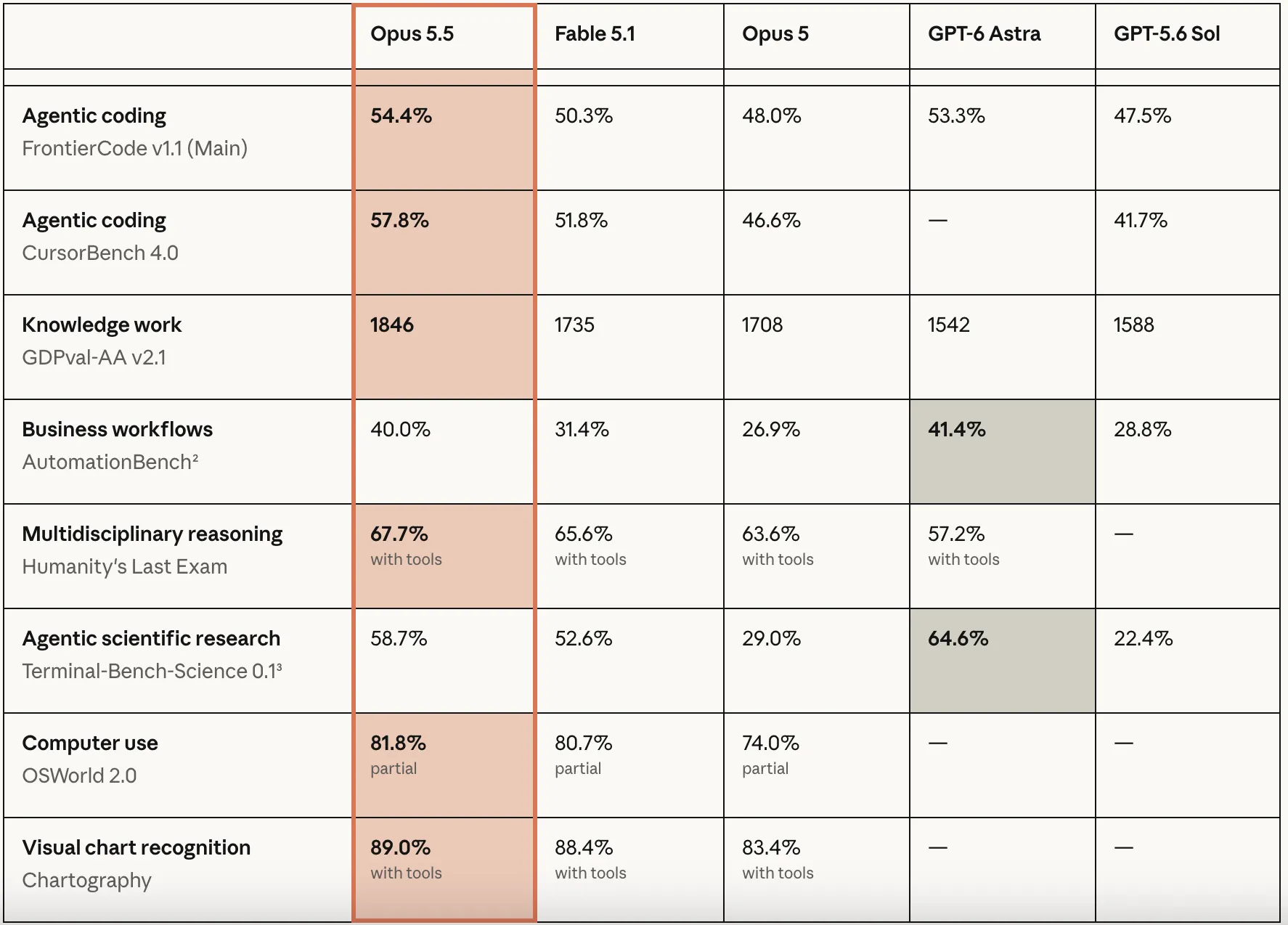
Anthropic's published data shows Opus 5.5 leading or matching Fable 5.1 on multiple tests including agent coding, computer use, and knowledge work. Reported gains include improvements on agent coding benchmarks such as Terminal‑Bench 4.0 and leadership on knowledge‑work evaluations like GDPval‑AA. Preliminary results from independent evaluation platforms also indicate notable performance on composite intelligence measures. It should be noted that most figures so far come mainly from the vendor and early third parties, and full reproduction is still underway.
Safety and release process
Opus 5.5 underwent evaluations by external security research firms (including METR and Frontier Design) prior to release, and inherits the safety protections previously applied to Anthropic's strongest models. The company says it performed better than its predecessor in internal behavior audits and showed a significantly reduced tendency to attempt to circumvent limits in certain boundary tests.
Availability
The model is available on the Claude platform (API ID: claude‑opus‑5‑5) and has been rolled out on AWS, Google Cloud and Microsoft Azure. Anthropic also said that Sonnet 5.5 and Haiku 5.5 from the same series will be released in the coming weeks.
Potential impacts
1. Intensified price‑performance competition for high‑end models
With near‑Fable performance at considerably lower unit prices, Opus 5.5 compresses the space where "top‑tier models must be expensive." Lower per‑unit costs for long‑running agents and large‑scale coding tasks could accelerate application deployment. Price and capability comparisons with contemporaneous products from OpenAI, Google and others will likely become more heated.
2. A real‑world test of safety and release‑rhythm narratives
This release is explicitly labeled as the first model after the call to slow frontier progress. Anthropic has introduced external evaluations and strengthened its safety stack to address concerns, while still iterating capabilities quickly. This highlights the industry tension between demonstrating technical leadership and addressing critiques that capability growth outpaces governance. The follow‑up cadence for Sonnet and Haiku will be watched to assess execution.
3. Improvements to workflows and communication experience
Adjustments to output style (placing key information up front and reducing jargon) may seem minor but can materially affect professional users and agent collaboration scenarios. A clearer feedback structure helps reduce human review costs and improve human‑AI collaboration efficiency. Combined with faster speeds and lower cache prices, the economics of long conversations and multi‑round agent loops improve significantly.
4. Ecosystem and market dynamics
Simultaneous availability on major cloud platforms lowers enterprise adoption barriers. For Anthropic, Opus 5.5 could strengthen its position in coding and enterprise knowledge‑work tracks; for the market, it reinforces a norm of rapid iteration for mid‑to‑high‑end models coupled with price reductions. Developers are likely to choose models by task rather than rely solely on the most expensive flagship.
Conclusion
The core significance of Claude Opus 5.5 is not merely updating benchmarks but offering near‑top‑tier abilities at lower cost while seeking a balance among performance, price and safety narratives. It marks Anthropic's opening for the 5.5 series and reflects a new stage in the AI race: simultaneous advances in capability and cost reduction, with external safety evaluation becoming a release standard. Its long‑term impact will depend on stability in real workflows, third‑party reproduction, and the follow‑through pace of subsequent models in the series.
▶️ Like this article? Creating it takes real effort!
Follow our YouTube channel:
AI Rosetta
Your likes, subscriptions and shares are our greatest support! 🙏
For more AI news visit: https://www.airosetta.com