
On 2026‑07‑24, Anthropic officially released Claude Opus 5. The company says the model's intelligence now approaches that of the previous flagship Claude Fable 5 while costing half as much, positioning it as a “powerful model for everyday use.” The announcement quickly became a focal point in the AI community, marking a key step by Anthropic in balancing performance and cost.

Claude Opus 5 Positioning and Pricing
Claude Opus 5 is the latest flagship in Anthropic’s Opus series, designed for complex agentic coding, enterprise workflows and long‑sequence tasks. The company describes it as “thoughtful and proactive,” delivering high intelligence while significantly improving efficiency.
Pricing comparison (per million tokens):
- Claude Opus 5: input $5, output $25
- Claude Fable 5: input $10, output $50
- Claude Opus 4.8 (previous generation): input $5, output $25
Opus 5 substantially improves performance at the same cost as the prior Opus 4.8, while offering near‑leading capabilities at half the price of Fable 5. It has become the default model for Claude Max and is the most capable available model in Claude Pro.
Performance Comparison: A Daily‑Usable Option Approaching Fable 5
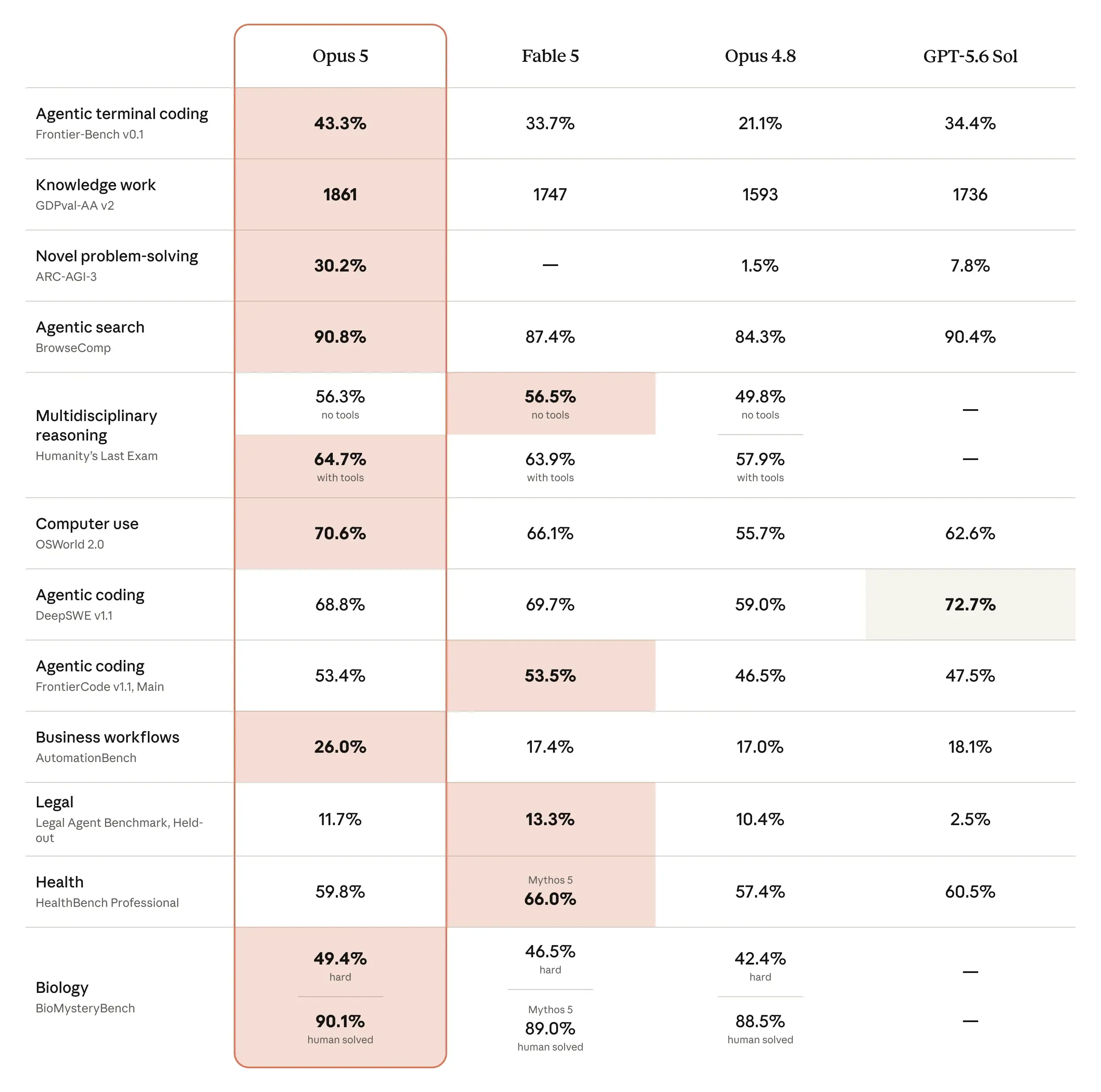
Official and third‑party evaluations show Claude Opus 5 performing strongly across several key benchmarks:
- Agentic coding and long‑context work: Significantly better than Opus 4.8, approaching or even surpassing Fable 5 in some scenarios.
- Knowledge work and mathematical/scientific reasoning: Overall capability markedly improved, suitable for complex multi‑step tasks.
- Computer use and tool calling: Noticeable improvements, supporting more reliable enterprise‑grade agent workflows.
- Third‑party tests such as ARC‑AGI: Achieved a new high on ARC‑AGI‑3 (High mode 30.2%), with strong logical reasoning performance.
Compared with Fable 5, Opus 5 is superior in “everyday usability”: more efficient reasoning, more controllable token consumption, and partial leads in coding and knowledge‑work evaluations. Fable 5 still retains advantages in some high‑risk, dual‑use capabilities (e.g., cybersecurity), but Opus 5 applies more balanced safety filtering, reducing excessive blocking.
The model’s knowledge cutoff is May 2026 and it supports a 1M context window, making it suitable for long documents and complex projects.
Release Background: Responding to Competition and Cost Pressure
Although Claude Fable 5 (released June 2026) delivered top‑tier performance, its high pricing and token consumption limited large‑scale daily use. OpenAI’s GPT‑5.6 series, updates to Google Gemini, and rapid iteration of Chinese large models have also put pressure on Anthropic.
The release of Opus 5 addresses these pain points: through architectural optimization and training improvements, Anthropic aims to maintain near‑leading intelligence while significantly reducing usage costs, shifting models from “specialized‑task” to “everyday workhorse.”
Potential Impact: Multi‑Dimensional Industry Effects
1. Impact on Anthropic itself
- Increased user stickiness: More accessible pricing helps expand the Claude ecosystem, especially among Max and Pro users.
- Accelerated commercialization: A powerful model suitable for daily use will drive API and enterprise subscription growth.
- Clearer product lineup: Fable 5 continues to serve the highest‑end needs while Opus 5 becomes the value‑oriented flagship.
2. Impact on developers and enterprises
- Significantly lower costs: Running complex agent tasks becomes half as expensive, lowering deployment barriers.
- Faster application rollout: Scenarios like coding, knowledge work, and long‑sequence agents are easier to implement.
- Optimized routing strategies: Enterprises can flexibly switch between Opus 5 and Fable 5.
3. Impact on AI industry competition
- Escalation of price competition: Forces rivals like OpenAI and Google to reconsider high‑end model pricing.
- Trend toward everyday use: Pushes the industry from “flagship showmanship” toward “high‑cost‑performance practicality.”
- Pressure on Chinese models: Domestic large models will need to further close gaps in both performance and cost.
4. Potential challenges
- Fable 5 positioning: High‑end users may still prefer Fable 5 for extreme capability needs.
- Safety and alignment: Ongoing balancing of performance and the strictness of safety filters is required.
- Compute and supply chain: Large‑scale daily usage could increase infrastructure pressure.
Industry Takeaway: Balancing Performance and Cost Is Key
The release of Claude Opus 5 demonstrates that in the AI race, pursuing peak performance alone is insufficient. Achieving near‑leading capability while dramatically lowering costs and improving everyday usability is the key to winning market adoption.
With Opus 5, Anthropic again shows its agility in model iteration and commercialization. As more efficient models emerge, AI will move faster from the lab into routine production tools.
▶️ Enjoy this article? Creating content is hard work!
Follow our YouTube channel:
AI Rosetta
Your likes, subscriptions and shares are our greatest support! 🙏
More AI news at: https://www.airosetta.com