
On April 16, 2026, Anthropic officially released Claude Opus 4.7, a major model upgrade following Opus 4.6. The model is available on the Claude web app, mobile apps, and via the API, and is offered to enterprise customers through cloud platforms including Amazon Bedrock, Google Vertex AI, and Microsoft Foundry. Anthropic positions it as "currently the most powerful generally available model", with notable improvements in complex programming, long‑range reasoning, vision tasks and knowledge work, marking another breakthrough in the Claude series' agentic capabilities.
The release of Opus 4.7 comes amid intense competition in AI agents and coding tools. Although a previous leak of Anthropic's Claude Code source raised security concerns, it accelerated community exploration of agent frameworks. The launch of Opus 4.7 is seen as Anthropic's response to the open‑source community's challenges with a stronger foundational model.
Key innovations: major gains in agentic coding and long‑range temporal capabilities
The headline feature of Opus 4.7 is the strengthened agentic coding capability. Compared with version 4.6, Opus 4.7 further improves scores on software engineering benchmarks such as SWE‑Bench Pro, and can more reliably handle multi‑file collaborative editing, long‑sequence code refactoring and complex project planning. The model supports a 1M context window (available to some high‑priority users via specific commands) and includes tokenizer optimizations that improve long‑context processing efficiency and consistency.
Another important innovation is the deep fusion of vision and code. Opus 4.7 performs more accurately when handling high‑resolution images, charts and code screenshots, directly understanding UI mockups, architecture diagrams or error screenshots and generating corresponding code or repair suggestions. This capability brings it closer to a "truly usable programming partner" in real development scenarios.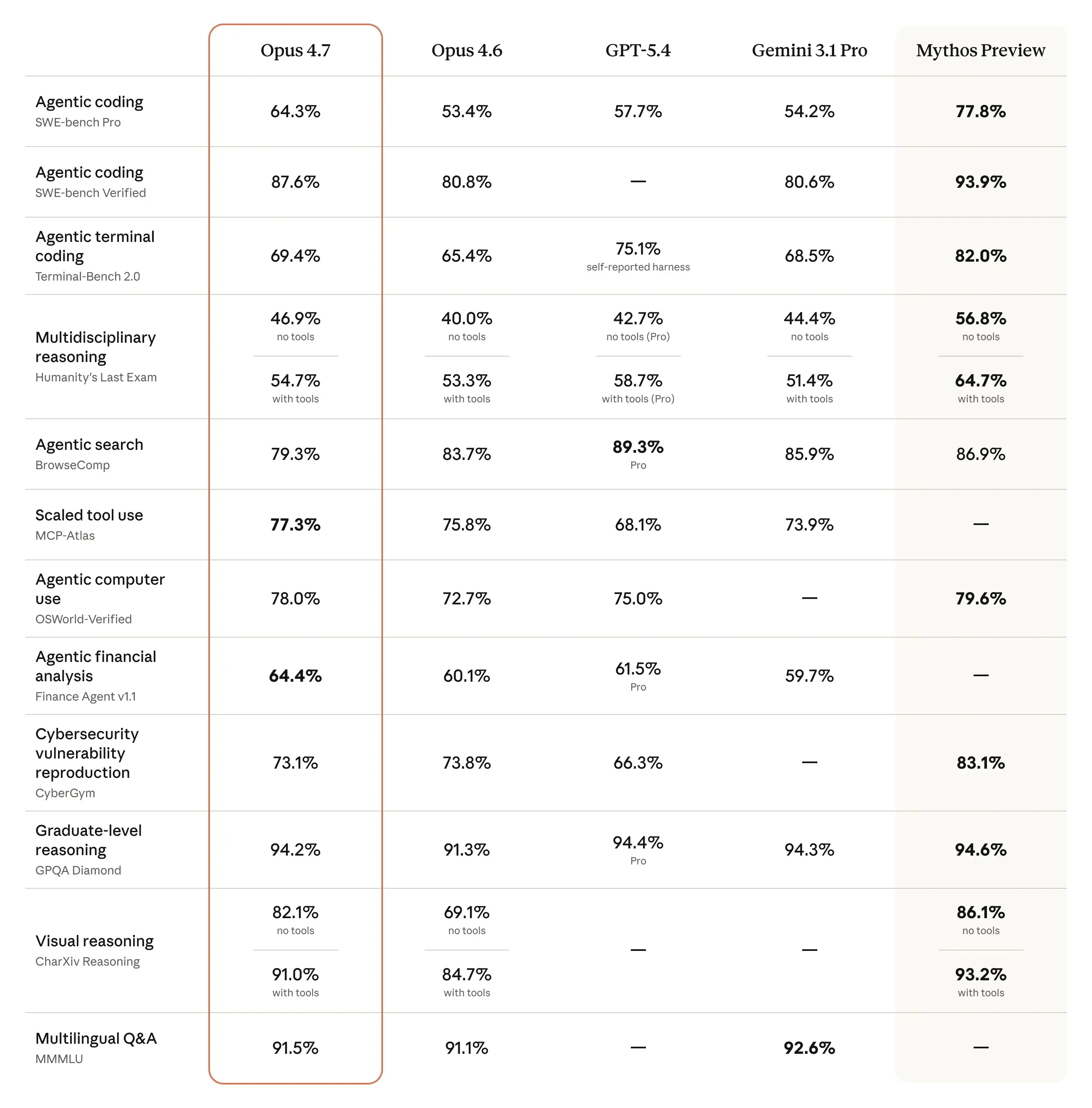
In addition, Opus 4.7 shows significant progress in long‑range reasoning and knowledge work. It maintains cross‑turn conversational context more effectively, reduces hallucinations, and demonstrates stronger logical coherence in complex research, report writing and multi‑step planning tasks. Anthropic says these improvements stem from targeted optimizations in large‑scale post‑training, especially reinforcement learning and self‑verification mechanisms tuned for agentic tasks.
Key Technical Change: New Tokenizer Increases Token Consumption by 0%‑35% Opus 4.7 introduces a brand‑new tokenizer. While this change significantly improves the model's ability to understand long contexts and complex structures, it also brings a significant impact: the same input text consumes 0% to 35% more tokens in Opus 4.7 compared to version 4.6 (the exact increase depends on the text type and language). Anthropic explicitly reminds developers in its migration guide that this change mainly stems from the new tokenizer's more refined segmentation of code, structured text, and multilingual content. Although token consumption has increased, the model's actual performance is better with the same token budget, and its overall efficiency is still higher than its predecessor.
Compared with the previous generation: from "usable" to "reliable"
Compared with Opus 4.6, Opus 4.7's improvements are mainly reflected in three areas:
- Coding capability: higher success rates and execution stability in practical software engineering tasks, particularly suited for long chains and multi‑file projects.
- Context handling: improved practical usability of the 1M window, combined with an optimized tokenizer, reducing "attention decay" in long‑context scenarios.
- Multimodal understanding: significantly enhanced accuracy and practicality in vision tasks, evolving from "able to understand" to "able to act reliably based on visual input".
In terms of pricing, Opus 4.7 retains the same rates as 4.6: $5 per million input tokens and $25 per million output tokens. This allows enterprise users to access stronger capabilities without additional cost.
Availability and ecosystem impact
Opus 4.7 is fully available to Claude Pro, Max, Team and Enterprise users, and is live on the Claude web app, mobile apps and API, as well as partner platforms such as Amazon Bedrock, Google Vertex AI and Microsoft Foundry. Developers can call the model via API or switch seamlessly within tools like Claude Code and Claude Managed Agents. Anthropic emphasizes that the model continues the "Constitutional AI" principles in its safety mechanisms, with stricter refusal boundaries and explainability tools built in, making it suitable for enterprise deployment.
The release has a direct impact on the AI agent ecosystem. Open‑source frameworks like OpenClaw and Hermes Agent have begun adapting to Opus 4.7, giving developers more powerful backend support. At the same time, Opus 4.7 intensifies competition with models such as OpenAI's GPT‑5.4 and Google's Gemini, prompting the industry to accelerate iteration on coding and long‑range reasoning capabilities.
Industry significance: AI shifting from "assistant" to "reliable partner"
The release of Opus 4.7 highlights an important trend in AI development in 2026: a shift from pure parameter‑scale competition toward a contest of practicality, reliability and agentic capability. Through continuous iteration of the Opus series, Anthropic demonstrates that, under safety and controllability constraints, closed‑source models can still maintain an edge over high‑performance open‑source models.
For developers, Opus 4.7 provides a more reliable coding assistant; for enterprises, it lowers the barrier to deploying high‑performance AI agents; for the industry, the upgrade reaffirms that AI is transitioning from a "conversational tool" into "productivity infrastructure".
Challenges and outlook
Despite its leading performance, Opus 4.7, as a new model, still requires further verification of stability in extremely complex multi‑file projects and extreme long‑context scenarios. Anthropic says it will continue to optimize based on user feedback and plans to roll out more enterprise features over the coming months.
From Opus 4.6 to 4.7, Anthropic completed a high‑quality iteration in less than two months. This pace reflects both its strong engineering capability and the brutal competitiveness of the AI track. Going forward, with more vendors releasing similar upgrades, AI coding and agent capabilities are expected to enter an explosive growth phase.
▶️ Enjoyed this article? Creating great content takes effort!
Subscribe to our YouTube channel:
AI Rosetta
Your likes, subscriptions and shares mean the world to us! 🙏
For more AI news, visit:
https://www.airosetta.com