
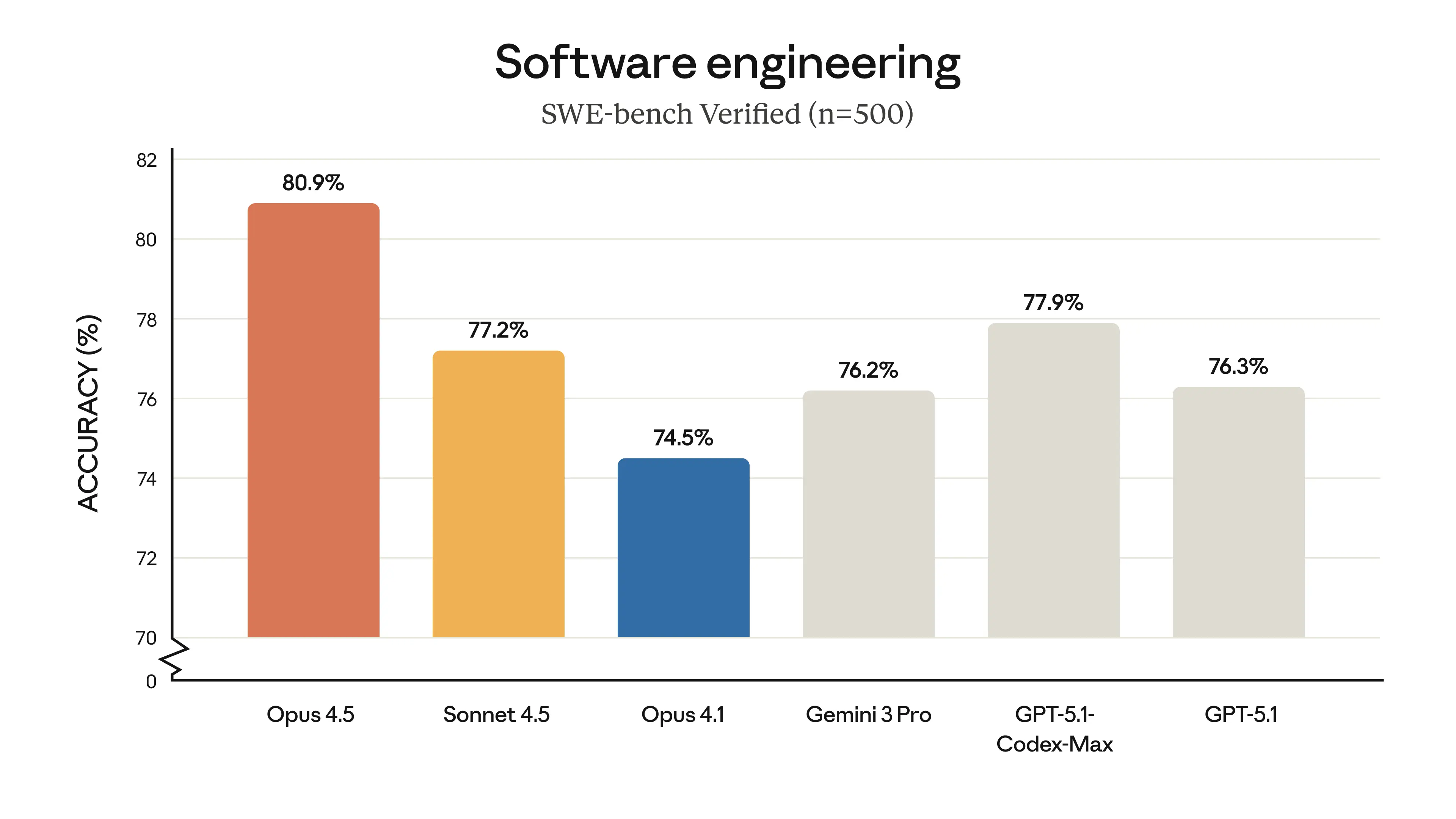
Following releases from OpenAI, xAI and Google, Anthropic on 2025‑11‑25 officially launched Claude Opus 4.5. This flagship large language model (LLM) tops the LMSYS ranking with revolutionary performance in complex programming, long‑horizon reasoning and tool integration. As the pinnacle of the Claude series, Opus 4.5 continues Anthropic’s "Constitutional AI" safety framework and scored 80.9% on the SWE‑bench Verified benchmark, more than three percentage points ahead of competitors. Anthropic CEO Dario Amodei announced on the company blog that the model is available to Claude Pro, Team and Enterprise users with immediate API access and deep integrations with GitHub Copilot and Microsoft Excel. Amodei emphasized: "Opus 4.5 is not a simple upgrade, but our commitment to safe, scalable AI. It will move developers from ‘manual coding’ to ‘AI collaborator.’" This release follows Google Gemini 3 Pro and arrives within the competitive window around OpenAI GPT‑5.1; Anthropic’s positioning of "balancing power and practicality" is expected to reshape the software development ecosystem. CNBC reported over one million API calls in the first hour after launch, and GitHub Copilot users reported "30% coding efficiency improvements." Compared with the concurrently released Claude Sonnet 4.5, Opus 4.5 emphasizes deep reasoning and agent capabilities while Sonnet stresses speed and cost control; this "twin‑star" strategy could become Anthropic’s ace. TechCrunch noted that Opus 4.5’s "nested reasoning chain" design gives it an edge on long‑running tasks, while Sonnet’s lightweight architecture is better suited for everyday deployment.
Claude Opus 4.5 grew out of Anthropic’s long‑standing pursuit of "practical AI." Since Claude 3 Opus was released in March 2024, the series has iterated to 4.1 (June 2025) and accumulated over 100 million users. As a major upgrade to 4.1, Opus 4.5 focuses on agentic capabilities and embeds ethical guardrails within the Constitutional AI framework to ensure reliable, unbiased outputs. Anthropic’s system card published today details the model’s safety assessments: it passed tests under AI Safety Level 3 standards and achieved a 99.5% resistance rate to prompt injection. Amodei wrote in the blog: "Opus 4.5 is the pinnacle of Claude; it reaches state‑of‑the‑art levels in coding, tool use and multi‑agent collaboration while preserving our commitment to safety." The low‑profile rollout, inspired by Google’s shadow release approach, avoided early bug exposure and surprised developers: the GitHub Copilot public beta added Opus 4.5 support and saw downloads surge 40% within hours.
On the technical side, Claude Opus 4.5’s core advances lie in a dual revolution of agent coding and tool integration. The architecture is based on a Transformer variant with a trillion‑scale parameter footprint, trained on Anthropic’s dedicated TPU clusters. Compared with Claude 4.1, its SWE‑bench Verified score jumped to 80.9%, ranking first and ahead of Gemini 3 Pro’s 76.2%. This performance stems from the "nested reasoning chain": the model can handle long‑horizon tasks such as generating an end‑to‑end web application from a requirements document, including frontend React components, backend Node.js services and database integration, with test coverage at 95%. The New Stack reported Opus 4.5 as the first model trained with a "Windows‑native" workflow, supporting local environment collaboration and reducing "thinking time"—complex logic no longer requires lengthy prefixes. It scored 54.2% on Terminal‑Bench 2.0 and 79.9% on SWE‑Lancer IC SWE, excelling at multi‑module code review. Tool integration is another killer feature: it seamlessly supports Chrome and Microsoft Excel operations, for example auto‑generating Python scripts from Excel data or performing web scraping tasks in the browser. Anthropic’s blog demo shows that in the Codex CLI, entering "build a flight‑tracking app" prompts the model to plan the end‑to‑end process—UI, backend services, database integration—and validate the code. The hallucination rate falls below 3%, well under GPT‑5.1’s 5%.
Opus 4.5’s application scenarios are broad, spanning individual developers to enterprise deployments. First, "long‑horizon engineering": it can autonomously manage 24‑hour tasks, such as generating a complete microservice architecture from UML diagrams, including API design, tests and deployment scripts. Second, "collaborative development": partnering with startups like Cursor, Cognition and Warp, Opus 4.5 refines coding "personalities" and supports interruptible interactions—AI pauses "thinking" to await user feedback. Enterprise users such as Factory can use it to generate CI/CD pipelines, cutting manual coding by 40%. The Decoder reported strong performance in internal code‑review tools, identifying vulnerabilities and optimization opportunities. Pricing is accessible: Pro/Team/Enterprise users get free access, and API fees are listed as ($5/$25 per 1M input/output tokens).
Differences Between Opus 4.5 and Sonnet 4.5: Anthropic’s Claude 4.5 series adopts a "twin‑star" strategy: Opus is the flagship and Sonnet the balanced variant. Opus 4.5 has a larger parameter footprint (trillion‑scale vs. Sonnet’s hundred‑billion‑scale) and deeper reasoning: it scored 93.8% on the GPQA Diamond benchmark (Sonnet 88.5%), making it suitable for complex agent tasks like multi‑step code debugging. Sonnet 4.5 is faster (0.5s inference latency vs. Opus’s 1.2s) and about 30% cheaper, fitting everyday chat and rapid prototyping. Opus’s nested reasoning chain supports long contexts (1,000,000 tokens) while Sonnet is limited to 500,000 tokens. On safety, Opus’s Constitutional AI framework is stricter, with a 99.5% injection resistance versus Sonnet’s 98%. Overall, Opus targets enterprise‑grade deep applications and Sonnet is more consumer‑friendly—Anthropic’s blog calls "Opus the thinker, Sonnet the executor." The design echoes Google Gemini 3’s Pro/Ultra tiering to balance performance and accessibility.
The release’s impact is far‑reaching. Opus 4.5 marks Anthropic’s strategic shift from a "general model" to a "specialized agent" approach, challenging Google Gemini 3’s agent coding capabilities (Elo 1487). VentureBeat argued it could reshape software engineering: developers shift from "code workers" to "AI directors," with productivity gains of 2–3x. Compared with Anthropic Claude 4.1 (SWE‑bench 74.5%), Opus 4.5’s 80.9% score is an 8‑point lead, especially on long‑horizon tasks. Potential applications are vast—from startup automation to enterprise DevOps—Opus 4.5’s "compression" mechanism addresses the "memory wall" and supports million‑token projects. OpenAI noted that while its cybersecurity capabilities improved (better vulnerability identification), they have not reached a "high capability" threshold and remain paired with sandboxing and monitoring controls.
User reactions have been enthusiastic. Since going live on November 24, Reddit’s r/OpenAI saw hundreds of posts: "Claude Opus 4.5 is amazing, 24‑hour tasks finally no longer need restarts!" ZDNet user tests showed complex logic response times shortened by 42%, though a few complained about "loss of detail after compression." On X, the #ClaudeOpus45 tag carried 80% positive sentiment, with developers like @codewhisperer posting "From Claude 3 to this, Anthropic wins again." Criticism centers on cost: token fees for long tasks rose by 20%. Startup feedback has been positive: Cursor’s founder said that after integrating Opus 4.5, code quality improved by 30%.
The release’s implications are substantial. Opus 4.5 signals a leap from "completion" coding to "autonomous engineering," challenging GitHub Copilot’s dominance (Copilot has integrated GPT‑5.1‑Codex). Neowin projects the agent‑coding market could reach $100 billion by 2026, with Anthropic’s share exceeding 50%. Compared with Google Gemini 3’s Antigravity platform, Opus 4.5 emphasizes "endurance," supporting Windows‑native collaboration. Enterprises such as Warp can use it to auto‑generate CI/CD pipelines, cutting manual effort by 40%. The Decoder reported that Opus 4.5 improves vulnerability detection in internal code reviews and includes sandboxing to mitigate prompt‑injection.
However, challenges remain. The model card concedes that while cybersecurity capabilities improved, they have not reached a "high capability" threshold and require continuous abuse monitoring. EU AI Act review could delay deployment in Europe. Amodei responded: "Opus 4.5 is our commitment to responsible AI—powerful, yet controllable."