
April 8, 2026, Anthropic officially launched the public beta of Claude Managed Agents, a managed AI‑agent infrastructure service that lets developers quickly deploy long‑horizon, autonomously running Claude agents without building complex environments themselves. The service immediately triggered discussion in developer communities: will it thoroughly replace traditional RPA (Robotic Process Automation) tools like n8n and Make, becoming the new standard for enterprise automation workflows?
Claude Managed Agents positions itself as a "managed agent harness" — it provides prebuilt, configurable agent runtime environments with built‑in sandboxed execution, credential management, multi‑agent coordination, and end‑to‑end tracing for production use. Developers only need to describe tasks in natural language and define tools and guardrails, and Anthropic hosts the entire runtime in the cloud. Agents can autonomously browse the web, operate software, execute code, and support long‑running asynchronous tasks. Companies including Notion, Sentry, Asana, and Rakuten have already begun integrating the service for scenarios such as automating code review, patch generation, and report handling.
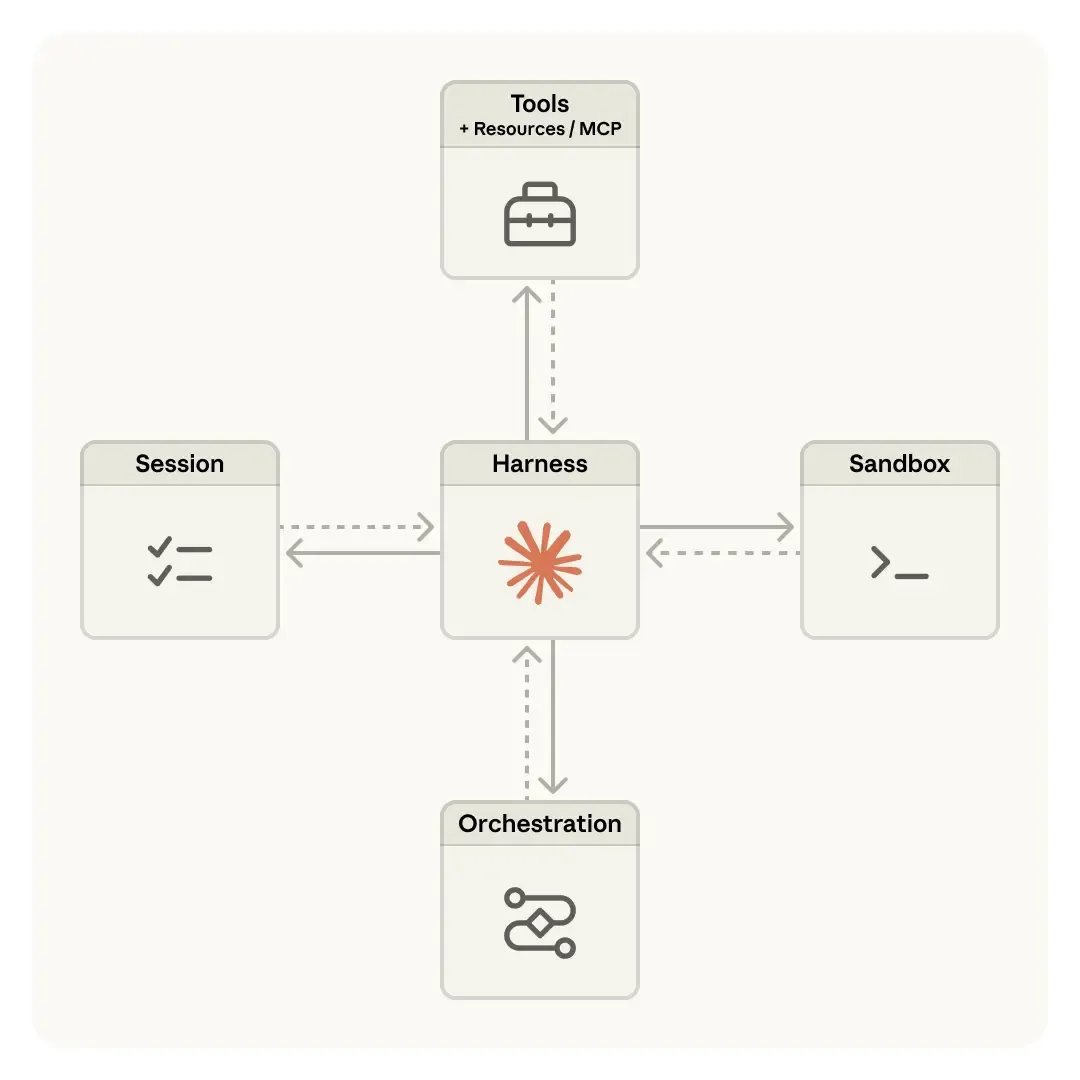
Implementation details: from self‑built harness to fully managed infrastructure
Traditional AI‑agent development requires developers to build the "harness" themselves — including tool invocation, memory management, sandboxing, permission controls, and state persistence — which often takes months of engineering work. Claude Managed Agents abstracts all of that:
- Managed infrastructure: Agents run in Anthropic cloud containers with automatic scaling, fault recovery, and support for long‑duration runs (hours‑level).
- Sandboxed execution environment: Built‑in secure sandboxes safely execute code, operate file systems and external tools, avoiding risks of direct access to users' real environments.
- Multi‑agent coordination (research preview): Supports multiple Claude agents working in parallel, with a central coordinator assigning tasks and aggregating results to decompose complex workflows.
- Credential and permission management: Centralized credential vault supporting OAuth, scoped permissions, and dynamic authorization to substantially reduce security risks.
- Observability and governance: Provides full execution tracing, logs, and self‑evaluation capabilities to facilitate enterprise compliance and auditing.
- Interfaces: Supports Console, Claude Code, and CLI development modes; developers can define agents via YAML or natural language, or integrate deeply via APIs.
Unlike Claude Code and Claude Cowork's "local/desktop agents," Managed Agents is a cloud‑hosted, serverless solution focused on production reliability and scalability. Anthropic emphasizes it is tailored for "long‑horizon, asynchronous" tasks, addressing the usual weaknesses of traditional agents that are prone to interruptions and hard to monitor.
Comparison with RPA tools like n8n: intelligence vs. rules
n8n, an open‑source, low‑code RPA/automation platform, is known for visual node orchestration, hundreds of SaaS integrations, and reliable execution, making it suitable for clearly defined business process automation (such as data synchronization, form handling, and notifications). Claude Managed Agents represent the AI‑native agent paradigm:
- Execution model: n8n is rule‑driven (if‑then, node flows), stable and reliable but with limited flexibility; Managed Agents are intent‑driven (natural language instructions), able to handle vague, dynamic tasks but subject to hallucinations or unpredictable behavior.
- Applicable scenarios: n8n excels at repetitive, structured processes; Managed Agents are better suited for cognitive tasks that require judgment, web browsing, or desktop operations (e.g., research report generation, complex data processing).
- Development barrier: n8n’s visual low‑code approach fits business and operations staff; Managed Agents rely on prompt engineering and Claude capabilities, more suitable for developers or teams experienced with AI.
- Reliability: n8n offers high determinism and is suitable for critical production paths; Managed Agents are currently in beta and better for experimental or non‑critical tasks.
- Cost model: n8n can be self‑hosted for free or used via low‑cost cloud subscriptions; Managed Agents are billed by usage and may be costlier for heavy long‑term use.
The community and industry analysts generally believe that Claude Managed Agents will not fully replace RPA tools like n8n, but rather form complementary and even collaborative relationships. Many developers are already experimenting with "hybrid workflows": using Claude Managed Agents for intelligent decision‑making and dynamic interaction, while relying on n8n for stable orchestration, scheduled triggers, and multi‑system integration. n8n experts note that AI agents fit "cognitively intensive" tasks, whereas traditional RPA retains advantages in high‑frequency, deterministic processes.
Broader impact: reshaping the automation tooling ecosystem
The launch of Claude Managed Agents accelerates the AI‑driven transformation of the RPA industry:
- For RPA vendors: Traditional RPA giants like UiPath and Automation Anywhere face pressure to integrate AI agent capabilities or risk being marginalized. Some vendors are already exploring "RPA + LLM Agent" hybrid approaches.
- For developers and enterprises: The service lowers the barrier to deploying production‑grade AI agents, shortening infrastructure setup from "months" to "days," and improving automation ROI. It also introduces new challenges: managing agent unpredictability, compliance auditing, and security boundaries.
- For the open‑source community: Projects like n8n may accelerate AI integration, while Anthropic’s hosted model offers enterprises an "out‑of‑the‑box" option, pushing automation from the "script era" into the "intelligent agent era."
- Overall trend: AI agents are gradually encroaching on traditional RPA market share, especially in scenarios requiring judgment and adaptability. But rule‑based RPA will likely persist long‑term in sectors demanding high reliability and strict auditability, such as finance and compliance.
Anthropic stressed in its announcement that Managed Agents is a production‑designed "full‑stack solution," not a simple drop‑in replacement. In the future, it may form a collaborative ecosystem of "AI brain + RPA skeleton" with tools like n8n, rather than a zero‑sum competition.
Conclusion: replace or coexist in the AI‑agent era?
The release of Claude Managed Agents indeed poses a challenge to traditional RPA tools such as n8n, but a more accurate assessment is "partial replacement plus deep integration." For simple, repetitive business processes, n8n’s stability and visual advantages remain prominent; for tasks requiring intelligent judgment and dynamic interaction, Managed Agents show clear strengths.
Ultimately, the evolution of automation tools is not about "who replaces whom," but "how to collaborate." Enterprises should choose or combine tools according to specific scenarios: use AI agents for complex cognitive parts and RPA for reliable execution. Claude Managed Agents' arrival accelerates this convergence and opens new possibilities for the automation industry.
In an era of exponential AI capability growth, Claude Managed Agents remind us that technological innovation often reshapes rather than eradicates. Traditional RPA will not disappear, but must embrace AI to continue thriving in the wave of intelligence.
▶️ Enjoy this article? Creating content is hard!
Follow our YouTube channel:
AI Rosetta
Your likes, subscriptions, and shares are our greatest support! 🙏
More AI news at: https://www.airosetta.com