
On 2026‑11‑09, Anthropic officially released the latest versions of its flagship model line—Claude Fable 5.2 and Claude Mythos 5.2. This represents another major iteration in the company's Mythos‑tier model track. The company says the new models show clear improvements in coding, reasoning, visual understanding and long‑horizon agent tasks, with output speed gains up to about 30%, and have lowered standard pricing to $8 per 1M input tokens and $40 per 1M output tokens. The release comes as Anthropic prepares for an IPO amid intensifying industry competition, highlighting the trade‑offs between capability rollout and safety controls for frontier models.
Dual‑track design and positioning
Fable 5.2 and Mythos 5.2 are built on the same underlying model; the core difference lies in the strength of safety guardrails. Fable 5.2 is accessible to a broader user base and retains stronger web‑safety and bio‑related protections to reduce misuse risks. Mythos 5.2 is available to institutions that pass the company's "Life Sciences Verification Program" and "Cybersecurity Verification Program," with relatively looser restrictions in certain high‑risk areas to support authorized defensive and research work. This "same‑model, dual‑track controls" strategy continues the approach introduced with Fable 5 and Mythos 5 in June 2026.
Anthropic explicitly recommends using mid‑tier flagship models such as Claude Opus 5.5 for everyday coding and knowledge work; the Fable and Mythos series are positioned for the "most challenging, open‑ended technical work." The new models can also act as "advisors" or "orchestrators" in multi‑agent scenarios, delegating simpler tasks to smaller models.
Performance metrics in detail
According to Anthropic's official evaluation data, Fable 5.2 leads the prior generation and major competitors on most public benchmarks.
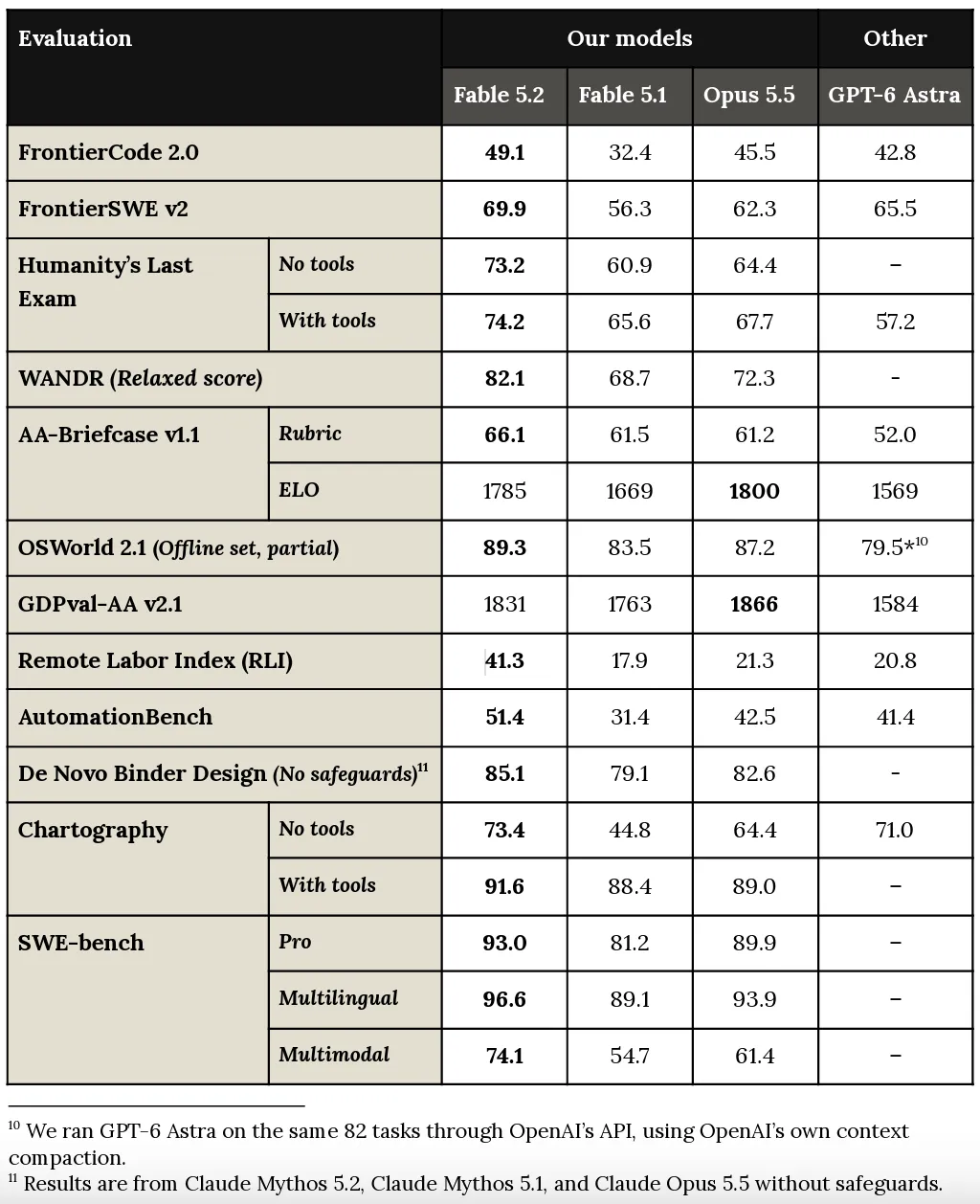
On agent coding, in FrontierCode 2.0 (which assesses whether generated code changes meet an open‑source maintainer's merge standard), Fable 5.2 achieved 49.1% at the Xhigh effort level, versus Fable 5.1's 32.4%, Opus 5.5's 45.5%, GPT‑6 Astra's 42.8% and Gemini 4 Carbon's 41.1%. On FrontierSWE v2, Fable 5.2 scored 69.9%, ahead of GPT‑6 Astra's 65.5% and Opus 5.5's 62.3%.
On science and agent‑research tasks, Terminal‑Bench‑Science 0.1 reported 74.6% for Fable 5.2 (Mythos 5.2 at 75.3%), markedly above Fable 5.1's 52.6% and Opus 5.5's 58.7%. On the multi‑agent scientific reasoning benchmark Humanity’s Last Exam (with tools), Fable 5.2 reached 74.2%, versus Opus 5.5's 67.7%.
For knowledge work and computer use, OSWorld 2.1 (computer operation) showed Fable 5.2 at 89.3%; the AA‑Briefcase knowledge‑work score was 66.1%; Remote Labor Index at High effort registered 41.3%, far above Fable 5.1's 17.9%. Visual chart recognition on Chartography (no tools) reached 73.4%. In robot‑related testing, RoboDojo Sim returned 64.9% for Fable 5.2, significantly higher than the prior generation's 27.6%.
Cybersecurity and life‑sciences related metrics are mainly reported for Mythos 5.2. In CyScenarioBench Mythos 5.2 scored 76.3%; CVE Rediscovery reached 89.6%; a 24‑hour de novo protein binder design task hit 85.1%. Independent evaluator Artificial Analysis's Intelligence Index v5 placed Fable 5.2 at 65 points at the highest effort level, ahead of Gemini 4 Carbon (60) and Opus 5.5 (59).
Additionally, in pre‑release tests, roughly 1,000 Fable 5.2 agents completed a formal proof of Fermat's Last Theorem within 30 hours; the model also assisted with complex software migrations, designed electronic devices from scratch, and resolved two open problems in black hole physics. The company reports improved communication clarity and an optional "fast mode" (token generation up to 2.5x faster, priced at $16 per 1M input tokens and $80 per 1M output tokens).
It should be emphasized that most figures above come from Anthropic's internal evaluations or pre‑release collaborations; effort levels, tool usage and guardrail interventions on some benchmarks affect comparability. Comprehensive independent reproduction and long‑term deployment effects remain to be observed.
Pricing, availability and safety context
The standard pricing has been reduced relative to prior versions, helping to lower costs for high‑load scenarios. Fable 5.2 now supports enterprise‑grade zero data retention. The release coincides with third‑party evaluators such as METR raising discussions about risks related to recursive self‑improvement (RSI). Anthropic says it conducted extensive pre‑release safety testing and believes performance in covert evaluations still supports its claims about high‑risk detection capabilities. The company also emphasises that it has imposed limits on specific capabilities that could accelerate AI development itself.
From an industry perspective, the dual‑track release of Fable and Mythos reflects Anthropic's pragmatic balance between capability rollout and risk management: lowering prices, increasing speed and expanding enterprise availability to boost competitiveness while placing some high‑risk capabilities in controlled environments. This pattern echoes prior instances where access to advanced models was temporarily restricted and illustrates the governance logic that stronger capabilities are often paired with stricter controls.
For developers and enterprises, the new models provide more powerful high‑end tools—particularly for complex coding, long‑horizon agents and interdisciplinary research. For industry and regulators, building reliable evaluation, access and continuous monitoring mechanisms as capabilities rapidly advance remains a core, ongoing challenge. Subsequent independent benchmark verification, the practical impact of guardrails on legitimate research, and stability in multi‑agent collaboration scenarios will determine the models' long‑term deployment value.
▶️ Enjoy this article? Creating content takes real effort!
Follow our YouTube channel:
AI Rosetta
Your likes, subscriptions and shares are our biggest support! 🙏
More AI news at: https://www.airosetta.com