
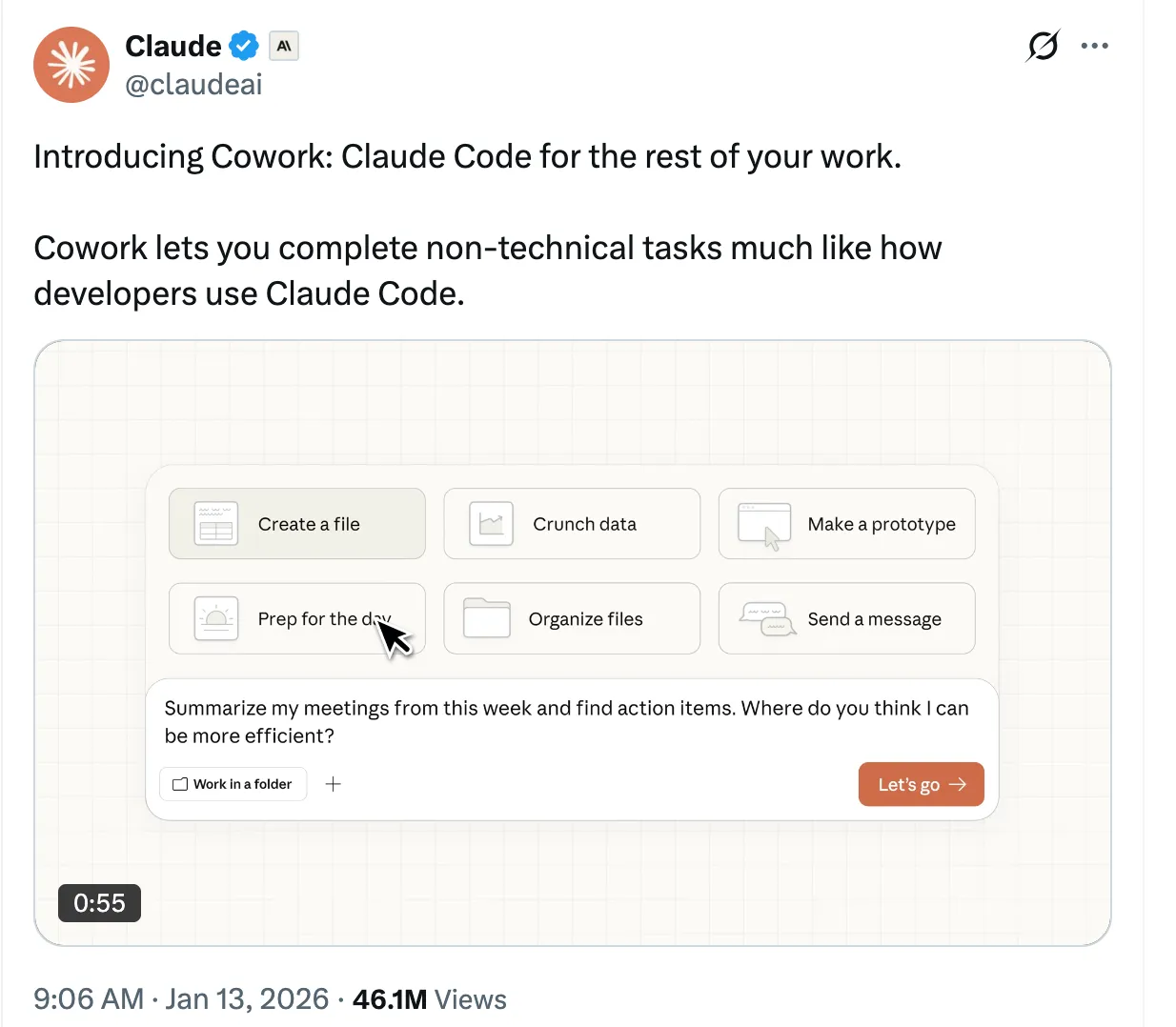
On January 13, 2026, Anthropic officially launched Claude Cowork, an AI agent integrated into the Claude desktop app designed to extend Claude Code’s capabilities to non‑developers. As the latest member of the Claude family, Cowork lets users use natural‑language instructions to have Claude autonomously access, manage, and create local files, automating tasks from file organization to report generation. Notably, the initial version was developed in roughly a week and a half (10 days), with much of the code generated by Claude Code itself, underscoring a new level of AI "bootstrapping" in software development. This article, based on reporting from VentureBeat, Fortune, WIRED, and Axios, details Cowork’s features, development process, and its impact on the AI agent ecosystem.
Features and design of Claude Cowork
Claude Cowork is essentially a streamlined version of Claude Code, optimized for nontechnical users with an improved interface and interaction model. It is embedded in the macOS Claude desktop app and released as a research preview, currently limited to Claude Max subscribers (monthly fee $100–200). Users can issue simple commands for Cowork to access specified folders and perform multi‑step tasks, such as automatically organizing a Downloads folder, creating spreadsheets from screenshots, drafting reports from scattered notes, or even controlling the browser to perform web searches and clean up Gmail.
Unlike traditional chatbots, Cowork emphasizes agentic behavior: it can make plans, execute tasks in parallel, and report progress to users along the way. For example, a user can instruct "organize my receipts folder and generate an expense report," and Cowork will scan files, categorize data, produce an Excel file, and provide a visual summary. It inherits Claude’s connector capabilities and supports integrations with external services like Google Drive or browser extensions, further extending its use cases. Anthropic says Cowork’s design was inspired by user feedback: after Claude Code’s release, many non‑developers used it for everyday tasks such as sorting vacation photos or preparing meeting notes, prompting the team to iterate quickly.
On privacy and security, Cowork only accesses folders explicitly specified by the user and requires clear authorization. WIRED’s tests found it reliable for file management and basic computation tasks, particularly in office scenarios, but as a beta product it still requires user supervision to prevent errors.
Development process: code led by Claude and completed in 10 days
The development story of Cowork is emblematic of the AI era. According to Boris Cherny, head of Anthropic’s Claude Code, who posted on X, the entire tool was built using Claude Code and the development cycle took just one and a half weeks. Anthropic engineer Felix Rieseberg confirmed on a livestream that this speed benefited from a "vibe coding" approach: engineers provided high‑level guidance while Claude Code automatically generated, debugged, and refined the code.
This process demonstrates AI bootstrapping: Claude Code, initially designed as a coding agent for developers, was used to build its own extension. After identifying needs from user feedback, the team rapidly prototyped: Claude Code handled most of the work from file API integration to UI logic, with engineers primarily reviewing and fine‑tuning. Fortune reported that this method not only accelerated iteration but showcased AI’s potential in software engineering, posing competitive pressure to traditional development tools and startups.
Anthropic CEO Dario Amodei wrote on the company blog that this development model is a preview of the "future of AI agents," emphasizing AI autonomy guided by human oversight. Reddit feedback showed excitement about the "AI building AI" narrative, with users viewing it as a milestone for productivity tools.
Comparison with Claude Code and industry impact
Claude Code, launched in 2025, is Anthropic’s coding‑specific agent supporting terminal operations, code generation, and debugging. Cowork simplifies the command‑line interface, shifts toward more intuitive natural‑language interaction, and focuses on file management and office automation rather than pure programming. Both share the same core engine, but Cowork prioritizes ease of use and removes the technical barrier of a command‑line interface.
The launch has broad industry implications. Axios analyzed that Cowork could disrupt numerous file‑management startups and AI extensions from companies like Notion or Airtable. It also accelerates the "vibe coding" trend: other firms such as OpenAI with GPT Code or Google with Gemini Code are following with AI‑assisted development tools. In productivity, Cowork signals AI’s shift from assistant to "virtual colleague," handling routine tasks and boosting efficiency.
Challenges remain, including potential errors (such as file mishandling) and privacy risks. Anthropic has pledged ongoing iteration, including plans to expand to Windows and web versions.
Outlook: proliferation of AI agents and ethical considerations
The rapid release of Claude Cowork reflects Anthropic’s safety‑first AI philosophy: delivering practical value through agent tools while emphasizing user control. As Claude models evolve, Cowork may support more complex tasks, such as cross‑application automations. However, policymakers and developers should remain mindful of employment impacts and data security.
▶️ Enjoyed this piece? Creating content is hard work!
Follow our YouTube channel:
AI Rosetta
Your likes, subscriptions, and shares are our greatest support! 🙏
More AI news at: https://www.airosetta.com