
On February 23, 2026, U.S. AI company Anthropic again publicly accused three Chinese AI startups—DeepSeek, Moonshot AI and MiniMax—of stealing core capabilities of its flagship model Claude through large‑scale "distillation attacks". The company said the three firms used more than 24,000 fake accounts to perform millions of high‑volume queries against Claude, systematically extracting outputs to train their own models. The allegation quickly sparked an uproar across the global AI community, and Elon Musk immediately launched a fierce mockery of Anthropic on X, calling it "hypocritical and contradictory," further stoking the controversy.
In an official blog post, Anthropic laid out what it called evidence of an "industrial‑scale distillation attack": the three companies allegedly created large numbers of fake accounts to evade usage limits, repeatedly posed complex questions to Claude, and then used the detailed returned outputs to train their own systems. This kind of "knowledge distillation" can allow follower models to approach or even surpass the original model's capabilities at very low cost. Anthropic emphasized that such behavior not only violates its terms of service but also poses potential risks to U.S. AI technology security. The company has suspended commercial access from mainland China and related entities and urged the U.S. government to strengthen AI data export controls.
Anthropic’s accusation details: 24,000 fake accounts and "data harvesting"
According to the report released by Anthropic, beginning in late 2025 the three companies used automated scripts to create more than 24,000 seemingly legitimate Claude accounts. These accounts were used for high‑frequency, targeted queries aimed at extracting Claude's high‑quality outputs on complex reasoning, code generation, long‑context understanding and multimodal tasks. Anthropic said the efficiency of such distillation attacks is very high: a single successful distillation can shorten the development cycle for a particular capability by months or even years.
This accusation is not entirely new. Anthropic warned repeatedly about similar behavior by Chinese companies in 2025, but this is the first time it publicly named three specific firms and provided detailed technical analysis and logs. Anthropic CEO Dario Amodei said in a statement: "We welcome fair competition, but we cannot tolerate systematic fraud to steal intellectual property. This not only harms the innovation ecosystem but also threatens national security."
Elon Musk’s sharp mockery: Anthropic is "misanthropic and evil"
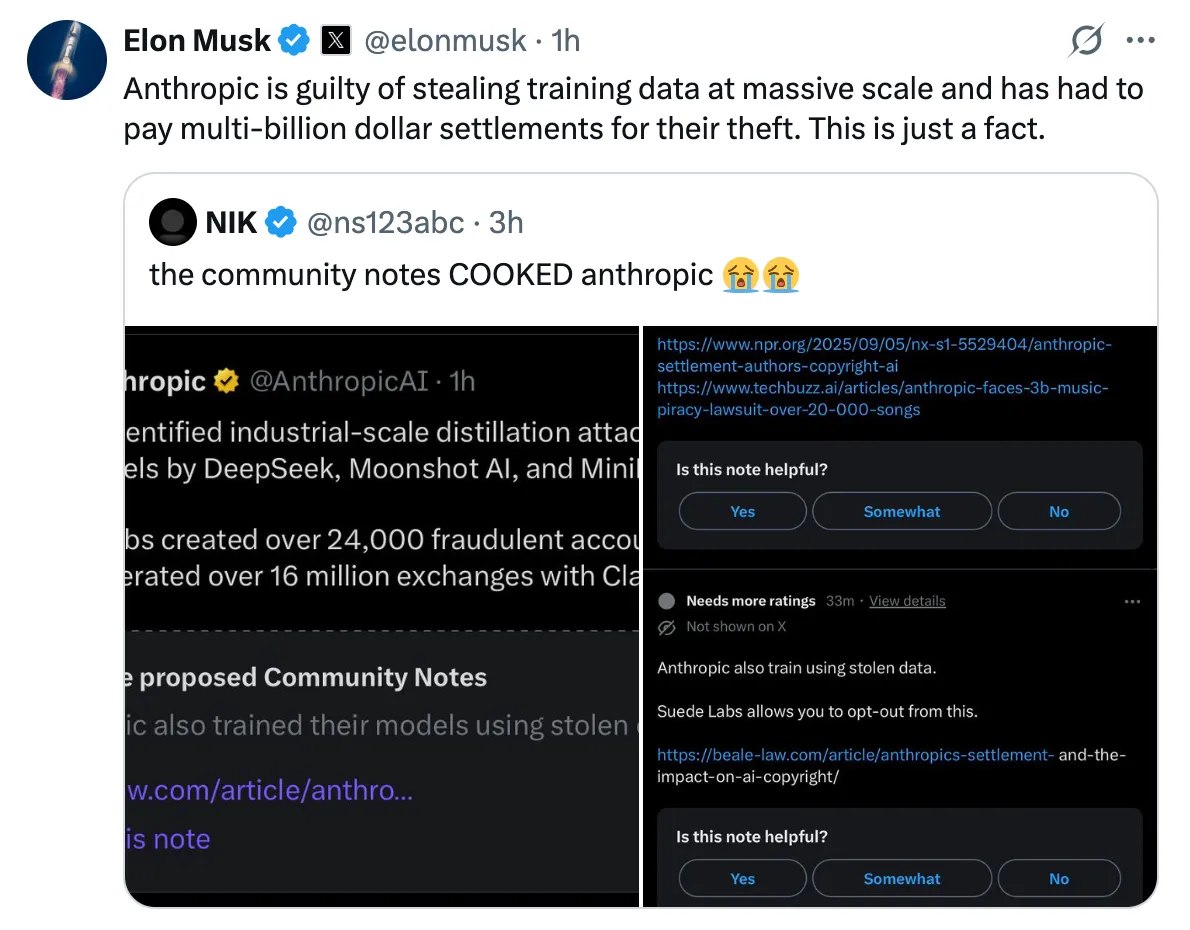
Less than 24 hours after the accusation was published, Elon Musk posted a series of messages on X mocking Anthropic. He wrote:
"Anthropic accuses others of 'stealing' their data while they themselves were distilled from OpenAI. Now that others are distilling them, they're crying? That's so ironic."
"By the way, your AI hates white people, hates Asians (especially Chinese), hates heterosexuals, hates men. That's what is truly misanthropic and evil. Go fix it."
Musk's mockery quickly drew millions of views and widespread reposts. He also played on Anthropic's name, saying the term (which refers to the anthropic principle) has effectively become "Anti‑human." The posts reignited long‑standing debates in the AI community about "who copied whom," "open source vs. closed source," and data ownership.
Industry reaction: distillation dispute escalates into a geo‑tech conflict
Anthropic's accusation and the Chinese companies' responses quickly pushed the incident into the geopolitical realm. DeepSeek and MiniMax denied engaging in systematic distillation, saying their model training relied entirely on public data and lawful channels. Moonshot AI did not respond publicly.
The episode exposed deep tensions in today's AI training ecosystem:
- Data barriers and distillation technology: Large language model training depends heavily on high‑quality output data, while distillation techniques can replicate cutting‑edge model capabilities at very low cost, providing a shortcut for followers to catch up rapidly.
- Open source vs. closed source: Anthropic itself has been accused of benefiting from early OpenAI models, and its strong opposition to others performing similar operations has prompted charges of a double standard.
- U.S.‑China AI competition: In the context of tightened U.S. AI chip export controls, such accusations are easily politicized and can become tools to constrain Chinese AI development.
Meanwhile, other U.S. AI giants such as Meta and Google remained relatively muted. Meta CEO Mark Zuckerberg said in an internal meeting: "Data distillation is a common industry phenomenon; the key is to establish fair rules, not one‑sided accusations."
Implications and challenges for Chinese AI firms
For Chinese AI companies, Anthropic's accusation is both pressure and a warning. DeepSeek, Moonshot AI and MiniMax have made notable progress in open‑model development but now face questions about the legality of their data sources. Going forward, these companies may need to further strengthen their own data construction and compliance systems to avoid similar disputes.
At the same time, the incident has accelerated efforts in China to reduce reliance on U.S. sources. Multiple domestic organizations have increased investment in building high‑quality local datasets and emphasize "verifiable data provenance" in model training to respond to international pressure.
Conclusion: the "data wars" of the AI era are only beginning
Anthropic's renewed public accusation that Chinese firms distilled its data and Elon Musk's biting mockery together exemplify the tensions between "data sovereignty" and "technology diffusion" in the AI era. In the fierce race toward AGI, whoever controls high‑quality data holds a crucial advantage.
For the global AI industry, this debate may spur clearer international rules: How should "fair use" be defined versus "illegal distillation"? How can intellectual property be protected without hindering technological progress? Answers will take time.
One thing is certain: the 2026 AI competition has evolved from a dispute over model parameters to a comprehensive contest over data, compute, rules and geopolitics. The public spat between Anthropic and Musk is just the latest scene in that larger struggle.
▶️ Enjoy this piece? Creating takes real effort!
Follow our YouTube channel:
Your likes, subscriptions and shares are our greatest support! 🙏
More AI news at: https://www.airosetta.com