
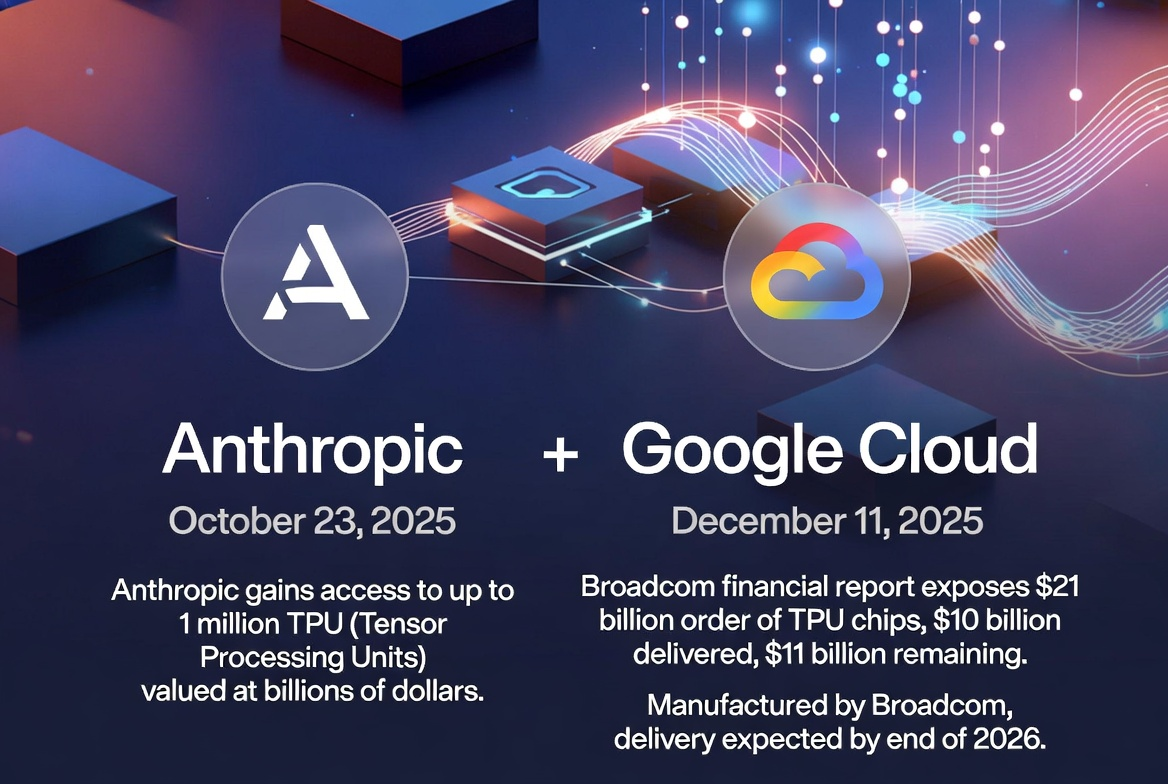
On October 23, 2025, AI startup Anthropic and Google Cloud announced a landmark collaboration to procure up to 1 million TPUs (Tensor Processing Units). Further details emerged in Broadcom’s December 11, 2025 earnings report: Anthropic has placed a $21 billion TPU order (including $10 billion already paid and $11 billion remaining), with Broadcom contracted to manufacture the chips and deliveries expected to complete by the end of 2026. According to an Anthropic statement and a Google Cloud press release, the purchase is intended to accelerate training and deployment of the Claude models and to advance "responsible AI." The move is being viewed as a significant challenge to NVIDIA’s CUDA dominance and a sign of AI compute shifting from a single ecosystem to a more diversified landscape.
Deal details: from TPU v7 to a massive order
Founded in 2021 by former OpenAI executives, Anthropic is known for the Claude model series and emphasizes safety and ethical alignment. The company had previously used Google TPUs for training, but this expansion is unprecedented in scale: Anthropic will acquire up to 1 million TPU v7 "Ironwood" chips, with total compute capacity exceeding 1 gigawatt — roughly comparable to the output of a large nuclear power plant. TPUs are Google’s in‑house AI accelerators, iterated since 2016 and now in their seventh generation. They are optimized for matrix operations, support bfloat16 numeric format, and offer higher energy efficiency than general‑purpose GPUs, performing strongly in large‑scale model training.
Supply‑chain details disclosed by Broadcom indicate Anthropic has paid $10 billion for Google’s latest Ironwood racks, with the remaining $11 billion due for delivery in 2026. Broadcom, acting as Google’s chip contractor, is responsible for producing these customized TPUs. The $21 billion transaction forms part of Broadcom’s AI product backlog, which totals $73 billion. Anthropic CEO Dario Amodei said the purchase will support the company in building safer models at the trillion‑parameter scale, while Google CEO Sundar Pichai emphasized that the deal reflects the competitiveness of the Cloud platform.
The scale of the procurement stems from explosive growth in compute demands for AI models. Claude has expanded from hundreds of billions to the trillion‑parameter level, requiring massive compute resources. Historically, AI training has relied on NVIDIA’s CUDA ecosystem, but chip shortages and rising prices have driven customers to diversify. Google’s TPU offerings, available via rental, provide flexibility: in 2025, Cloud RPO (remaining performance obligations) attributable to TPU business reached $42 billion, up 49% year on year.
Technical impact: breaking CUDA’s hold and driving compute diversification
The most significant impact of the deal is its challenge to NVIDIA’s CUDA dominance. NVIDIA controls more than 90% of the AI chip market, and its CUDA software ecosystem has locked in many developers, creating supply vulnerabilities. Anthropic’s choice shows that TPU’s customization advantages — such as higher energy efficiency and matrix optimizations — are attracting large customers. TechCrunch analysis suggests the move could compress NVIDIA’s margins; NVIDIA’s share price had already shown sensitivity in 2025. Moreover, Anthropic’s Claude 4.5 and Google’s Gemini 3 are shifting toward TPU use, potentially reducing dependence on GPUs.
From a technical perspective, the purchase accelerates a multipolar AI infrastructure. TPU v7 is designed for large‑scale training: each Pod contains thousands of chips, interconnected at high speed to enable parallel computation, delivering tens of petaflops of performance. Compared with the NVIDIA H100, TPU power consumption can be 30–50% lower, making it suitable for sustained workloads. Anthropic will use this compute to iterate Claude, improving safety and multimodal capabilities for applications in healthcare and finance. Industry experts say the move may prompt other firms, including OpenAI, to diversify their hardware stack and erode NVIDIA’s de facto exclusivity.
Economically, the order reshapes supply chains. Broadcom’s involvement highlights the rise of contract manufacturers in AI hardware; its AI backlog stands at $73 billion. For Google, the transaction is a milestone for its Cloud business, with AI revenue in 2025 exceeding expectations. Geopolitics could complicate deployment: U.S. export controls on chips may limit TPU distribution globally, forcing companies in markets like China to turn to domestic silicon providers.
Environmental and societal effects: energy consumption and ethical challenges
The purchase also raises environmental concerns. A 1‑gigawatt compute capacity is comparable to powering a city, and AI data centers already account for a growing share of global electricity use. The Guardian has reported that large supercomputing projects can cause uncontrolled emissions in some cases. Anthropic and Google have pledged to use renewable energy, but experts warn that AI’s carbon footprint could become a material climate risk by 2026. The development is driving the industry toward more efficient architectures, such as optimizations like DeepSeek’s mHC.
On the social side, the deal amplifies debates about AI ethics. Anthropic’s emphasis on "responsible AI" means the compute will be used to build safer models that mitigate hallucinations and bias. Yet concentration of vast compute resources among a small number of companies could exacerbate AI inequality. The EU AI Act calls for transparency around such large‑scale projects to prevent misuse.
Outlook: a multipolar era for AI compute
Looking toward 2026, the transaction signals a move to a multipolar AI compute era. Google plans to export TPUs to more countries and to foster a more open ecosystem. Industry analysts believe this could accelerate innovation and lower costs, though energy and supply‑chain risks remain. Anthropic’s move may prompt other companies to shift to TPUs, challenging NVIDIA’s dominance.
In sum, Anthropic’s reported $21 billion TPU procurement is more than a commercial deal — it represents a reconfiguration of the AI compute landscape, moving from monopoly toward competition and potentially enabling more sustainable AI development. The consequences of this event are expected to unfold through 2026 and beyond, affecting the global technology ecosystem.
▶️ Enjoyed this article? Creating great content takes effort!
Subscribe to our YouTube channel:
AI Rosetta
Your likes, subscriptions and shares mean the world to us! 🙏
For more AI news, visit:
https://www.airosetta.com