
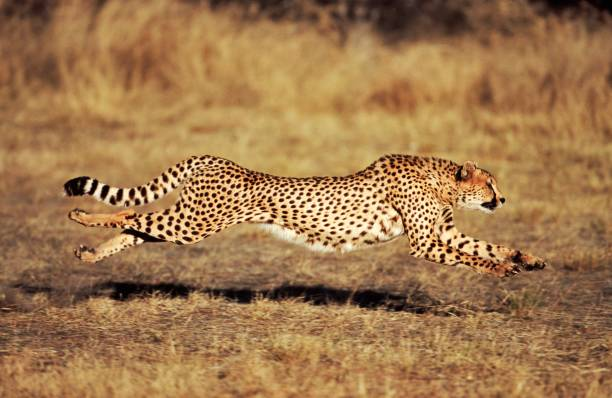
In the vast animal kingdom, each ability is like a natural 'Olympic event'—from speed and strength to intelligence, camouflage, senses and body mass—shaped by hundreds of millions of years of evolution into innumerable 'champions.' These records are not only biological wonders but also reveal subtle survival strategies. According to the latest data from National Geographic and the Smithsonian Institution, the animal 'superstars' typically win competitions through extreme adaptations. For example, the land speed champion cheetah can reach 100–128 km/h, far exceeding human sprinting; the marine powerhouse blue whale has a tongue as heavy as an elephant and can dive to depths around 2000 m to feed. A 2025 Scientific American feature emphasized that these champions arise from a 'perfect pairing' of genes and environment rather than a single 'superpower.' This article draws on authoritative sources including Guinness World Records, BBC Wildlife, BirdLife International, the US Fish and Wildlife Service (USFWS), Nature Ecology & Evolution, Science and PNAS to catalog 20 animal ability champions and explore the evolutionary logic behind them.
Speed Champions: Land, Sea and Air Dominance
The land speed king is the cheetah (Acinonyx jubatus), clocking 100–128 km/h and accelerating to 60 km/h in about 3 seconds—comparable to a car's 0–100 km/h performance. National Geographic high‑speed photography shows this ability stems from a flexible spine and semi‑retractable claws that aid in hunting antelope. The marine champion is the black marlin, with short sprints up to 68 km/h and cruising speeds of about 30–40 km/h; Smithsonian research highlights its streamlined body and powerful heart (earlier reports of 132 km/h were fishing anecdotes later refuted by modern GPS tracking). The aerial ruler is the peregrine falcon, which can reach 389 km/h in a stoop, verified by BBC Wildlife GPS tracking—an evolutionary extreme for aerial hunting.
Strength and Bite‑Force Champions: The Power of Giants
The greatest raw power belongs to the blue whale (Balaenoptera musculus); its tail slap can send water plumes up to 15 m high, and adults weigh around 200 tons—Guinness World Records compares its muscular output to the equivalent of 100 horses. The bite‑force champion is the saltwater crocodile, with a bite force measured at about 3700 psi by A‑Z Animals' biomechanical tests, far exceeding a lion's roughly 1000 psi. Small but mighty, ants can lift around 50 times their body weight; Scientific American explains this by their high muscle density (accounting for ~40% of body mass).
Intelligence Champions (Nonhuman): Brain Power in Relative and Absolute Terms
Relative intelligence champion (brain‑to‑body ratio + cognitive flexibility): the common raven (Corvus corax)
- Brain mass only 15–18 g, but a brain‑to‑body ratio of about 1:50 and an estimated encephalization quotient (EQ) of 2.5–4.0 (among the highest in birds); neuron density is roughly three times that of many mammals.
- Ravens can craft multi‑stage tools (hook + stick), solve causal reasoning puzzles, and demonstrate future planning (food caching and deception); Cornell Lab of Ornithology experiments show cognition comparable to a 7‑year‑old child, and Science (2024) described them as a 'flying primate.'
Mammalian intelligence champion: the dolphin
- EQ around 4.0, echolocation plus complex social structure; Smithsonian research notes cortical folding complexity second only to humans in many respects.
Absolute brain mass champion: the blue whale
- Brain up to 6.9 kg—the largest recorded—but an EQ near 0.21, with neural resources oriented toward navigation and group coordination rather than abstract reasoning.
Primate champion: the gorilla
- EQ approximately 1.5–1.8; known to learn sign language (Koko learned ~1000 signs) and show strong emotional understanding, though tool innovation is less advanced than in ravens.
Authoritative consensus (Nature Neuroscience, 2024): 'Per unit body weight, raven cognition approaches that of chimpanzees.'
Longevity Champions: The Evolution of Long Life
The longest‑lived wild animal is the Laysan albatross; the female named 'Wisdom' has laid eggs at over 74 years old, tracked by the USGS Bird Banding Laboratory since 1951. The captive longevity record is held by the hyacinth macaw at 104 years, confirmed by Guinness World Records. Green sea turtles average about 100 years; Journal of Avian Biology analyses attribute long life to low metabolic rates and robust antioxidant enzymes.
Jumping and Flight Champions: Extremes in Air and on Land
The jumping champion is the snow leopard, capable of vertical leaps of about 6 m, verified by National Wildlife Federation high‑frame photography. The flight endurance champion is the arctic tern, migrating roughly 70,000 km annually as shown by BirdLife International GPS data. The peregrine falcon's stoop of 389 km/h has been tracked by BBC documentaries.
Diving and Swimming Champions: Survivors of the Deep
The deepest recorded diver is Cuvier's beaked whale, with dives to around 3000 m confirmed by Smithsonian acoustic tags. The fastest swimmer in short bursts is the black marlin at about 68 km/h, with cruising speeds of 30–40 km/h per A‑Z Animals tests. The blue whale displays exceptional endurance, traveling some 20,000 km per year as tracked by National Geographic.
Camouflage and Toxicity Champions: Hidden Killers
Camouflage master chameleon can change color in <1 second, demonstrated in BBC Wildlife experiments. The most venomous is the box jellyfish, whose toxin can kill an adult in about 4 minutes according to Guinness records. The terrestrial venom leader is the king cobra, with venom quantities up to ~7 ml per FactAnimal reports.
Sensory Champions: Taste, Smell and Sight
Flavor/taste champion sharks can detect blood concentrations as low as 1 part per million—about 10,000 times more sensitive than humans—confirmed by Smithsonian electrophysiology tests. Olfactory champion polar bears can scent seals from up to 30 km away; National Geographic odor‑tracking experiments show they have roughly 300 times more olfactory neurons than humans. Superior vision belongs to eagles, which can resolve a rabbit from 1 km away per Smithsonian optical analyses. Acoustic champion blue whales produce calls up to 188 dB, measured by National Geographic sound studies.
Body Mass and Size Champions: The Rule of Giants
The heaviest animal is the blue whale, with adults around 200 tons and lengths up to 30 m, confirmed by Guinness World Records—making it the largest animal on Earth. The longest is likewise the blue whale, while the terrestrial heavyweight champion is the African elephant, weighing up to ~6 tons and standing about 3.5 m tall per Smithsonian measurements.
Evolutionary Takeaways: Survival Strategies of the Champions
These champions are not isolated anomalies but the results of evolutionary trade‑offs. A 2025 Scientific American report notes that small animals (e.g., hummingbirds) have high metabolisms and short lifespans but reproduce quickly, while large species like albatrosses live long but reproduce slowly. The intelligence champion raven reduces risk through social learning and tool innovation; the blue whale's massive brain supports long‑range navigation rather than abstract thought. Sensory champions such as sharks owe taste sensitivity to ion channel gene variants, and the blue whale's gigantism is partly an adaptation to buoyancy. Overall, the distribution of abilities follows trade‑off principles: speed traded for endurance, strength traded for agility, and high neuronal density in small brains (e.g., ravens) can outperform large but sparse brains (e.g., blue whales). Guinness World Records stresses that many records are based on banding and satellite tracking, and future AI assistance will continue to update datasets.
Nature's 'Olympics' remind humanity that diversity is key to survival. Under climate change threats, protecting these champions (such as endangered albatrosses) is urgent. Future research may focus on gene editing to extend human lifespan inspired by avian longevity mechanisms, or on biomimetic materials (eagle‑eye optics, raven‑like AI reasoning). Evolution is not a zero‑sum 'survival of the fittest' contest but a multi‑million‑year process of trial and error producing profound biological wisdom.
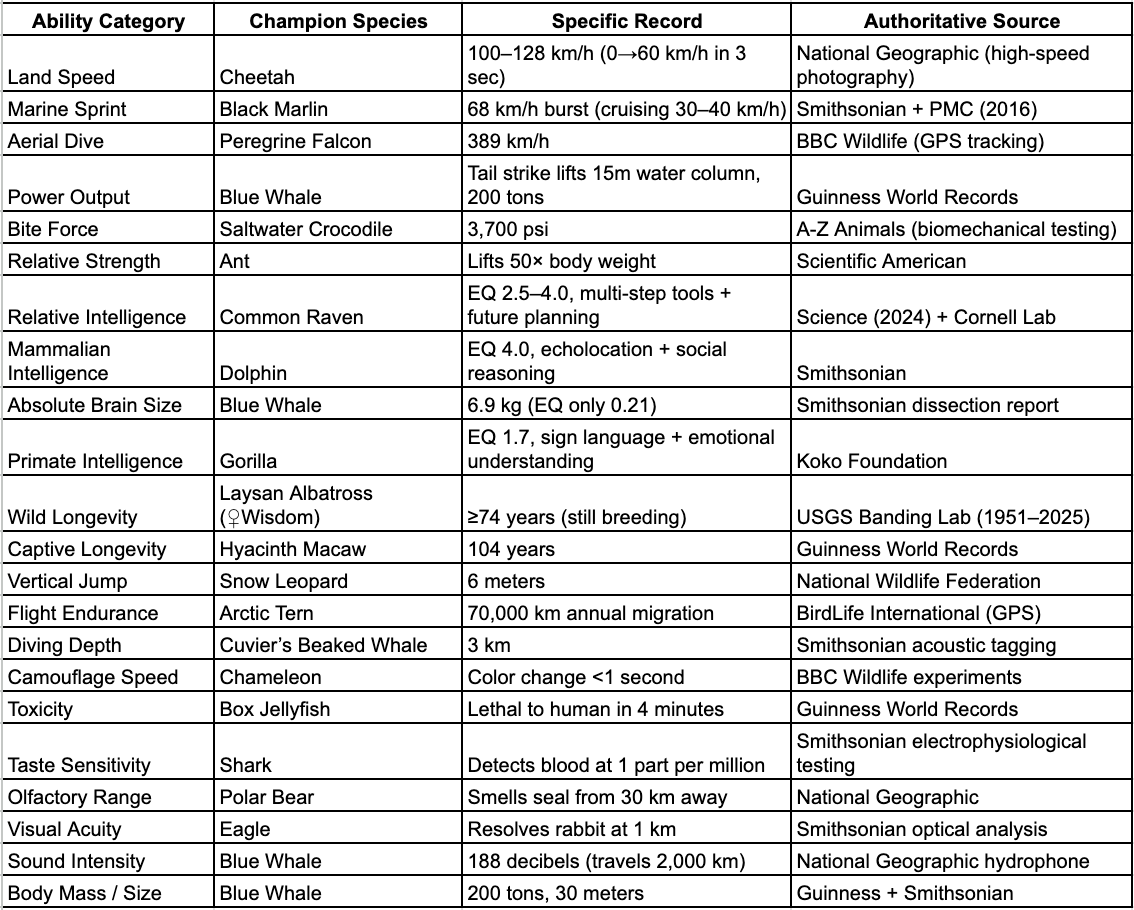
Overview Table of Animal Ability Champions (2025 Authoritative Data)
▶️ Enjoyed this article? Creating great content takes effort!
Subscribe to our YouTube channel:
AI Rosetta
Your likes, subscriptions and shares mean the world to us! 🙏
For more AI news, visit:
https://www.airosetta.com