
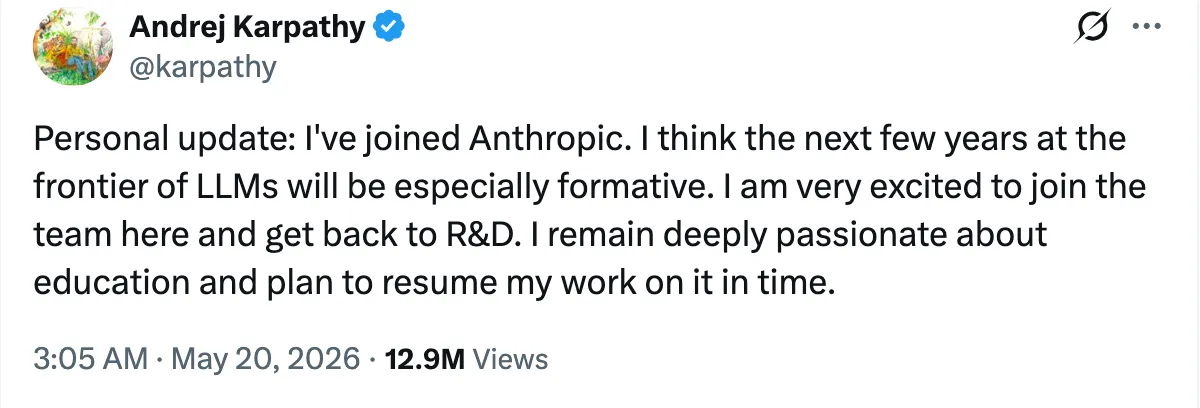
May 19, 2026, one of the most influential researchers in artificial intelligence, Andrej Karpathy, posted a brief but industry‑shaking message on social platform X: "Personal update: I've joined Anthropic." This seven‑word post marks that the OpenAI founding member, former Tesla AI head, and a leading figure in deep learning education has officially joined Anthropic's core pretraining team.
Core role: pretraining, not PR or product
According to confirmations from Reuters, Axios, TechCrunch and other major outlets, Karpathy will join Anthropic's pretraining team and report to its head, Nick Joseph. The key detail is that he is not joining PR, developer relations, or product, but directly entering the organization responsible for building Claude's foundational capabilities. Nick Joseph is also a former OpenAI member and now leads Anthropic's pretraining efforts; he has publicly discussed scaling laws, compute allocation and infrastructure challenges.
In an official statement provided to TechCrunch, Anthropic said Karpathy will form a new team dedicated to exploring how to use Claude itself to accelerate pretraining research. This indicates his focus is less on conventional model architecture design and more on the forward‑looking area of "model‑assisted model training."
Karpathy's unique industry standing
Karpathy's career has intersected almost every key node of modern AI development. In 2015 he was one of 11 founding members of OpenAI; in 2017 he was recruited by Elon Musk to Tesla to lead neural network development for Autopilot and full self‑driving; he returned to OpenAI in 2023 to work on mid‑training and synthetic data; in February 2024 he left again to found the AI‑native education company Eureka Labs, during which his nanoGPT project, neural network tutorial series and the "vibe coding" concept influenced a generation of AI engineers' development paths.
This combination of top‑tier research ability, large‑scale engineering experience and exceptional educational outreach makes him irreplaceable in the global AI talent market. It is worth noting Karpathy's move is not driven by financial necessity—his Tesla equity provides financial independence and Eureka Labs remains operational; his move appears to be a pause rather than a shutdown. His X post also echoed this: "I think the next few years will be a critical formative period for the LLM frontier. I'm very excited to return to R&D work."
Industry signal: revaluation of pretraining and talent reshaping
Karpathy's choice to join a pretraining team rather than the currently popular inference‑time compute or agent teams sends a strong strategic signal. Over the past year some argued that "scaling law is dead," suggesting foundational model capabilities had reached a ceiling and future competition should shift to tool use, inference compute and agent architectures. Karpathy's move indicates leading labs still view foundational model capability as a decisive moat, and that algorithmic innovation, data engineering and architecture optimization during pretraining still hold large opportunities.
A deeper implication is a structural shift in talent flows. In recent years OpenAI has seen notable departures of core personnel: Ilya Sutskever left to found SSI, John Schulman joined Anthropic, Mira Murati and other executives have left. Karpathy, an OpenAI founding member, joining Anthropic—founded by former OpenAI research heads Dario and Daniela Amodei—marks a further intensification of the OpenAI diaspora. Reuters specifically noted this wave of senior movement in its reporting.
At the same time Anthropic's own trajectory supports its pull on top talent. Bloomberg reported the company is seeking a new financing round at about a $900 billion valuation; if completed it would for the first time surpass OpenAI in private‑market valuation. Combined with strengths in Claude Code, agent coding and tool use, Anthropic has evolved from an early "AI safety" positioning to a leading lab with broad competitiveness in coding, reasoning and agent capabilities.
Technical prospect: a flywheel of AI‑assisted research
The core mission of Karpathy's new team—"using Claude to accelerate pretraining research"—reveals Anthropic's view of the next competitive logic: when leading labs can secure large‑scale compute, raw compute investment alone cannot sustain a durable moat. The real advantage will be research velocity: running more experiments per unit compute, finding better data mixes faster, and tuning architectures more precisely.
This strategy aligns with Karpathy's personal technical interests. He has long focused on AI‑assisted research, autonomous coding and software generation, and Anthropic's product strengths in Claude Code and agent coding give him an ideal experimental platform. If the "train the next‑generation Claude with Claude" flywheel proves effective, it could redefine how frontier models are developed.
Conclusion
Karpathy's move to Anthropic is more than a high‑profile job change. It signals three deeper trends: the reaffirmation of pretraining as a core competitive asset for foundation models; a systematic flow of top research talent from OpenAI to Anthropic; and a shift in lab competition from a "compute arms race" to an "AI‑assisted research efficiency" race. As Karpathy said, the next few years will be a "critical formative period" for the LLM frontier—and this time he has chosen to stand at the forefront of Anthropic's pretraining cluster to help shape that formation.
▶️ Enjoy this piece? Creating it takes hard work!
Follow our YouTube channel:
AI Rosetta
Your likes, subscriptions and shares are our greatest support! 🙏
More AI news at: https://www.airosetta.com