
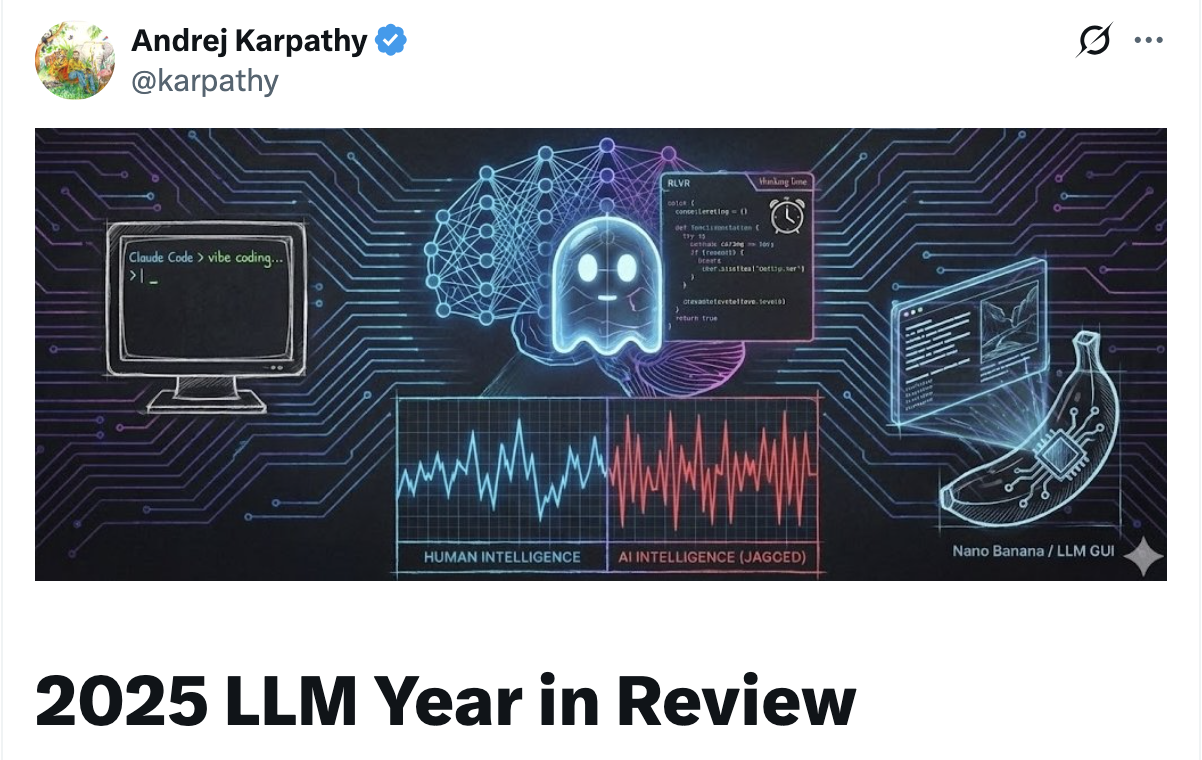
December 20, 2025, AI authority Andrej Karpathy posted a review of 2025 LLM developments on X, summarizing the year’s major advances. Excerpts from the article follow:
2025 was a tumultuous and consequential year for large language models (LLMs). Over the past year we witnessed several technical advances that I view as paradigm shifts—changes that reshape the industry and introduce conceptual surprises. Below are the six shifts I consider most notable. These are not incremental optimizations but fundamental adjustments to the LLM ecosystem. According to Stanford University’s 2025 AI Index report, capability gains this year came mainly from new training paradigms and application innovation rather than sheer scale. These shifts deepened my sense of LLMs’ nature: they are not mere tools but emerging intelligent entities.
1. Verifiable Reward Reinforcement Learning (RLVR)
At the start of 2025, many labs still followed the classic pipeline: pretraining (akin to GPT‑2/3 in 2020), supervised fine‑tuning (InstructGPT‑style, ~2022) and reinforcement learning from human feedback (RLHF, ~2022). This recipe was stable, but RLVR changed the game. As a new phase, RLVR trains models in automatically verifiable environments (e.g., math or coding puzzles), enabling LLMs to spontaneously develop human‑like "reasoning" strategies—decomposing problems, performing intermediate calculations, and exploring trial‑and‑error paths. The DeepSeek R1 paper showed examples of such strategies, where models learned to backtrack and adjust to optimize outcomes.
Unlike short RLHF or SFT fine‑tuning, RLVR allows longer optimization cycles because the reward function is objective and harder to game. This consumed compute that previously went to pretraining, so models in 2025 were similar in scale but ran much longer RL phases. According to an OpenAI research report, this shift yielded cost‑effective capability improvements. RLVR also introduced a "test‑time compute" knob: generating longer chains of thought controls capability and follows new scaling laws. OpenAI’s o1 (late 2024) was an early demo, while o3 (early 2025) marked a turning point that users could tangibly feel.
2. Ghosts vs. Animals / Jagged Intelligence
In 2025 many of us began to intuitively grasp the "shape" of LLM intelligence: we are not evolving animals, we are summoning ghosts. LLM architectures, training data, algorithms and optimization pressures differ fundamentally from human evolution, producing a distinct form of intelligence. Human intelligence is optimized for survival in the wild, while LLMs are optimized for text mimicry, solving mathematical puzzles and earning upvotes in LM arenas.
After applying RLVR in verifiable domains, LLM capabilities often produced "spikes"—excellent performance in those domains, but overall a jagged profile: brilliant generalists in some tasks and easily misled in others. For example, a model may solve advanced mathematics yet fall prey to jailbreak attacks that leak data. Human intelligence follows a smooth blue curve; AI intelligence shows a red jagged line (referenced in popular memes on X).
This also reduced my trust in benchmarks. Benchmarks are essentially verifiable environments and can be heavily influenced by RLVR and synthetic data. Lab teams often construct benchmark‑adjacent environments and generate "spikes" that cover them, turning "train‑test" into an art. Benchmarks proliferated in 2025, but real AGI remained distant. For more discussion, see the "Animals vs. Ghosts", "Verifiability" and "The Space of Minds" series.
3. Cursor / The Next‑Generation LLM Application Layer
The rise of Cursor was one of 2025’s most striking phenomena, revealing a new layer of "LLM applications" and prompting talk of "Cursor for X." As I emphasized in a Y Combinator talk, LLM applications like Cursor orchestrate LLM calls within specific verticals:
- handling "context engineering";
- orchestrating multiple LLM calls into complex DAGs that balance performance and cost;
- providing domain‑specific GUIs that support human intervention;
- offering "autonomy sliders" to control automation levels.
The 2025 debate focused on the thickness of this application layer: will LLM labs monopolize applications or will startups have room? I believe labs will produce general‑purpose "college students," while the application layer will assemble them into specialist teams deployed with private data, sensors and feedback loops.
4. Claude Code / Resident‑on‑Computer AI
Claude Code (CC) was the first compelling LLM agent demo in 2025: it iteratively uses tools and reasoning to scale problem‑solving. Crucially, CC runs on local machines and interacts with the user’s environment, data and context. While OpenAI’s Codex efforts emphasized cloud containers, CC prioritized localization and came packaged in a lean CLI form. This changed the interaction paradigm: it is no longer just visiting a website, but a "small ghost" that resides on your computer.
This shift aligns with viewing LLMs as a new computing paradigm: in a world where adoption is gradual, local agents are often more practical.
5. Vibe Coding
In 2025 AI crossed a threshold: complex programs could be built using plain English while the code itself became incidental. I joked on Twitter about "vibe coding," and it went further than I expected. Vibe coding democratizes programming so non‑specialists can participate. This reverses the usual diffusion pattern: ordinary users benefit more than specialized developers or companies.
Professionals can also build software they previously would not have written. I used vibe coding to customize a BPE tokenizer, and on projects like menugen and llm‑council, even for ad‑hoc debugging. Code became disposable, malleable and freeform. Vibe coding will reshape the software landscape and job descriptions.
6. Nano Banana / LLM GUI
Google Gemini Nano Banana was one of 2025’s most transformative models. It hinted at the arrival of LLM GUIs: chat resembles an 1980s console, but humans prefer visual‑spatial information, so a GUI is needed. LLMs should respond with images, infographics, slides, whiteboards, animations and web apps. Early forms included emojis and Markdown, but Nano Banana fused text generation, image synthesis and world knowledge, foreshadowing what’s to come.
TLDR: 2025 was exhilarating for LLMs. They were at once smarter and stupider than expected, but full of potential. The industry has realized only about 10% of that potential and the space is broad. I expect fast progress alongside a lot of hard work. Buckle up.
▶️ Enjoyed this piece? Creating it was hard work!
Follow our YouTube channel:
AI Rosetta
Your likes, subscriptions and shares are our greatest support! 🙏
More AI news at: https://www.airosetta.com