
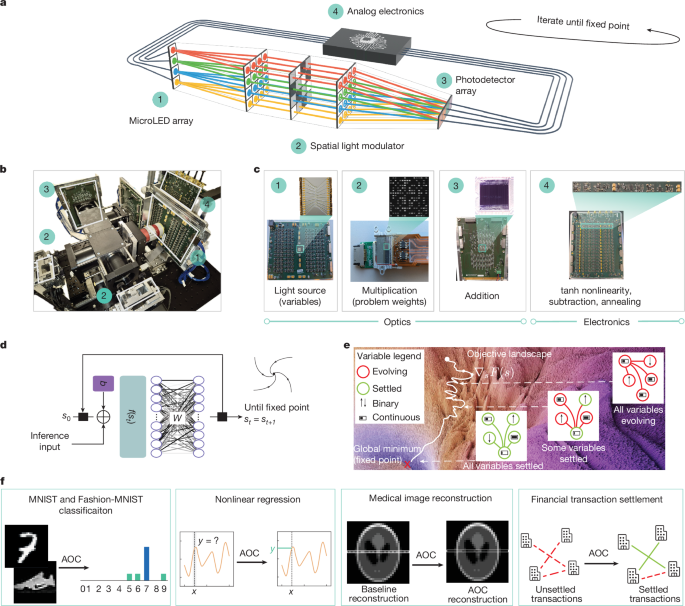
A 2025 paper in Nature reported an analog optical computer that integrates analog electronic circuits, three‑dimensional free‑space optical propagation and an iterative‑operator architecture into a single device. The paper, titled "Analog optical computer for AI inference and combinatorial optimization", proposes and demonstrates a hybrid analog platform capable of performing AI inference and combinatorial optimization on the same system.
The article describes three foundational modules: control and feedback loops implemented with analog electronics; a three‑dimensional optical subsystem for large‑scale linear mappings (parallel matrix operations in the optical domain); and an iterative architecture that closes the loop between them to progressively converge to target solutions. The team did not treat optics merely as a one‑shot accelerator, but used electro‑optical closed‑loop interactions to "refine" results across iterations on noisy and mismatched analog devices.
The paper retains substantial experimental detail: the researchers implemented high‑dimensional matrix–vector multiplication in a free‑space optical path, using spatial modes of the optical field to carry vector components in parallel; analog electronic circuits scale and apply phase adjustments to outputs after each iteration and feed them back to the optical module; the overall architecture allows most linear algebra to be executed in the optical domain while iterative steps introduce nonlinearities or constraints incrementally for solving combinatorial‑optimization problems.
In demonstrations, the authors validated prototypes for both AI inference and combinatorial optimization. For AI inference, they showed that trained linear layers or approximate operators mapped to the optical subsystem can maintain usable accuracy under iterative correction; for combinatorial optimization, the team used an opto‑electronic hybrid iterative flow to converge to near‑optimal solutions and discussed how multiple iterations and parameter tuning improve solution quality.
The authors emphasize three technical implications: first, combining "analog" and "iterative" approaches can perform large‑scale linear operations with lower energy within a controllable noise regime; second, three‑dimensional free‑space optics provides natural channels for high parallelism, well suited to large matrices; third, closed‑loop electronic feedback supplies programmability and error‑correction capability, enabling the same hardware to switch between different task types.
The paper also acknowledges limitations: challenges include device mismatch, optical scattering and thermal management, and how to engineer a laboratory prototype into a stable, widely deployable product. Proposed pathways include stricter calibration procedures, noise‑tolerant algorithm design, and cooperation with existing digital backends.
For early‑career or technical readers, the work offers an intuitive picture: instead of only using electronic bits to carry computation, light can serve as a natural parallel computing medium while analog electronics "correct" and control, allowing AI inference and combinatorial optimization—often considered distinct domains—to run efficiently on the same machine. The paper centers on experimental detail and system architecture, presenting short‑term engineering routes and ideas for bringing optical accelerators to data centers or edge devices.
In sum, this 2025 study presents "analog optics + electronic closed‑loop + iterative algorithms" as an integrated solution, a physical‑layer innovation that will also drive software and algorithm adaptation and optimization for this new class of hardware.