
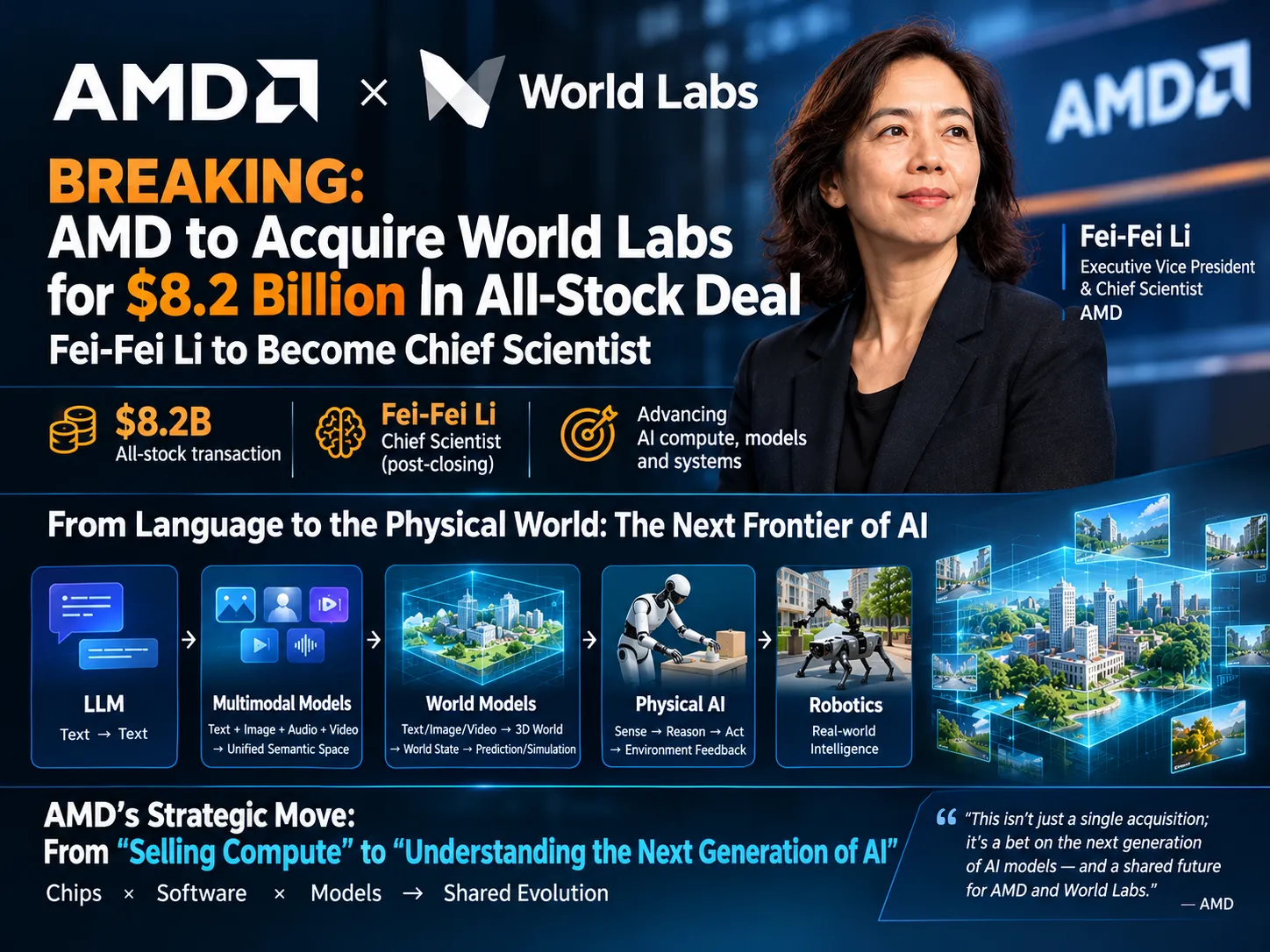
On Sept. 28, 2026, AMD formally announced it will acquire World Labs, founded by AI pioneer Fei‑Fei Li, in an all‑stock transaction valued at about $8.2 billion. The deal is expected to close by the end of 2026 and remains subject to regulatory approvals and other customary closing conditions. The move is seen as a key step for AMD to extend from chip hardware into full‑stack "models + systems + infrastructure" capabilities in AI computing, and marks a notable instance of a chip giant directly moving into spatial intelligence and physical‑world simulation models.
Deal Details and Background
World Labs, headquartered in San Francisco, was founded by Fei‑Fei Li in 2024 and focuses on research into spatial intelligence models. Its core technology can generate, reconstruct and simulate interactive three‑dimensional environments from text, image and video inputs, and also covers robotics learning and simulation technologies. The company has previously launched commercial product Marble (a world‑generation model) and completed about $1 billion in funding in 2026, rapidly increasing its valuation. Li, a leading authority in computer vision and a key driver of the ImageNet project often called the "godmother of AI," and her team have accumulated significant expertise in physical‑world understanding and synthetic data generation.
According to statements from both parties, after the transaction World Labs’ team will continue to focus on cutting‑edge AI model research; Fei‑Fei Li will join AMD as Executive Vice President and Chief Scientist, reporting directly to AMD chairman and CEO Lisa Su. World Labs co‑founders Justin Johnson and Ben Mildenhall and other core members will continue to lead related research and development. AMD and World Labs had previously collaborated on training and inference optimizations; the acquisition is seen by both sides as a natural deepening of that technical partnership into full integration.
AMD emphasized that the acquisition will bring world‑class research teams and model expertise to the company, strengthening its ability to design AI hardware, software and systems around emerging model and application needs, and further advancing the construction of an open AI ecosystem. Li said the next generation of AI requires tight collaboration between model research, systems and compute; joining AMD will provide her team with resources and engineering depth to accelerate research and help define the infrastructure needed for next‑generation AI.
Strategic Intent and Technical Rationale
The acquisition comes at a pivotal moment as AI evolves from pure text/chat models toward systems that understand and interact with the physical world. While large language models are powerful, they still face limitations in 3D spatial reasoning, physical simulation and robotic policy learning due to scarcity of real‑world data. World Labs’ spatial intelligence and world‑modeling technologies can help fill this gap by providing high‑quality synthetic data and interactive simulation, directly serving scenarios such as robotics, autonomous driving, industrial simulation and immersive content.
For AMD, a deep understanding of these emerging workloads can inform the customization of future chip architectures, software stacks and system solutions, shortening the feedback loop from "model requirements to hardware design." In fierce competition with NVIDIA, AMD hopes that direct control of model research will enable it to build differentiated advantages in open ecosystems, heterogeneous computing and certain vertical scenarios. Lisa Su said in a statement that building the next‑generation AI computing platform requires a deep understanding of how models will evolve, and World Labs’ expertise will help AMD develop the hardware, software and systems that support the next wave of AI.
Potential Impacts
1. AMD AI strategy upgrade
The acquisition moves AMD further from "selling shovels" to participating in "building models and defining workloads." A closed loop between hardware and model research could accelerate iteration on training/inference chips, software frameworks and system‑level solutions, especially for emerging spatial and physical AI workloads.
2. Acceleration of spatial intelligence and robotics
Combining World Labs’ technology with AMD’s computing power and engineering resources could speed deployment of large‑scale simulation and synthetic data generation capabilities, benefiting general‑purpose robotics, embodied intelligence and industrial automation. Improved synthetic data quality could lower the cost and risk of real‑world data collection.
3. Changes in industry competition
The model of chipmakers directly acquiring cutting‑edge model labs may draw attention or imitation from other players. Competitors such as NVIDIA already have deep model and software ecosystems; AMD’s move is an important attempt to catch up and differentiate. The deal may also trigger discussion over whether hardware giants controlling model research affect openness in the ecosystem.
4. Talent and research consolidation
Fei‑Fei Li joining AMD as chief scientist will significantly raise the company’s profile in academia and industry. Allowing the World Labs team to continue focused research may help AMD attract top AI talent and promote closer industry‑academia collaboration.
5. Regulatory and closing risks
An $8.2 billion all‑stock transaction is sizable and will require regulatory approvals. Both parties must maintain business continuity before closing, and integration may face cultural and R&D cadence coordination challenges. If completed successfully, the acquisition could deliver real research and product synergies to AMD by the end of 2026.
6. Impact on open ecosystems
Both parties stressed they will work to build an end‑to‑end open AI ecosystem covering hardware, software, platforms and open models. If realized, this could provide developers and small businesses with more non‑proprietary options; if integration prioritizes internal optimization, the degree of openness will need to be monitored.
Conclusion
AMD’s acquisition of World Labs is a major deal at the intersection of AI and semiconductors in the second half of 2026. It not only strengthens AMD’s research capabilities in spatial intelligence and physical‑world modeling, but also signals that chip companies are taking a more active role in defining next‑generation AI workloads. Fei‑Fei Li’s addition and the continued research of her team could shorten the cycle from model innovation to hardware deployment and inject new momentum into robotics and embodied intelligence. Whether the transaction closes smoothly and achieves synergies will depend on regulatory progress and integration execution. Regardless of the outcome, the acquisition clearly signals that future AI competition will increasingly rely on deep integration of hardware, software and model research.
▶️ Enjoyed this article? Creating great content takes effort!
Subscribe to our YouTube channel:
AI Rosetta
Your likes, subscriptions and shares mean the world to us! 🙏
For more AI news, visit:
https://www.airosetta.com