
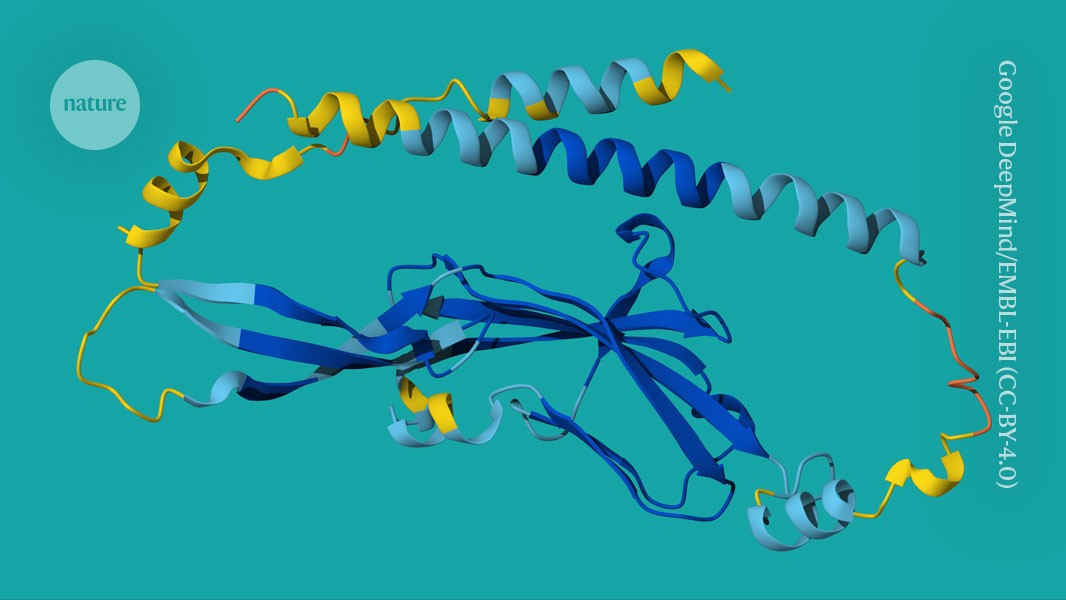
On 26 November 2025, Nature published a set of charts focusing on a tool that has changed how science is done: AlphaFold. The feature uses time‑series and field‑distribution charts to show how AlphaFold, since its 2020 debut, has turned "unknown three‑dimensional structures" into "accessible models."
Chart one shows an explosive increase in database scale: predictions grew from tens of thousands in early datasets to cover hundreds of millions of protein sequences, including not only model organisms but also large numbers of sequences from uncultivated microbes and environmental samples. That scale has meant experimental teams often no longer need to infer folding topologies from scratch and instead use AlphaFold models as starting points, saving months to years of structure validation time.
Another set of charts uses citation counts and field‑penetration metrics to illustrate adoption speed: the proportion of structural biology papers citing AlphaFold surged within a few years, and citations in drug discovery, enzyme engineering, plant science and microbial ecology rose rapidly. Some interdisciplinary curves show sharp increases in 2023–2024, indicating that more early‑career and cross‑disciplinary teams now incorporate predicted structures directly into experimental design, promoting wider use of high‑throughput screening and rational design.
The article also details AlphaFold's role in laboratory workflows: for obscure or poorly soluble proteins, researchers use predicted models to guide truncation, mutation and expression strategies; in processing low‑resolution cryo‑EM maps, AlphaFold models serve as initial templates, accelerating assembly and fitting. Nature's charts aggregate cases that illustrate how the "model → experimental validation → functional discovery" loop shortens the time from hypothesis to confirmation.
However, the charts also reveal limitations: predictions for ligand binding, post‑translational modifications, multi‑protein complexes and highly intrinsically disordered regions remain uneven in confidence. A distribution of confidence scores (pLDDT) shows that low‑confidence regions often coincide with regulatory segments or interaction interfaces, signaling that these areas still require experimental verification.
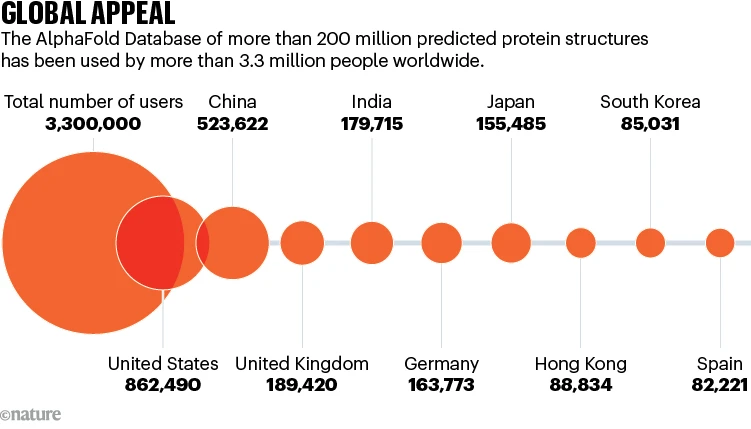
On technical evolution, Nature notes that expansions of the AlphaFold family (such as AlphaFold Multimer) are attempting to cover complex modeling; the charts also show that open‑data strategies have greatly lowered access barriers, enabling research institutes in many low‑ and middle‑income countries to apply structure prediction to local samples and thereby broaden the range of biological questions addressed.
Forward‑looking charts emphasize "interpretability" and "dynamics": static 3D coordinates are useful but protein function frequently depends on conformational fluctuation and transitions. The article recommends tighter integration of machine‑learning prediction, molecular dynamics and high‑throughput experiments to capture functionally relevant dynamic landscapes. It also highlights engineering and algorithmic challenges in correctly handling confidence intervals in target selection and design and in integrating predicted structures with chemical site and ligand information.
Overall, the charts do not merely praise the tool but use visualized data to show that AlphaFold has sparked an efficiency revolution while exposing new scientific problems: open models and databases have lowered structural biology barriers for researchers worldwide while clarifying the "boundaries that require experimental validation." For research teams and startups seeking the next breakthrough, AlphaFold is both an accelerator and a magnifier—amplifying tractable biological questions and the unresolved complexities within them.