
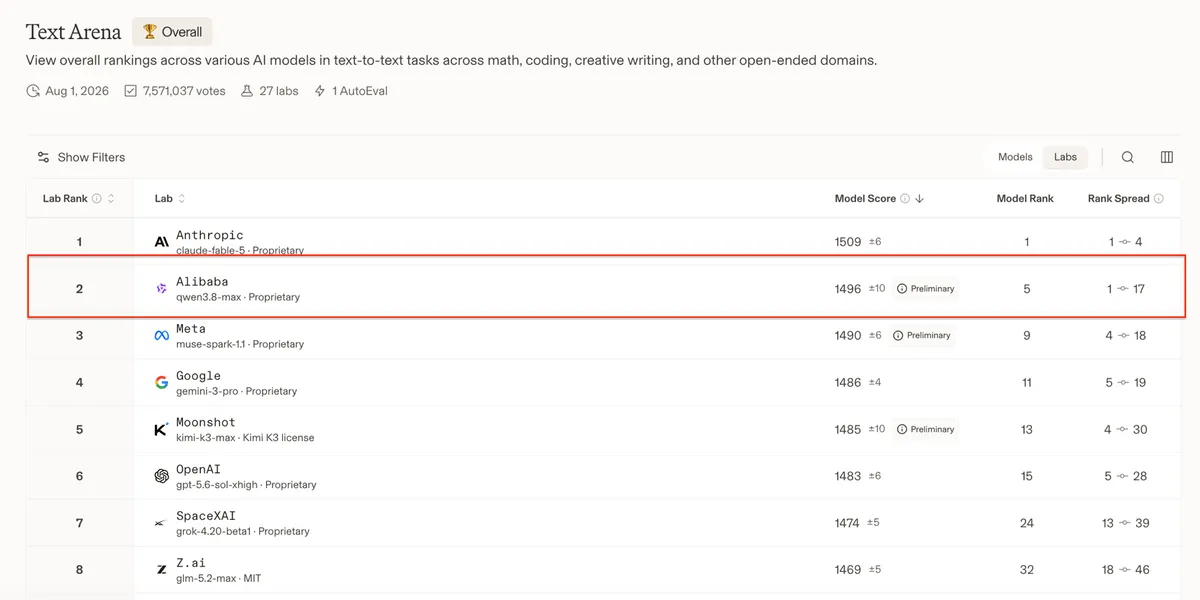
August 3, 2026, Alibaba's Tongyi Qianwen (Qwen) team officially released the next‑generation foundation model Qwen3.8‑MAX, significantly improving capabilities in programming (Coding) and professional office (Cowork). In today's authoritative third‑party leaderboard Arena, Alibaba's Qwen model ranked second only to Anthropic's Claude series, placing it in the global first tier of large models. Earlier during the World Artificial Intelligence Conference (WAIC), Tongyi Qianwen officially released the preview version Qwen3.8‑Max‑preview. The model reaches 2.4 trillion parameters, making it the largest model in the Qwen series to date; the company stated its overall capability is “second only to Claude Fable 5”. The stable version has been deployed on Token Plan, Qoder and QoderWork platforms, and the stable release and model weights are expected to be open‑sourced next week, with a smaller Qwen3.8‑27B version also to be made available.
Model details
Qwen3.8‑Max adopts a large‑scale mixture‑of‑experts (MoE) architecture, with a total of 2.4T parameters, and is Alibaba's first multimodal model to exceed 1 trillion parameters, supporting unified processing of text, images, video and documents. The company emphasized significant improvements over the previous Qwen3.7‑Max in coding, full‑stack development, data analysis, office workflows and autonomous system planning.
The preview was launched in a “continuous evolution” mode, with the team pledging daily iteration and optimization. The model performed strongly on leaderboards such as Frontend Code Arena, and in some tests matched or even surpassed certain leading models from OpenAI, Anthropic and Google. API pricing is competitive—about $2 per million input tokens—making it suitable for large‑scale development and enterprise applications.
Unlike earlier Max‑series models that largely remained closed‑source, Qwen3.8 explicitly commits to open‑sourcing weights, marking an important adjustment in Alibaba's flagship model strategy. The open‑source scope is expected to include the main model and the smaller 27B version, facilitating local deployment and secondary development.
Release background and strategic considerations
The release of Qwen3.8‑Max follows the moon's dark side Kimi K3 (a 2.8T open‑source model), reflecting intense domestic competition over ultra‑large parameter scales and open‑source strategies. Alibaba chose to open preview access early and iterate rapidly with daily updates, demonstrating strong attention to the market window.
At the same time, the open‑source commitment responds to community discussions about the Max series' long‑standing closed‑source approach. With model capabilities still trailing some top closed models, open‑sourcing to build an ecosystem and attract developers has become a key strategy for Alibaba to maintain competitiveness.
Potential impact: open‑source ecosystem and competitive landscape
1. Impact on developers and enterprises After the open‑source release next week, developers will be able to deploy a 2.4T‑class model locally or in private environments, greatly reducing dependence on closed APIs. Barriers for coding, agent construction and multimodal applications are likely to decline further. The smaller 27B version will be better suited to local hardware and edge deployments with limited resources.
2. Impact on domestic large‑model competition Qwen3.8‑Max, Kimi K3 and DeepSeek V4 series will form a three‑way competitive landscape. Ultra‑large parameter counts combined with open‑source strategies will intensify competition across performance, ecosystem and cost, accelerating overall progress.
3. Impact on the global AI landscape Open‑sourcing a 2.4T model will further enrich the global open‑weight ecosystem, providing near‑leading capabilities to research institutions and small and medium enterprises. It may also heighten discussions about open‑source model safety, distillation risks and geopolitical considerations.
4. Potential challenges
- The model's actual performance after official open‑sourcing, license terms and community support still need verification.
- The inference cost and deployment complexity of ultra‑large models are high; practical adoption depends on engineering optimizations.
- The gap with top closed models such as Claude Fable 5 needs to be narrowed through continuous iteration.
Industry implications: open source as key competitiveness
The release and open‑source plan for Alibaba's Qwen3.8‑Max mark a further deepening of leading domestic vendors' dual strategy of “scale + open source.” While closed‑source flagships continue to push the upper limits, open‑source models are accelerating penetration into practical applications by offering larger parameter counts, stronger agent capabilities and lower usage barriers.
After the official open‑source release next week, Qwen3.8‑Max's real‑world performance and ecosystem response will be an important window for assessing the effectiveness of China's large‑model open‑source strategy. For developers, this represents both an opportunity to access cutting‑edge capabilities and a chance to participate in building the open ecosystem.
▶️ Enjoy this article? Creating content is hard!
Follow our YouTube channel:
AI Rosetta
Your likes, subscriptions and shares are our biggest support! 🙏
For more AI news visit:
https://www.airosetta.com