
On the evening of April 8, 2026, the global AI evaluation platform Artificial Analysis' Video Arena leaderboard saw an explosive change: the previously anonymous model HappyHorse‑1.0 topped two lists with Elo scores of 1332 (text‑to‑video without audio) and 1392 (image‑to‑video without audio) (these numbers are still changing), significantly ahead of mainstream competitors such as ByteDance's Dreamina Seedance 2.0 and Kuaishou's SkyReels V4. Hours later, Taotian Group's Future Life Lab (an Alibaba affiliate) officially confirmed that HappyHorse‑1.0 is the lab's latest work, led by former Kuaishou Kling technical head Zhang Di, and announced it will be fully open‑sourced, including base model weights, distilled models, upscaling models and full inference code. This marks a discreet but powerful strategic move by Alibaba in the video‑generation track and injects a new open‑source variable into the global AI video‑generation landscape.
HappyHorse‑1.0's sudden rise can be described as a "dark horse" victory. Artificial Analysis uses a strict blind‑test plus Elo rating mechanism: users anonymously compare videos generated by different models and vote. HappyHorse‑1.0 excelled in motion naturalness, prompt compliance, visual consistency, physical realism and multi‑shot coherence, especially in complex dynamic scenes and multi‑actor interactions. When audio is included, its text‑to‑video and image‑to‑video results rank second, only slightly behind Seedance 2.0, but its overall capability places it in the world's leading tier.
Technical implementation: 15B parameters, 40‑layer single‑stream self‑attention Transformer architecture
HappyHorse‑1.0 adopts a unified single‑stream self‑attention Transformer architecture with 15 billion parameters, which is its core design highlight. This architecture abandons the traditional multi‑stream video‑generation pipeline, packaging text, images, video frames and audio tokens into a single sequence to perform joint modeling and denoising within the same attention space, without requiring extra cross‑attention mechanisms.
The specific architecture uses a distinctive sandwich‑style (Sandwich) layer design:
- First 4 and last 4 layers: modality‑specific projection layers responsible for embedding and final decoding of different modalities (text, image, video, audio), ensuring tailored initial representations and outputs for each modality.
- Middle 32 layers: shared‑parameter layers where all modality tokens undergo deep fusion and interaction via self‑attention, maximizing parameter efficiency and achieving tight cross‑modal coupling.
This design greatly simplifies traditional video‑generation workflows, avoids inter‑modal alignment errors and significantly improves temporal consistency and audio‑visual synchronization. The model also incorporates DMD‑2 distillation, compressing the denoising process to only 8 steps and eliminating the need for Classifier‑Free Guidance (CFG), greatly reducing inference cost. In practice, a 256p video takes about 2 seconds and a 1080p video about 38 seconds to generate, with inference speeds far exceeding most competitors.
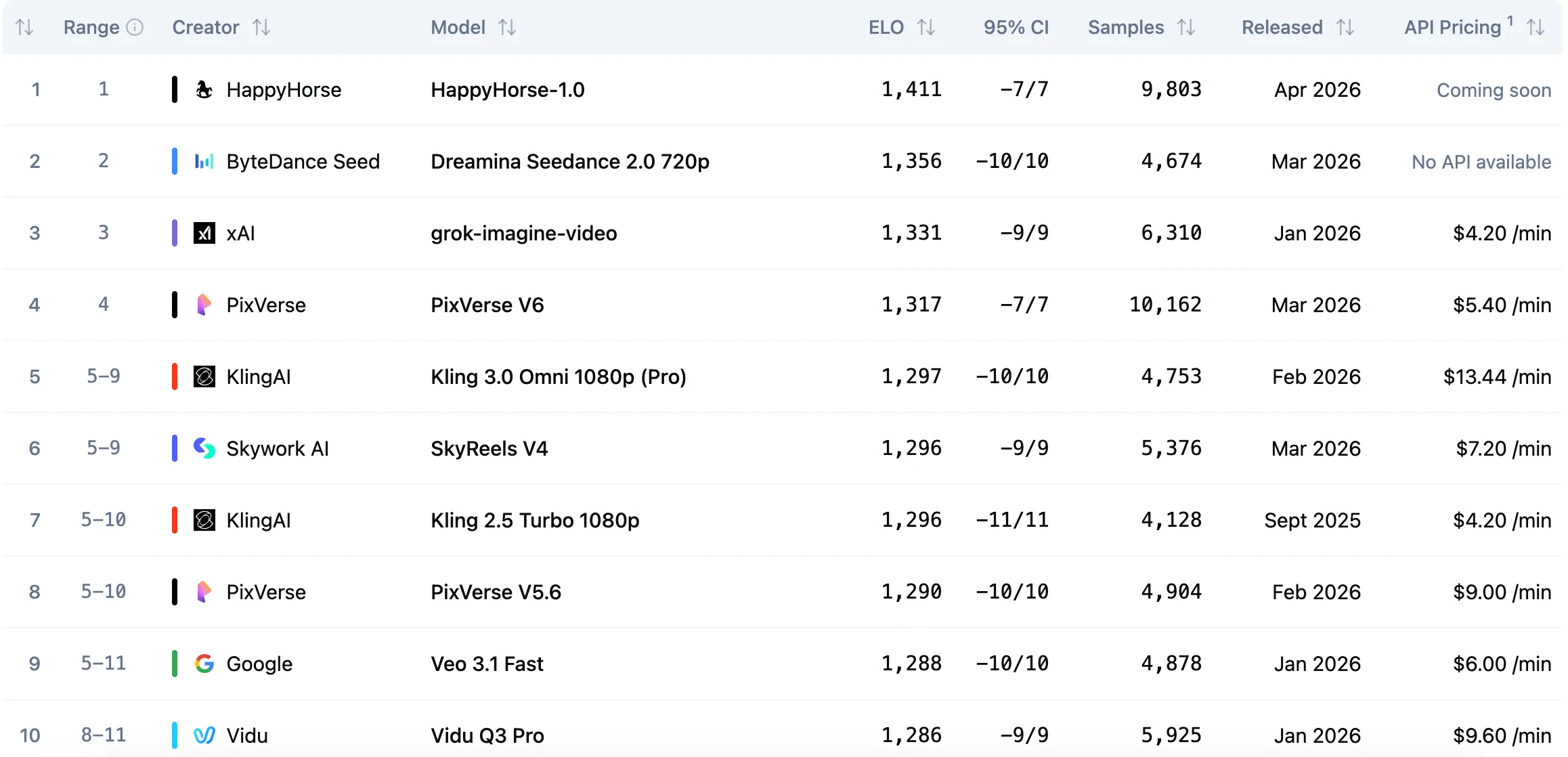
Screenshot from https://artificialanalysis.ai/video/leaderboard/image‑to‑video
In addition, HappyHorse‑1.0 natively supports joint audio‑video generation and lip‑sync in seven languages (Chinese, English, Japanese, Korean, German, French and Cantonese), with high mouth‑shape matching accuracy and very low WER (Word Error Rate). This is achieved by joint training on the unified sequence, enabling natural synchronization of audio and video frames during generation rather than post‑hoc splicing.
Zhang Di's team had already accumulated extensive video‑generation experience in Kuaishou's Kling project. Backed by Taotian Group's Future Life Lab at Alibaba, HappyHorse‑1.0 integrates Taotian's multimodal large‑model technological reserves, realizing a leap from "generation" to "controllable generation." After open‑sourcing, the community will be able to fine‑tune, distill and vertically optimize based on full weights and code, further unlocking the model's potential.
Fully open‑sourced: from mysterious dark horse to community commons
Most attention centers on the open‑source commitment. Taotian Group stated that HappyHorse‑1.0 will be completely open‑sourced, including base model weights, distilled models, upscaling models and full inference code. This decision sharply contrasts with the closed or semi‑open strategies of most current video‑generation models, and the release is expected to appear on GitHub and Hugging Face within days.
Open‑source scope includes:
- Base model
- Distilled model
- Upscaling model
- Complete inference code and training scripts
The move is seen as a strategic opening by Alibaba in the video‑generation field, likely to quickly attract global developers to fine‑tune, optimize and build vertical applications, further expanding HappyHorse's influence in the open‑source ecosystem. After open‑sourcing, developers will be able to deploy locally, customize training, or build short‑video, advertising and short‑drama generation tools based on HappyHorse, greatly lowering content‑production barriers.
Industry impact: reshaping the video‑generation competitive landscape
HappyHorse‑1.0's top ranking and open‑source plan deliver multiple shocks to the AI video‑generation track:
- Direct challenge to leading players: Models that previously dominated the leaderboard, such as ByteDance's Seedance and Kuaishou's Kling‑related systems, will face greater pressure. Competition among Chinese AI firms in text‑to‑video will intensify, and international players (such as Google Veo and related OpenAI technologies) will see new variables.
- Acceleration of the open‑source ecosystem: Full open‑sourcing will lower barriers for developers, driving the emergence of derivative tools, plugins and vertical applications based on HappyHorse, potentially sparking innovation in short video, advertising and short‑drama sectors.
- Strategic significance: Through HappyHorse, Alibaba demonstrates a "small‑efficient models + open source" path that resonates with open strategies from Meta's Llama and Mistral, while opening new spaces for Taotian Group's multimodal AI commercialization. The 15B‑parameter lightweight design combined with a 40‑layer efficient architecture reflects a Chinese AI approach of "winning with smaller, efficient models."
For ordinary creators, HappyHorse‑1.0's launch (currently available for limited trials on platforms such as happyhorse.ai) means more cost‑effective 1080p video‑generation tools will become widely accessible, further lowering the threshold for content production.
Challenges and outlook
Despite its strong performance, as a new model HappyHorse‑1.0 still has room for improvement in very long‑video generation, complex multi‑character narratives and commercial deployment stability. After open‑sourcing, balancing community contributions with intellectual property protection will also be a new challenge for Taotian Group. As weights are released and community iterations accelerate, HappyHorse could become a new open‑source benchmark in video generation and further drive AI's shift from "generating content" to "generating worlds."
From anonymous top‑ranker to official open‑source confirmation, HappyHorse‑1.0 has moved from dark horse to focal point in just days. The event reminds the industry that the AI video‑generation race is far from over, and that the combination of open source and innovation may decide the next phase's winners. In the ongoing surge of multimodal AI, HappyHorse‑1.0's rapid rise shows that breakthroughs often come from unexpected corners, and that ultimate success depends on practical value and innovation in real‑world applications.
▶️ Enjoyed this article? Creating great content takes effort!
Subscribe to our YouTube channel:
AI Rosetta
Your likes, subscriptions and shares mean the world to us! 🙏
For more AI news, visit:
https://www.airosetta.com