
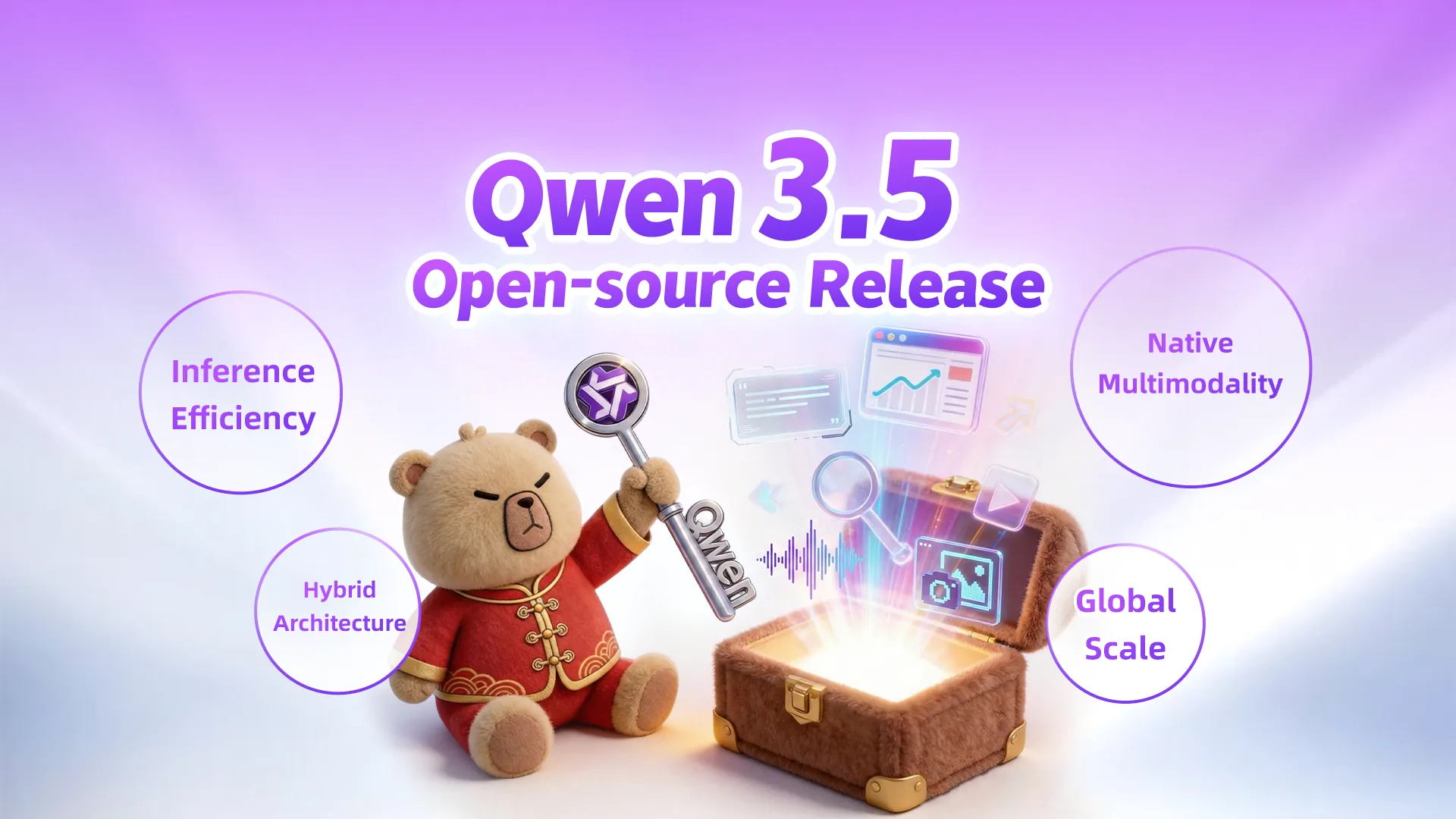
On February 15, 2026 (the day before Lunar New Year’s Eve), Alibaba Damo Academy officially released the next‑generation open‑source large model Qwen 3.5 (Tongyi Qianwen 3.5), and the first open‑weight model Qwen3.5‑397B‑A17B went live simultaneously. The release was regarded by the industry as the most significant open‑source AI offering of the Spring Festival period, marking Alibaba’s core deployment for the “Agentic AI” era.
Qwen 3.5 adopts a native multimodal vision‑language architecture with 397 billion total parameters and only 17 billion activations per forward pass, achieving extreme efficiency. Alibaba’s official benchmarks show Qwen 3.5 meets or surpasses OpenAI GPT‑5.2, Anthropic Claude Opus 4.5, and Google Gemini 3 Pro across inference, coding, agent abilities, and visual understanding, topping the global list of strongest open‑source models. At the same time, its inference cost is only 1/18 that of comparable models, delivering “stronger performance, lower cost, and complete multimodal capability.”
Technical Breakthroughs: Hybrid Architecture + Native Multimodal Fusion
The standout features of Qwen 3.5 are a hybrid attention mechanism (combining Gated Delta Networks linear attention with sparse MoE) and joint native vision‑language pretraining. Unlike the conventional text‑then‑vision concatenation training, Qwen 3.5 unifies language reasoning and visual perception from pretraining, supporting seamless integration of text, images, and video (up to two hours) across modalities.
- Visual Agent capabilities: The model can perform “screen understanding + cross‑app autonomous operations,” directly reading phone or computer interfaces and autonomously completing multi‑step complex tasks (e.g., compiling research reports, booking services, converting sketches to code).
- Multilingual support: Expanded from 119 to 201 languages, covering more South Asian and African low‑resource languages, with a vocabulary size enlarged to 250k.
- Context window: Default 1M tokens (Qwen3.5‑Plus), supporting ultra‑long documents and complex multi‑step reasoning.
- Efficiency optimizations: Although the model has 397B parameters, activations are only 17B, reducing deployment memory usage by 60% and increasing peak inference throughput up to 19x versus the previous generation. It employs end‑to‑end FP8 training, asynchronous RL frameworks, and multi‑turn rollout locking among other advanced techniques.
Alibaba Cloud’s Bailian platform simultaneously launched a commercial Qwen 3.5‑Plus offering with highly competitive pricing: input at million‑token scale as low as 0.8 RMB, only 1/18 the cost of Gemini 3 Pro. The pricing strategy has been called aggressively competitive, directly lowering the adoption threshold for enterprise‑grade agent applications.
Performance Benchmarks: Leading Across Multiple Measures

According to Alibaba’s published benchmark table, Qwen3.5‑397B‑A17B excelled on the following key tasks:
Language and reasoning
- MMLU‑Pro: 87.8 (GPT‑5.2: 87.4; Claude 4.5 Opus: 89.5; Gemini‑3 Pro: 89.8)
- SuperGPQA: 70.4 (GPT‑5.2: 67.9)
- IFBench: 76.5 (ahead of GPT‑5.2)
- LiveCodeBench v6: 83.6
- AIME26: 91.3
Vision‑language
- MMMU: 85.0 (GPT‑5.2: 86.7; Gemini‑3 Pro: 87.2)
- MathVision: 88.6 (ahead of GPT‑5.2)
- RealWorldQA: 83.9
- MMStar: 83.8
Agent capabilities
- TAU2‑Bench: 86.7 (close to Claude 4.5 Opus at 91.6)
- VITA‑Bench: 49.7 (substantially ahead of GPT‑5.2 at 38.2)
These results demonstrate that Qwen 3.5 has reached international first‑class levels in core Agentic AI capabilities—autonomous planning, tool use, and multimodal understanding—while delivering overwhelming advantages in cost and open‑source accessibility.
Open Source and Ecosystem: Inclusive AI Infrastructure
Qwen3.5‑397B‑A17B is fully open‑sourced under the Apache 2.0 license and has been uploaded to Hugging Face (https://huggingface.co/Qwen/Qwen3.5‑397B‑A17B) and GitHub. Developers can deploy with no barriers using mainstream frameworks such as vLLM, SGLang, and Transformers, and it supports an OpenAI‑compatible API.
Alibaba also launched the Qwen Code toolchain to support “vibe coding”—developers describe requirements in natural language and the model generates and iterates code in real time, including handling creative tasks like video generation. The Qwen 3.5 series also supports integrations with popular workflows such as ComfyUI, greatly lowering development barriers.
Strategic Significance: Alibaba’s Start of the “Agentic AI” Era
In its statement, Alibaba said: “Qwen3.5 is built for the Agentic AI era, designed to help developers and enterprises do more with less compute.” This strategy, alongside ByteDance’s Doubao 2.0 and Zhipu’s GLM‑5, forms a “top three” pattern in China’s Spring Festival AI releases. All three leading companies issued flagship open or semi‑open models around the holiday, signaling China’s shift from technology catching‑up to ecosystem leadership.
Qwen 3.5’s open‑source release not only consolidates Alibaba’s leadership in global open‑source large models but also sends a clear message to international giants: Chinese AI is accelerating to seize the technical high ground in the Agent era through a combination of high performance, low cost, and full openness.
Market Reaction and Outlook
After the Qwen 3.5 release, Alibaba Cloud’s share price rose slightly and market confidence in Alibaba’s AI commercialization strengthened. The Hugging Face page reached tens of thousands of downloads within hours of going live, and GitHub Stars climbed rapidly. The developer community responded enthusiastically, with many saying “finally a high‑performance visual agent model that can run on enterprise servers.”
Alibaba indicated the Qwen 3.5 series will later include more scale variants and continued iterations in visual agent, multilingual, and long‑video understanding capabilities. Qwen 3.5 is expected to be deeply integrated into Alibaba Cloud Bailian, DingTalk, Taobao, Fliggy, and other ecosystems, providing low‑cost, high‑performance AI infrastructure across industries.
One‑line summary:
With Qwen 3.5, Alibaba demonstrates again that open‑sourcing is not a compromise but a core competitive advantage: 397B parameters, native multimodality, and extreme cost‑performance—this release is both Alibaba’s new milestone and China’s strongest signal in the 2026 Agentic AI era.
▶️ Enjoy this article? Content creation is hard!
Follow our YouTube channel:
AI Rosetta
Your likes, subscriptions and shares are our greatest support! 🙏
More AI news at: https://www.airosetta.com