
In 2025, competition in AI image and video generation is intense, with major vendors pushing advances in text‑to‑image and image‑to‑video capabilities as extensions of large language models (LLMs). OpenAI's Sora 2, Google's Veo 3.1, ByteDance's Seedream 4 and xAI's Grok 4 Image (hereafter Grok 4 Image) represent the current frontier. These models not only raise generation quality but also innovate in audio synchronization, narrative control and practicality, driving AI from experimentation toward commercial applications. This report draws on authoritative sources to compare these models across multiple dimensions, including vendor, release timing, generation quality, video length, and audio‑video synchronization. Data are sourced from official announcements and third‑party evaluations, aiming to provide guidance for developers and creators. The report emphasizes key innovations and discusses potential impacts.
Model overview and key parameter comparison
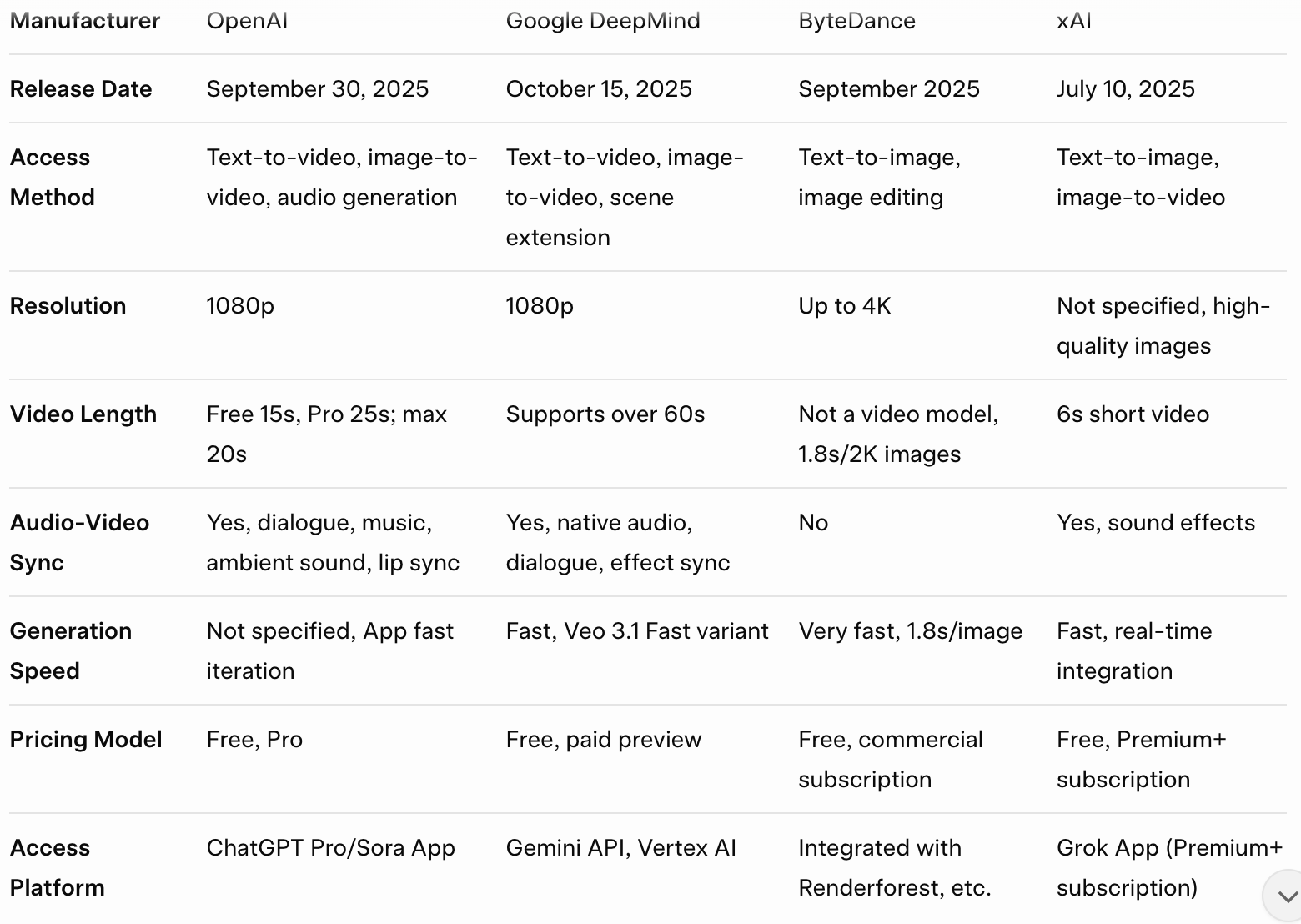
The table below summarizes the core parameters of the four models. Note that Seedream 4 primarily focuses on image generation and editing rather than pure video; its high‑resolution outputs are often used as preprocessing assets in video pipelines (for example, in combination with Veo). Grok 4 Image is image‑centric, with video capabilities as an auxiliary extension.
Generation quality and innovation analysis
Generation quality is the central competitive dimension for these models, emphasizing realism, temporal consistency and creative control.
Sora 2 leads in physical accuracy and realism and has been described as "a GPT‑3.5 moment for video generation." Its innovation lies in synchronized audio generation: the model can create dialogue, music and environmental sounds while ensuring lip‑sync, enhancing immersion. Output quality is high with strong frame‑to‑frame consistency, but copyright controls are strict and the model often refuses IP‑sensitive content. Evaluations show that in complex scenes such as human interaction, Sora 2 produces natural motion and avoids deformation. Its Remix and Cameo features allow users to upload images to generate personalized videos, enabling new social‑sharing scenarios.
Veo 3.1 emphasizes narrative control and audio integration; its innovation is "native audio": generated dialogue, ambient sound and effects that synchronize tightly with video. Quality improvements include more realistic texture capture and a roughly 20% increase in prompt adherence, reducing useless outputs. Compared with Sora 2, Veo 3.1 is stronger in multi‑shot storytelling, supports up to three reference images and scene extension to realize longer videos. However, some evaluations note an occasional "oily" look in renders and slightly less realism than Sora 2. Tools like "Ingredients to video" and "Scene extension" simplify editing workflows, making Veo 3.1 attractive to professional creators.
Seedream 4, as an image model, innovates through a unified architecture that merges generation and editing, supporting 4K output and batch processing. Its strengths are detail and speed: it can produce a 2K image in about 1.8 seconds, outperforming models like Nano Banana in some tests. Although it lacks native video capabilities, Seedream 4 is frequently used at the front end of video pipelines—for example, to generate initial frames for Veo or Sora—to improve overall quality. It has no audio support, but its multimodal prompt understanding (such as using reference photos) makes it efficient for text‑to‑image tasks. Compared with others, Seedream 4 emphasizes commercial applications like posters and infographics.
Grok 4 Image innovates in multimodal integration: positioned as a highly capable general AI, it supports image‑to‑video conversion and can generate 6‑second clips with sound. Quality and realism are strong, and its "Spicy" mode permits less filtered content. Audio synchronization supports sound effects, but clip length is short, making the model suitable for memes and social sharing. Compared with Sora 2, Grok 4 Image offers better lip‑sync and reference‑image retention in some cases, but its short duration limits deep narrative use. Future updates aim to add longer video generation and unlimited image support.
Other dimensions and impact of innovations
On speed and cost, Veo 3.1's Fast variant stands out for real‑time applications; Sora 2 lowers the threshold via its app, while Pro features require subscription. Seedream 4's rapid inference (about 1.8 seconds) advances image editing workflows, and Grok 4 Image's integrated real‑time search increases practicality.
Ethics and safety: all models implement watermarks and content filters, with Sora 2 enforcing the strictest controls. The innovations have far‑reaching effects: Sora 2 and Veo 3.1 could drive a revolution in film and video production, Seedream 4 optimizes design workflows, and Grok 4 Image expands social AI use cases. Challenges remain around copyright and authenticity risks.
Conclusion
Sora 2 leads in audio synchronization and realism, making it well suited for social creation; Veo 3.1 excels in narrative control and is more professionalized; Seedream 4—while not a video model—enhances pipelines through image innovation; Grok 4 Image fills the short‑form video niche. These models are likely to converge over time and fuel an explosion of AI‑generated content. Developers should choose based on needs: pick Veo for long‑form video and Grok for short clips.