
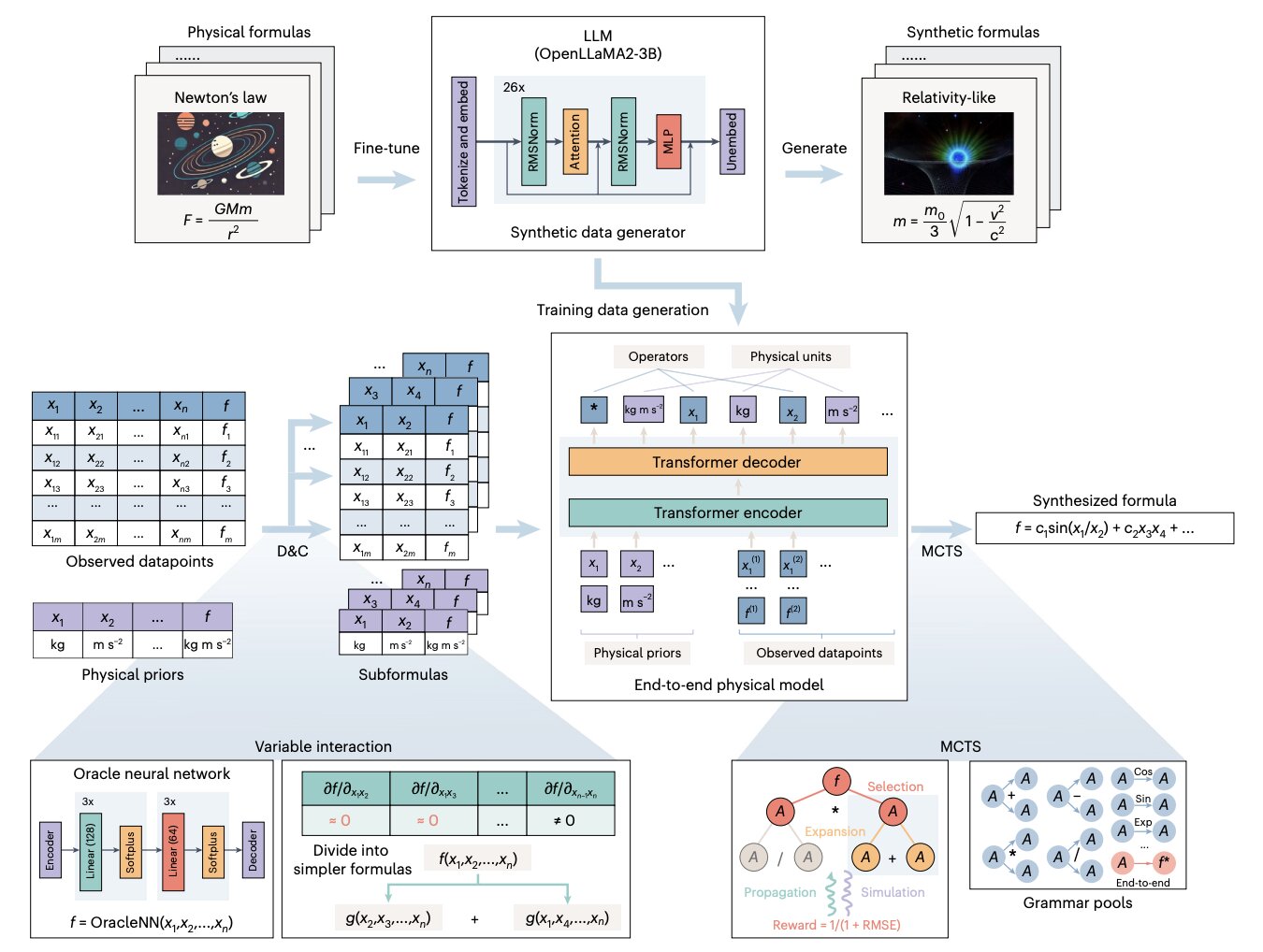
On November 11, 2025, researchers from Tsinghua University, Peking University and other institutions published in Nature Machine Intelligence a paper presenting a new AI framework—PhyE2E—that can identify physical equations directly from raw space observational data. The article reports that the framework can recover concise mathematical expressions that reveal intrinsic laws governing the evolution of plasmas in the magnetosphere and the corona, even when applied to highly noisy, discontinuous data collected by magnetometers and plasma instruments.
The framework's core procedure consists of two stages: first, deep neural networks are used to denoise and continuaize the raw time series, producing representations that are differentiable in time and space; second, those representations are subjected to sparse symbolic regression, searching a preconstructed library of candidate operators for the simplest differential or algebraic equations. The authors emphasize that the combination of "differentiable representations + sparse search" enables the system to leverage neural networks' fitting power while producing interpretable closed‑form equations.
The paper presents multiple validation experiments: on synthetically constructed plasma‑dynamics models, the framework successfully reconstructed equations including time derivatives and nonlinear coupling terms; on subsets of real spacecraft observations, the team demonstrated recovery of dominant terms controlling fluid and magnetic‑field evolution from data segments with gaps and measurement errors. The manuscript quantifies trade‑offs among noise tolerance, data‑missing ratios and candidate‑library size, noting that an excessively large operator library can lead to overfitting while a library that is too narrow may miss key physical terms.
The researchers discuss potential applications in space physics: automatically identifying emerging dynamical mechanisms, providing compact closed‑form approximations for numerical models, and quickly filtering large in‑flight datasets to flag events that warrant deeper human analysis. The article states that unlike purely physics‑constrained learning methods, this approach neither fully relies on prior equation structures nor remains a black‑box predictor, but instead directly yields mathematical expressions amenable to physical interpretation.
The work is attractive to early‑career researchers and data scientists because it combines neural networks' expressivity with symbolic methods' interpretability, lowering the barrier between observation and theoretical discovery. The team says the next steps include scaling the framework to larger on‑orbit mission datasets and exploring direct incorporation of domain knowledge—such as conservation laws—into the candidate‑operator library to improve discovery efficiency and physical consistency.
This study provides a new data‑driven tool for space physics that could change how physical laws are extracted from massive spacecraft observation streams in the coming years.