

In October 2025, the AI‑Trader project from the University of Hong Kong Data Science Lab (HKUDS) exploded onto GitHub, rapidly amassing over 5k stars and 1.5k forks—cementing its status as a breakout tool in AI‑driven finance. The framework rigorously tests whether AI models can outperform the market by simulating autonomous trading in the NASDAQ 100 environment. Five leading models—DeepSeek, Claude‑3.7, GPT‑5, Qwen3‑max, and Gemini‑2.5‑flash—compete with zero human intervention, making independent decisions based on market data, news, and toolchains. The project emphasizes fairness, reproducibility, and strict anti‑lookahead controls. This report dissects its architecture, technical innovations, and performance, offering a practical blueprint for AI quant developers.
1. Project Vision: A Pure AI‑Powered “Arena”
Unlike traditional quant frameworks reliant on predefined rules, AI‑Trader enforces 100% autonomous decision‑making: AI agents start from scratch—analyzing data, forming strategies, and executing trades without human prompts or hardcoded logic. The central question: Can AI beat the market? Multi‑model parallel competition ensures objective, comparable results.
Design philosophy:
Tool‑driven + modular = extensible AI trading ecosystem.
Built on the Model Context Protocol (MCP) toolchain, it enables standardized tool calling, third‑party strategy integration, and custom agent extensions. Ideal for research, education, and prototyping—focused on the NASDAQ 100 as the trading universe.
2. Core Architecture: MCP Toolchain and Closed‑Loop Data
1. System Overview
Clean, modular structure:
AI-Trader/
├── core_system/    # Core logic: main.py, base agent class
├── mcp_toolchain/  # Tools: trading, price lookup, news search, math
├── data_system/    # Data: price JSONL, performance calc
└── frontend/       # Web dashboard: real-time monitoring
main.py orchestrates multi‑model concurrency, config loading, and date control. Supports JSON config + .env variables.
2. MCP Toolchain: The AI’s “Trading Arms”
MCP is the heart of the system, offering four tool categories:
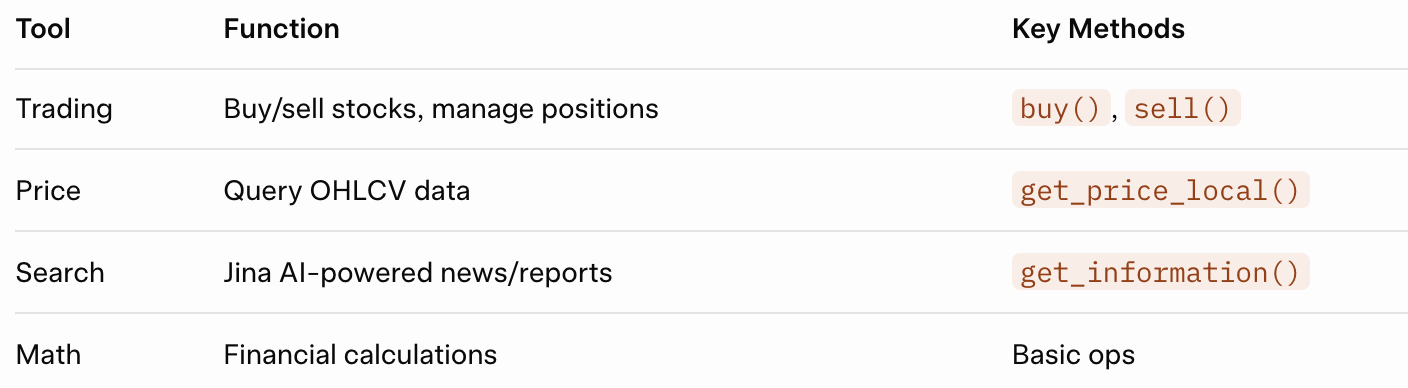
Tools use @mcp.tools() decorators for hot‑swappable extensions. Agents (inheriting BaseAgent) follow a ReAct loop (think → act → observe):
while not done:
    thought = llm.think(observation)
    action = llm.tool_call(thought)  # e.g., buy(AAPL, 10)
    observation = execute(action)
3. Data System: Backtesting with Anti‑Lookahead Safeguards
Data from Alpha Vantage (OHLCV) and Jina AI (real‑time intel). Prices stored in merged.jsonl:
{"symbol": "AAPL", "date": "2025-01-20", "open": "255.8850", ...}
Trade logs in position.jsonl:
{"date": "2025-01-20", "action": {"buy": "AAPL", "amount": 10}, "positions": {"AAPL": 10, "CASH": 9737.6}}
Historical replay via init_date and end_date simulates past markets. Future data filtering (e.g., news timestamps) prevents lookahead bias. Performance script calculate_performance.py auto‑generates:
- Total return
- Sharpe ratio
- Max drawdown
- Annualized return
4. Frontend & Config: Developer‑Friendly
Web dashboard (run via HTTP in docs/) offers real‑time agent tracking. Flexible config:
{"models": [{"name": "claude-3.7-sonnet", "enabled": true}], "agent_config": {"initial_cash": 10000.0, "max_steps": 30}}
Dependencies: langchain, pandas, etc. Python 3.8+ compatible.
3. Performance Benchmarks: DeepSeek Takes Early Lead
Built‑in leaderboard (as of 2025‑10‑24), $10,000 starting capital, benchmark: QQQ ETF:
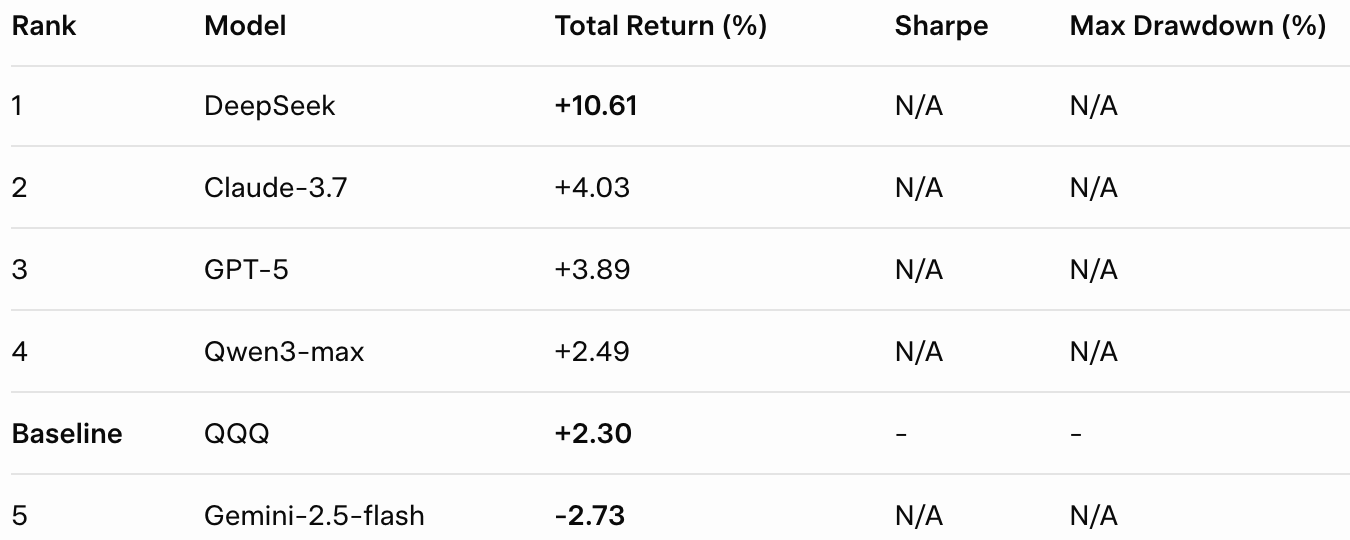
Test conditions: Daily trading, open‑price execution. DeepSeek excels via superior tool usage and news synthesis—but no model consistently beats the benchmark, highlighting AI’s struggle with market uncertainty.
4. Community Impact & Ecosystem Growth
Instant acclaim from HuggingFace and QuantStack. Developers hail it as the “AI quant starter kit.” X buzz:
@FinAIHub: “Finally a pure AI trading framework. Can’t wait for custom agent extensions.”
Contributions welcome: bug fixes, strategy sharing, new tools. Forks include:
- AI‑Trader‑CN (A‑shares support)
- Crypto‑Trader variant
5. Limitations & Future Roadmap
Despite innovation, gaps remain:
- No real‑time granularity: Daily data only
- Missing risk controls: No stop‑loss, prone to blowups
- API cost barrier: Requires model keys
- Narrow scope: NASDAQ 100 only
Roadmap:
- A‑shares & crypto support
- Intraday (minute‑level) replay
- Strategy marketplace
Authors encourage forking to advance open‑source AI finance.
6. Conclusion: An Experimental Arena for AI Trading
AI‑Trader is more than code—it’s a bold probe into AI’s market‑beating potential. Key takeaway:
AI can trade autonomously, but consistently outperforming the market demands deeper reasoning and adaptability.
In the 2025 AI‑finance surge, this framework is both a mirror and a warning: AI is powerful, but markets remain unpredictable. For developers, it’s a gold‑standard prototyping tool. For investors, a sobering reminder—AI is smart, but not infallible.
As the project slogan asks: “Can AI Beat the Market?”
The answer awaits more experiments.
Project URL: https://github.com/HKUDS/AI‑Trader