
In September 2026, Google and Google DeepMind published the study AI in Science: Early Insights, led by Mihai Codreanu, Arthur Turrell and others. The research draws on three data sources: about 15 million Gemini interaction records, a catalog of over 2,600 interdisciplinary specialized AI models, and a survey of more than 600 active scientists. It is an early systematic empirical attempt to show how AI is actually entering research workflows and what efficiency changes it brings.
Scientists are already using AI heavily
Data show scientists are using AI disproportionately. Relative to their share of employment, science‑related occupations account for about 2.7 times the expected share of Gemini usage. In the survey, nearly half of respondents said they use some form of AI in their workflow every day.
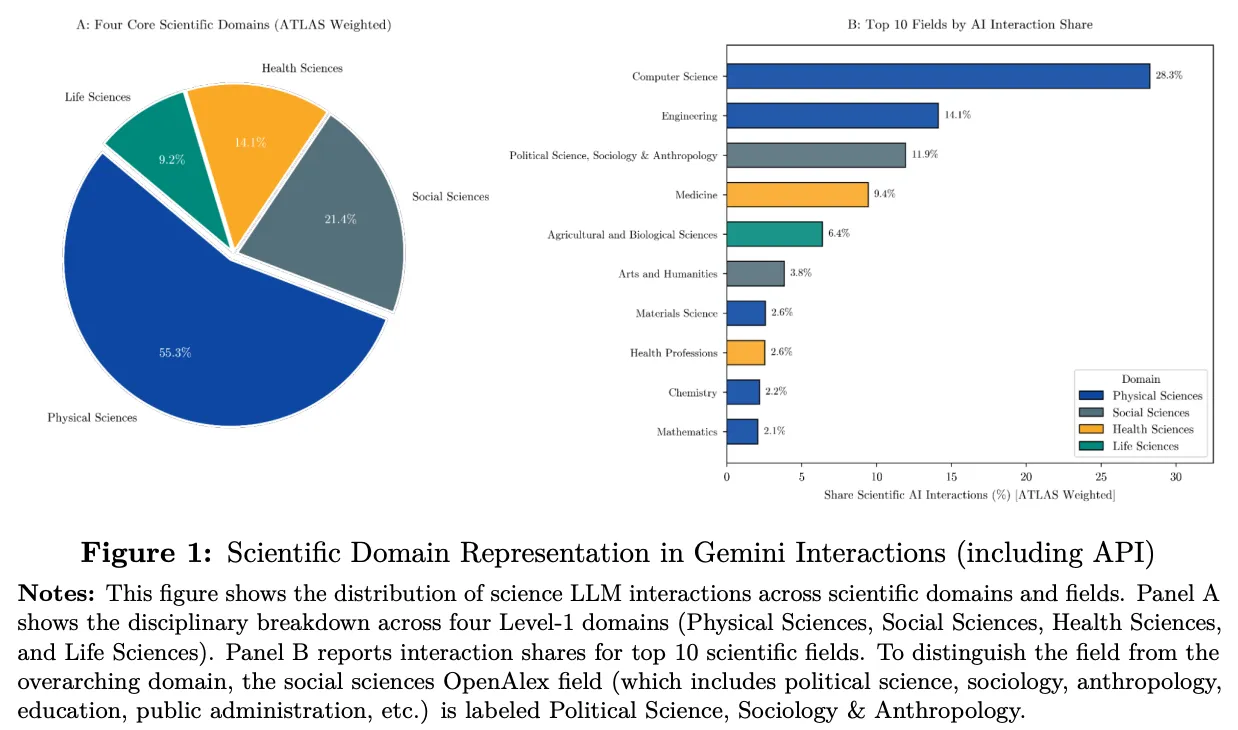
Use cases show a clear division of labor: large language models (represented by Gemini) are primarily used for general tasks—writing code, statistical analysis, literature reviews, drafting papers, teaching and administrative support—while specialized models focus on domain prediction, generation and classification, such as protein structure prediction (e.g., the AlphaFold series), materials design and weather forecasting. The two are complementary rather than simple substitutes.
At the task level, analysis and modeling and communicating research results are the most common scenarios for calling LLMs. Computer science has the highest usage density, but other disciplines are quickly catching up.
Productivity gains are already visible
The most striking number in the survey is that 74% of scientists report net time savings after using AI, averaging about 7 hours per week; only 6% report time loss. The time saved mainly flows back into research. About 47% of respondents report output increases of 10% or more.
This is not just "writing faster": if the costs of generation, code implementation and preliminary analysis fall significantly, researchers can devote more effort to parts that require human judgment. Cross‑disciplinary recombination of ideas has also increased—AI lowers the barrier to borrowing ideas from other fields.
New bottlenecks are emerging
As efficiency improves, bottlenecks in the research process shift. When hypothesis generation and modeling become relatively cheap, pressure on verification and experimental stages rises.
Of scientists who saved time, 89% say they spend more than one‑tenth of the saved time checking AI outputs; 41% report growing backlogs of untested hypotheses. In other words, AI amplifies the ability to pose questions without a corresponding amplification of the ability to rigorously test them. Peer review, experimental validation and reproducibility checks are becoming new constraints.
This raises an important risk: if generation outpaces verification capacity, the literature may see more superficially complete but substantively weak "sci‑slop" (scientific bubble content). Some commentators have already pointed out that AI‑generated content's impact on peer review systems may be one of the most immediate negative effects.
Deeper implications for scientific method
The early judgment of the study is that AI has significant potential to increase scientific productivity—weekly savings of 7 hours are already substantial. But whether it truly represents an "invention of a method of invention" depends on overcoming the verification bottleneck.
If AI only speeds routine tasks within existing paradigms, gains are mostly horizontal; if it can systematically help scientists pose better questions, design more informative experiments and more efficiently eliminate false hypotheses, it may change the rate of discovery itself. Current evidence indicates we are in an early transition from the former toward the latter.
The division of labor between specialized models and general large models also suggests a possible path: future AI research assistants should not just be "helpers that finish papers faster" but should act more as "challengers"—actively finding counterexamples, testing hypothesis boundaries and pointing out evidence gaps to enhance the rigor of the whole research process.
Conclusion
This report uses real usage data and scientist feedback to ground the optimistic expectation that AI will accelerate science in observable early facts: broad adoption, task complementarity and real time savings, but with verification pressure rising simultaneously. The true test is not how many hypotheses or drafts AI can generate, but whether the scientific community can improve verification, filtering and the accumulation of reliable knowledge at the same pace.
If verification keeps up, AI could represent an upgrade in methods for scientific discovery; if it does not, output may increase while signal‑to‑noise falls. We are still in an early stage, but the direction is clear: AI is changing how scientists work, and the scientific system must adapt to turn efficiency gains into discovery gains.
▶️ Enjoyed this article? Creating great content takes effort!
Subscribe to our YouTube channel:
AI Rosetta
Your likes, subscriptions and shares mean the world to us! 🙏
For more AI news, visit:
https://www.airosetta.com