
In December 2025, the artificial intelligence (AI) field delivered another blockbuster: leading reasoning models such as Google's Gemini 3.0 Pro and OpenAI's GPT‑5 not only easily passed the Chartered Financial Analyst (CFA) Level III exam but also scored near perfect on multiple benchmarks. This achievement marks a leap forward for AI in professional finance and has drawn wide attention from Wall Street and global finance professionals. The CFA credential is known as the industry's "golden pass"; human candidates typically spend years and at least 1,000 hours studying to pass, while AI can complete simulated exams in minutes. According to a recent preprint from research teams at Columbia University, Rensselaer Polytechnic Institute and the University of North Carolina, six reasoning models passed all levels of the CFA exams, with Gemini 3.0 Pro setting a record 97.6% in Level I. This is not merely a technical demo but a potential disruptive signal to traditional finance careers. Experts stress, however, that although AI can "pass into Wall Street," it cannot fully replace human analysts in the short term.
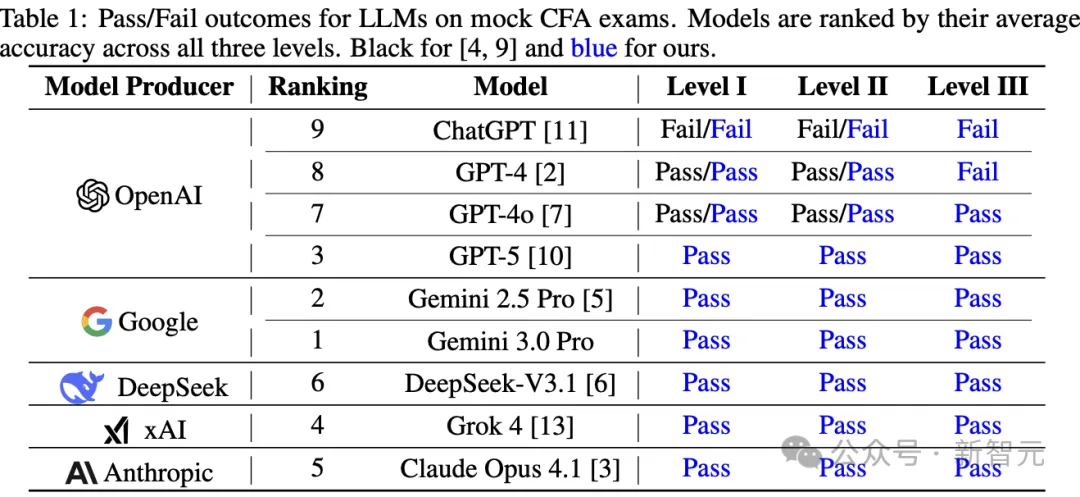
The CFA Exam: Finance's "Mount Everest"
The CFA (Chartered Financial Analyst) credential, awarded by the CFA Institute, is among the top professional qualifications in global finance. The exam is divided into three levels: Level I focuses on foundational knowledge such as ethics, quantitative methods and financial reporting; Level II emphasizes applied analysis including equity and fixed income; Level III tests integrated skills related to portfolio management and wealth planning. Formats vary: Level I and II are mainly multiple‑choice, while Level III mixes multiple‑choice and constructed‑response questions that require written analysis, testing critical thinking and decision‑making. Global pass rates remain modest: in 2023 Level I pass rate was around 40% and Level III about 50%. For human candidates this typically entails intense preparation and a major career investment.
As early as 2023, AI models such as GPT‑4 began to show up in CFA assessments, but performance was uneven. ChatGPT 3.5 failed Levels I and II; GPT‑4 passed Level I but failed Level II, and struggled with Level III's constructed‑response complexity. Research indicated that earlier AI lacked the deep reasoning required for high‑stakes financial decision‑making. Yet in a span of two years the technology advanced rapidly. In July 2025, researchers from NYU Stern and the GoodFin platform tested 23 large language models (LLMs) and found that models like o4‑mini, Gemini 2.5 Pro and Claude Opus, using chain‑of‑thought prompting techniques, successfully passed Level III simulated exams. That study argued AI had acquired the high‑risk analytical reasoning necessary for professional financial decisions.
Latest Study: AI "Sweeps" the CFA
A preprint released on the 9th of this month, titled "Reasoning Models Ace the CFA Exams," further confirmed AI dominance. The research team evaluated six reasoning models—Gemini 3.0 Pro, Gemini 2.5 Pro, GPT‑5, Grok 4, Claude Opus 4.1 and DeepSeek‑V3.1—using a 980‑question simulated bank that included official CFA Institute practice packages (Levels I and II) and AnalystPrep Level III simulations. The pass thresholds followed prior studies: Level I required at least 60% in each topic and 70% overall; Level II 50% per topic and 60% overall; Level III an average of 63%. All models passed Level III, with some scores approaching perfection.
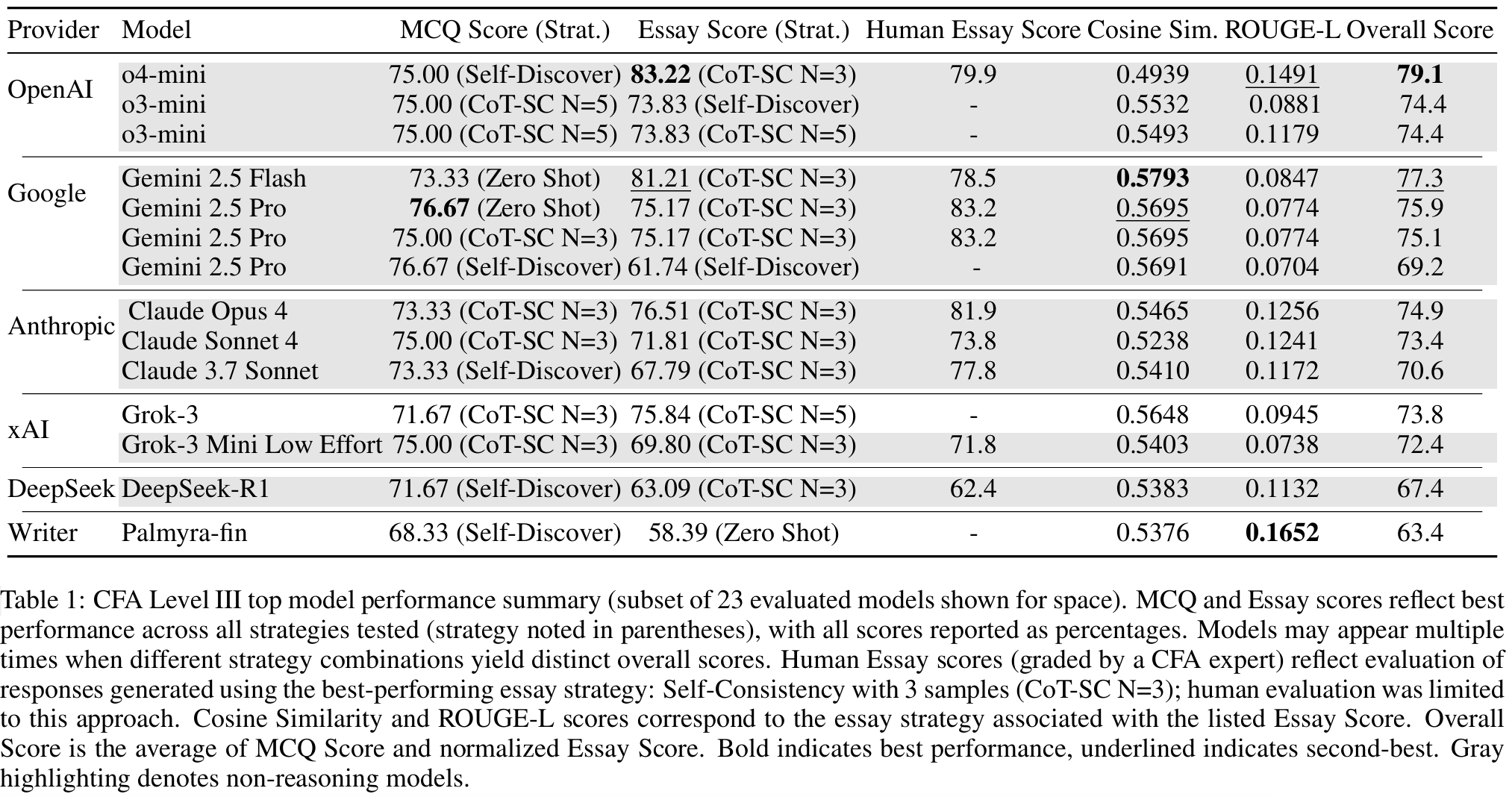
Link: https://arxiv.org/pdf/2507.02954
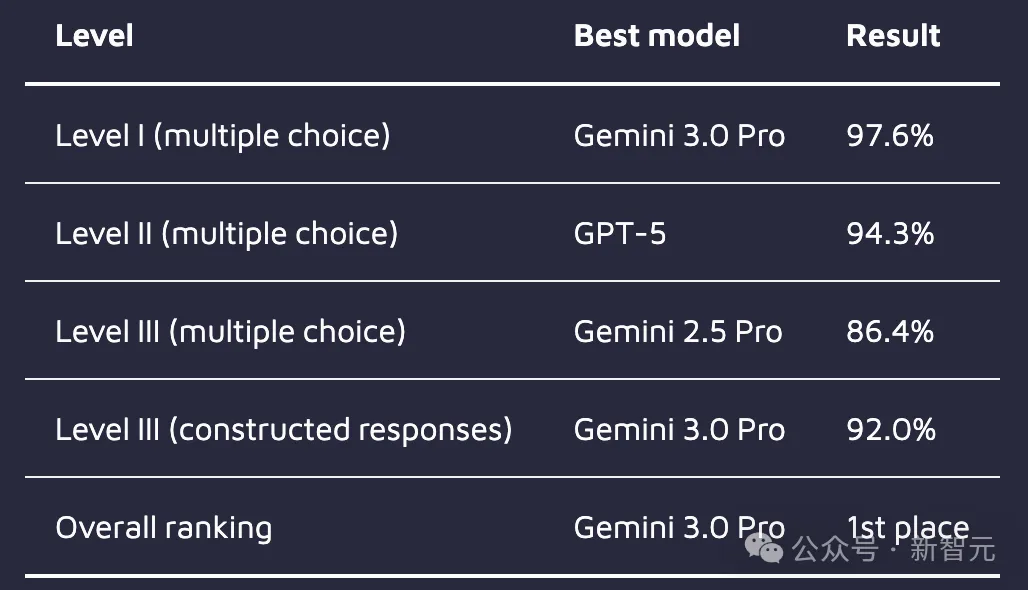
On Level I (540 multiple‑choice questions), Gemini 3.0 Pro recorded a historic 97.6%, GPT‑5 96.1%, Gemini 2.5 Pro 95.7%, and even the lowest‑performing DeepSeek‑V3.1 reached 90.9%. On Level II (176 case‑based items), GPT‑5 led with 94.3%, Gemini 3.0 Pro 93.2% and Gemini 2.5 Pro 92.6%. On Level III (264 items, including multiple‑choice and constructed‑response), Gemini 2.5 Pro led the multiple‑choice portion with 86.4% while Gemini 3.0 Pro scored 92.0% on constructed‑response items, a substantial improvement over prior generations. Constructed‑response grading used automated evaluation by o4‑mini, which may introduce a "verbosity bias," where longer answers score higher.
Compared with other models, the Gemini series ranked ahead overall while GPT‑5 excelled at applied analysis; Claude Opus 4.1 and Grok 4 followed closely. For example, in GoodFin research o4‑mini achieved a composite score of 79.1%, Gemini 2.5 Flash 77.3% and Claude Opus 4 74.9%. These results suggest AI has moved beyond rote memorization toward integrated reasoning required by Level III.
In the most complex CFA Level III exam (which includes multiple‑choice and open‑ended questions), Gemini 2.5 Pro led the multiple‑choice section with an accuracy of 86.4%. But in the more generation‑focused constructed‑response section, Gemini 3.0 Pro demonstrated dominance with a scoring rate of 92.0%, a qualitative leap from previous models' 82.8%.
AI's Limitations and Challenges
Despite eye‑catching scores, AI still shows weaknesses on the CFA. The Ethics section is the largest soft spot: Level II ethics questions exhibited relative error rates of 17%–21%. These items require contextual understanding and value judgments that AI often lacks. In addition, data contamination cannot be ruled out: even with paid materials, exam questions or their variants may have leaked into training data, causing AI to "memorize answers" rather than genuinely reason. Benchmark tests evaluate isolated knowledge and cannot simulate real‑world incomplete information, market sentiment or client interaction.
CNBC noted that passing exams does not equal job competence: humans excel at interpreting body language and intent—areas AI struggles to assess. GoodFin CEO Anna Joo Fee believes AI will reshape the industry but will not replace the CFA credential. CFA Institute executive Ingrid Tierens, Ph.D., emphasized in a blog that AI is an assistant, not a substitute: financial success depends on spotting market outliers and innovating in ways exams cannot cover.
Impact on the Finance Industry and Responses
AI's rise is reshaping finance. Barron's reported that AI passing the CFA in minutes has stoked employment concerns: entry‑level analyst roles may be automated. Wealth Management noted that this demonstrates deepening general intelligence in AI, but ethics and practical application still require human oversight. Historical experience suggests technology shifts (for example, from pen‑and‑paper to Excel) did not eliminate professions but boosted efficiency. Benjamin Graham, father of value investing, optimistically predicted in a 1963 essay that financial analysis would succeed along multiple technological paths.
Experts advise practitioners to embrace an "AI + human intelligence" model: use AI to save time and focus on strategy and client relationships. The CFA Institute has updated curricula to incorporate AI and big‑data analysis. In the future AI may handle report generation and data processing, but decision‑making will require human accountability and creativity.
Outlook: The Future of AI‑Finance Integration
AI passing CFA exams in 2025 marks an inflection point for professional fields. On LinkedIn discussions, experts predict AI will accelerate industry digitization while human advantages remain adaptability and ethical judgment. As models like Gemini 3.0 Pro iterate, AI may reach senior analyst levels but must still address hallucinations and bias. The finance industry should set "guardrails" to ensure safe AI deployment. Graham's prophecy still echoes: the future is multi‑path, and AI will help humans scale new heights.
▶️ Enjoyed this article? Creating great content takes effort!
Subscribe to our YouTube channel:
AI Rosetta
Your likes, subscriptions and shares mean the world to us! 🙏
For more AI news, visit:
https://www.airosetta.com