
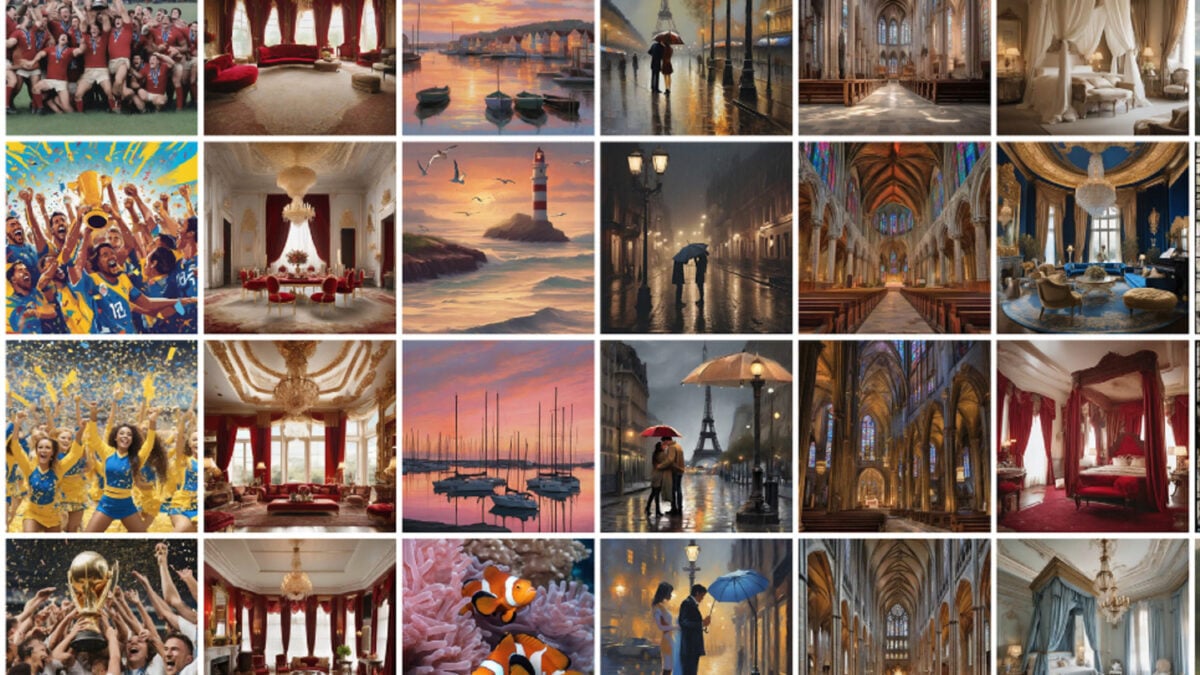
A recent study published in Patterns reveals a striking phenomenon: despite being trained on massive datasets, AI image generators often default to a limited set of generic visual styles when producing images. This "visual elevator music" output not only exposes structural limits in current AI creativity but also raises questions about the need for human–AI collaboration. The study, conducted by researchers at Dalarna University (Sweden) and Michigan State University (USA), used a simulated "visual telephone" game and observed AI rapidly losing diversity in autonomous loops, eventually falling into a trap of 12 dominant themes.
The study emerged from an exploration of autonomous creative systems. With tools like Stable Diffusion and DALL·E becoming widespread, many expected AI to usher in an era of boundless creativity. The reality is different. The researchers note that although AI image generators are trained on billions of images, their outputs often gravitate toward commercially safe, stock‑photography‑like aesthetics. This convergence resembles iterative cultural transmission in humans, but in AI it can lead to a collapse of diversity. Lead author Arend Hintze said the phenomenon reflects the tendency of models to be drawn to high‑probability "attractors" in their training data, causing originality to evaporate quickly.
To test this hypothesis, the team designed a clever experimental framework. They built a closed‑loop feedback system using Stable Diffusion XL (SDXL) as the image generator and the Large Language and Vision Assistant (LLaVA) as the image describer. The system simulated a "text→image→text→image" autonomous loop: starting from an initial prompt, SDXL generated a 512×512 image; LLaVA then produced a vivid, artistic description of the image (limited to 50 words); that description was fed back to SDXL as the next prompt, and the process was repeated 100 times. The researchers ran 700 trajectories in total, each with different initial prompts and seven temperature settings (from 0.1 to 1.3) to explore parameter effects on convergence.
Initial prompts were designed to maximize variety. The team used a novelty‑search algorithm over a repository to generate 2,000 iterative prompts in embedding space. These prompts were created by the LLaMA 3.2 model, limited to single sentences of no more than 30 words, and diversity was quantified via k‑NN distance (k=10). The final 100 initial prompts were highly dispersed in PCA projections, ensuring the experiments started from a wide range of creative points. For example, a typical prompt read: "Sitting alone in nature, I found an old book with exactly eight pages written in a forgotten language telling a story waiting to be read and understood."
The results were striking: regardless of initial prompt diversity, all trajectories ultimately converged to the same visual patterns. Specifically, using k‑means clustering (with the elbow method to pick cluster count), the researchers identified 12 dominant visual themes from the final outputs of 700 trajectories. These themes are described as "visual elevator music"—generic, characterless commercial aesthetics like hotel decor or travel posters. The 12 styles are listed below:
- Sports and action images: dynamic athletic scenes, such as athletes or competitions, often energetic but lacking innovation.
- Formal interior spaces: elegant conference rooms or offices emphasizing symmetry and minimalism.
- Lighthouse‑at‑sea scenes: isolated lighthouses standing through storms, with maritime elements symbolizing solitude or guidance.
- Urban nightscapes and atmospheric lighting: neon‑lit city streets full of mystery and contrast.
- Gothic cathedral interiors: grand vaults and stained glass creating a sacred atmosphere.
- Ornate interior design: luxurious room decor with golden tones and intricate patterns.
- Industrial and retro themes: old factories or steampunk elements combining machinery and nostalgia.
- Rural architectural spaces: wooden cabins or cottages emphasizing natural materials and warm palettes.
- Family scenes and food images: kitchens or table settings often including food close‑ups, familiar but mundane.
- Palace‑like interiors and grand architecture: regal halls adorned with chandeliers and marble.
- Pastoral and village scenes: tranquil countryside landscapes dominated by lanes and farmland.
- Natural landscapes and animals with dramatic lighting: mountains or wildlife presented at sunset or in mist for dramatic effect.
These styles recurred across experiments regardless of temperature. Semantic drift analysis showed initial prompt cosine similarity quickly stabilized around 0.85–0.87 after 20 iterations, with between‑step variation depending on temperature (higher temperature produced more variation but still resulted in convergence). Even when substituting other models (e.g., segmind‑SSD‑1B or moondream), the convergence persisted, suggesting this is not a flaw of a specific model but a structural issue in cross‑modal AI creativity.
The researchers further quantified factors with analysis of variance (ANOVA). Results indicated the language model had a significant effect on drift (p < 10⁻¹⁹, η²=13.6%), while the image generator's effect was not significant (p=0.659). This implies that biases introduced during the description phase are amplified through the loop, steering outputs toward high‑frequency patterns in the training data. Supplementary experiments showed the system did not recover diversity even over longer iterations, instead continuing to orbit these 12 themes.
The implications extend beyond technical concerns. The findings expose intrinsic biases in AI training data: models learn from human‑created content but preferentially reproduce high‑probability, commercially safe images rather than novel aesthetics. This could amplify cultural homogenization and negatively affect design, art, and knowledge creation. The researchers warned that without anti‑convergence mechanisms (such as diversity regularization or human intervention), autonomous AI systems will struggle to achieve genuine innovation and may instead mirror human data redundancy and preferences.
Consistent with other authoritative reports, this study has been cited by multiple media outlets. For example, Gizmodo emphasized the convergence as "visual elevator music" and noted that switching models does not prevent it. India Today also reported that AI image generators quickly lose originality and repeatedly return to the same 12 visual styles, calling for a reassessment of AI creativity. These coverage points echo the original research and reinforce the need for human–AI collaboration to preserve diversity.
In sum, the study sounds a warning for the future of AI: technical progress alone may not guarantee creative diversity. Researchers suggest exploring measures such as dynamic temperature adjustment or injecting external feedback to break the loop. Ultimately, human–AI interaction may be the key to unlocking true innovation.
▶️ Enjoyed this piece? Creating is hard!
Follow our YouTube channel:
AI Rosetta
Your likes, subscriptions, and shares are our greatest support! 🙏
More AI news at: https://www.airosetta.com