
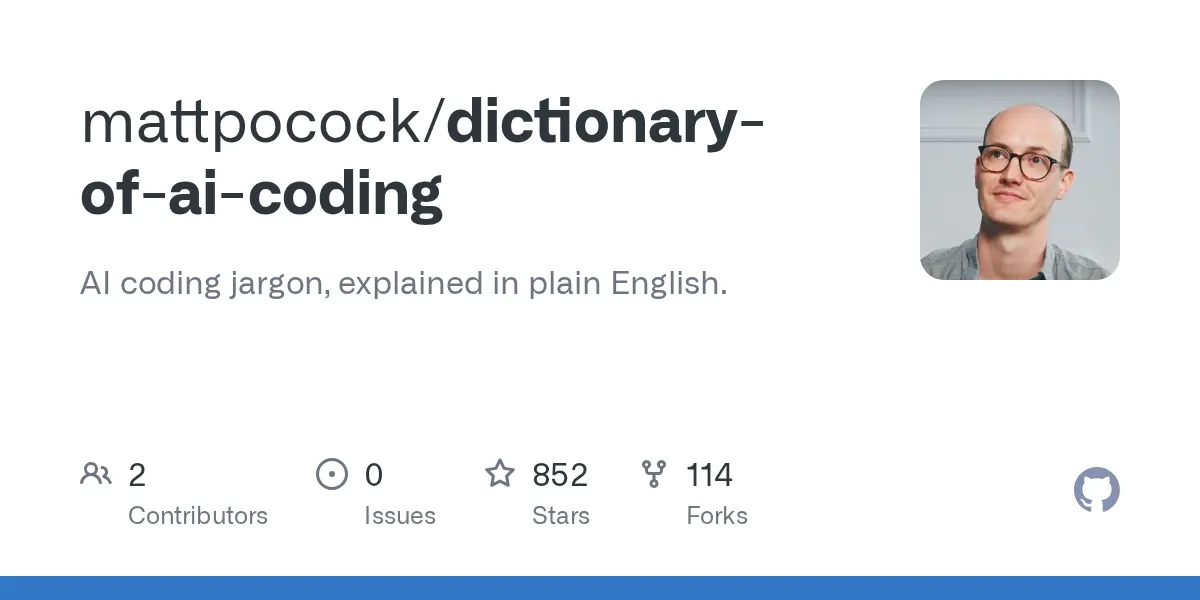
Matt Pocock open‑sources "dictionary‑of‑ai‑coding": demystifying AI coding terms to help engineers onboard efficiently
In May 2026, TypeScript educator and AI Hero founder Matt Pocock published the open‑source dictionary‑of‑ai‑coding project on GitHub. This glossary explains many professional terms and jargon in AI coding in clear, accessible English, helping developers cross the “expert threshold” and avoid common pitfalls of "vibe coding". The repository sparked discussion in developer communities and is seen as an important educational supplement for programming in the AI era.
In the README, Pocock states plainly: "AI coding often feels like it's reserved for experts." Developers faced with new concepts such as RAG, Agentic Workflow, Evals, and Tracer Bullets often struggle to communicate and practice efficiently due to terminology barriers. This dictionary aims to address that pain point—translating AI‑coding vocabulary into language that ordinary engineers can easily understand.
Key contents and design highlights
The project includes dozens of core terms commonly used in AI‑coding practice, covering prompt engineering, building AI agents, evaluation systems, code‑generation workflows, and more. Each entry seeks to be concise and practical, with real‑world examples. Pocock emphasizes that the dictionary is more than a glossary; it functions as an "on‑ramp" to AI coding, helping developers form a systematic understanding.
Typical entries include:
- Vibe Coding: Letting AI generate code based on intuition or "feeling" without rigorous engineering review, often leading to maintenance problems later.
- Evals: Systematic methods for evaluating AI‑generated code or model outputs; a key practice for ensuring quality.
- Agentic Harnesses: Frameworks or toolchains for building AI agents that can autonomously complete complex tasks.
- Tracer Bullets: A rapid prototyping approach that builds the smallest viable version to test core assumptions.
The repository uses an open collaboration model, encouraging community contributions of new entries and improved explanations, reflecting open‑source values. Pocock also designed the format to be suitable for direct inclusion in LLM contexts, so AI assistants can reference standard definitions during coding and reduce hallucinations.
Pocock is a well‑known TypeScript instructor, a former developer advocate at Vercel, and founder of the AI Hero Newsletter (with over 62,000 subscribers). He says the dictionary grew out of observations from teaching and AI engineering practice: many developers can rapidly build prototypes with AI tools, but unclear terminology leads to issues in code quality and maintainability.
Impact on the AI‑coding ecosystem and developers
1. Lowering the learning barrier for AI coding
With the spread of AI coding tools (such as Cursor, Claude Code, GitHub Copilot), more developers are entering the field. But the explosion of terminology has created a new "digital divide." The dictionary offers a standardized, easy‑to‑understand reference to help beginners and career‑changers get up to speed, accelerating the shift from "using AI" to "mastering AI engineering." This is especially helpful for SMEs and individual developers, lowering the cost of entering the AI era.
2. Improving team collaboration and communication efficiency
In AI‑driven development teams, differing interpretations of the same term can cause misunderstandings and rework. A unified dictionary builds a common language base and facilitates effective dialogue among product managers, engineers, and AI specialists. This helps teams iterate faster, reduce errors, and establish more standardized AI engineering processes.
3. Promoting engineering discipline against "vibe coding"
Pocock has long advocated rigorous engineering practices. The dictionary clearly distinguishes between rapid prototyping and production‑quality code, and emphasizes best practices such as evals and test‑driven approaches. This helps the industry avoid accumulating large amounts of low‑quality AI‑generated code and technical debt, steering AI coding toward sustainable engineering.
4. A new model of community‑driven knowledge sharing
The open‑source glossary encourages global developers to jointly maintain and expand content, similar to a vertical Wikipedia for AI coding. As contributions grow, it may evolve into a factual standard reference for AI coding, accelerating the spread of best practices and providing a template for similar educational tools.
5. Influence on AI tools and platforms
If AI coding assistants can integrate such a dictionary, they will significantly reduce hallucination risk and provide more accurate, context‑relevant suggestions. Platform providers may adopt or cooperate to expand similar resources, further improving tool professionalism and user experience.
Industry background: the terminology explosion in the AI‑coding era
In 2025–2026, with iterations of large models like the GPT‑5 series and Claude 4, and the maturation of technologies such as agentic AI and RAG, AI coding tools evolved from assistive completion to autonomous agents. Developers must grasp concepts like prompt engineering, fine‑tuning, evaluation frameworks, and multi‑agent systems. The pace of terminology change far outstrips traditional programming, leaving many people "understanding what AI says but not how to apply it systematically."
Matt Pocock's project is a timely response to this phenomenon. It does not pursue academic depth but focuses on practicality to help engineers avoid detours in real projects.
Conclusion: clear language is a core competency in the AI era
The open‑sourcing of the Dictionary of AI Coding reflects Matt Pocock's educational philosophy: technology should serve people, not create barriers. In a rapidly evolving AI landscape, mastering the right terminology is not only a communication tool but a way of thinking and a competitive advantage.
With more contributions and iterations, the dictionary may become a "living glossary" for AI engineering. For individuals, it is a shortcut to getting started quickly; for the industry, it is a catalyst for standardization and higher‑quality development.
The future of AI coding belongs to those who both understand the technology and can express it clearly. Matt Pocock's open‑source initiative is opening that door for many.
▶️ Enjoy this article? Creating content is hard!
Follow our YouTube channel:
AI Rosetta
Your likes, subscriptions, and shares are our biggest support! 🙏
More AI news at: https://www.airosetta.com